
Contents
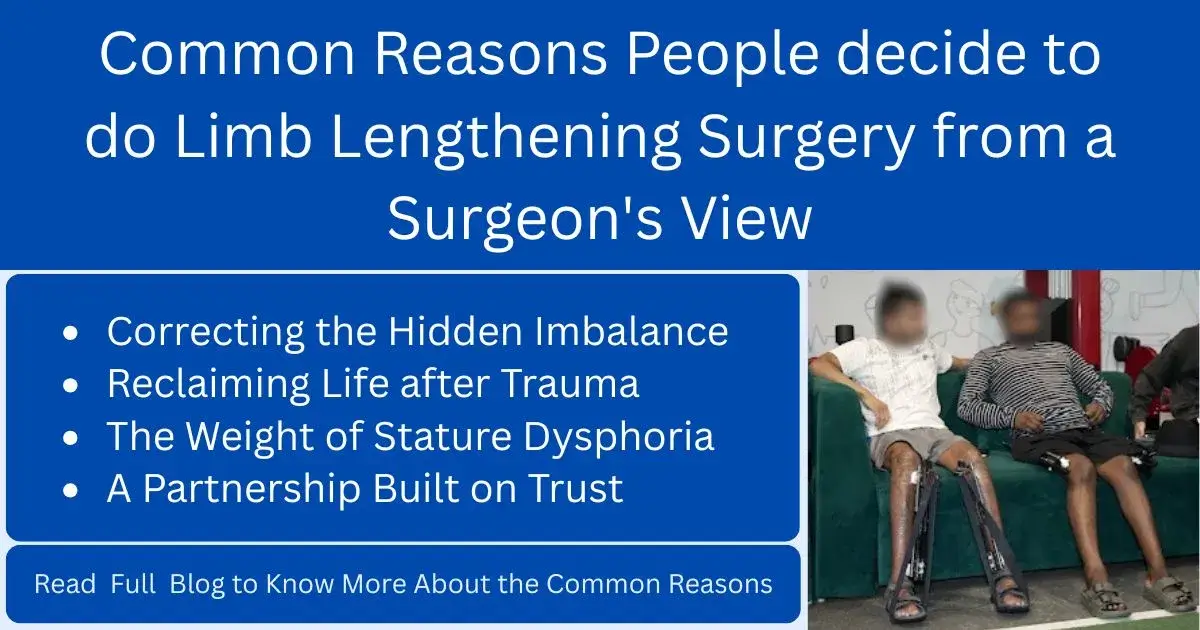
Common reasons people decide to do limb lengthening surgery from a surgeon's view
As a surgeon, I do not just take X-rays and take bone measurements; my clinic is a place where I see more than that. I am there every day, watching people who have made a single decision, and who have been thinking for months, or years. They come to me with a variety of stories, but they all share the same goal to feel that their bodies would function so that they could live freely. When we talk about surgery to lengthen limbs, it is rarely the simple addition of inches or centimeters. It is about breaking through this gap between how one feels and how one’s body moves around the world.
From my perspective behind the desk, the reasons people pursue this path are deeply personal and usually fall into three distinct categories. Understanding these motivations is the first step in ensuring that the procedure is not just a success on a medical chart, but a success in a patient’s daily life.
Correcting the Hidden Imbalance
The most common reason I see for this procedure is a limb length discrepancy. This is when one leg is significantly shorter than the other, often due to a growth plate injury in childhood or a condition present at birth. While a difference of a few millimeters is normal for many people, a gap of two centimeters or more can cause a cascade of physical problems.
Patients tell me about the chronic back pain that comes from a tilted pelvis or the way their hips ache after a simple walk. They have spent years wearing shoe lifts that are clunky and limit their choice of footwear. For these individuals, limb lengthening surgery is a functional necessity. When we equalize the limbs, we are not simply equalizing them; we are protecting their spine and joints against decades of wear and tear. It is an emotional moment when a patient steps up for the first time since recovery and feels its weight split perfectly between two feet for the first time in their life.
Reclaiming Life after Trauma
Another significant group of patients comes to me following a major accident. High-energy trauma, such as a motorcycle accident or fall, may occur, which has the potential to cause bone loss or a fracture that does not heal properly. Frequently, the goal in those cases is deformity correction. If a bone is healed in a narrowing or twisting position, it is almost impossible to run, jump, or even walk without a serious limp.
In these situations, deformity correction is about restoration. We use the principles of limb lengthening to slowly grow new bone in the gap or to realign a limb that was previously crooked. To a surgeon, this is one of the most rewarding aspects of the job. We are using the body’s own incredible ability to regenerate itself to fix a mistake that happened during a moment of crisis. These patients aren't looking for perfection; they are looking to get back the life they had before their injury.
The Weight of Stature Dysphoria
In recent years, more people have sought out limb lengthening surgery for reasons related to their overall height. This is often referred to as cosmetic lengthening, but for the person sitting in my exam room, it feels far from "cosmetic." They often describe a condition called stature dysphoria where they feel extremely unhappy because of their height or feel they are being marginalized in their professional and social lives.
I need to handle these situations with much empathy and intellectual honesty as a surgeon. I listen to their stories about how they feel in a world that values height. Despite the physically demanding and long recovery following the operation, for these patients, the psychological relief is usually nearly as important as the physical change. We spend a great deal of time on the reality of this process to ensure they know what is safe for them.
A Partnership Built on Trust
Whatever the reason, a limb lengthening surgery procedure is never an easy fix. It is a journey that requires a lot of patient effort and a lot of precision on the part of the surgical staff. When I recommend this procedure, I am asking the patient to commit to months of physical therapy and a slow, disciplined process of bone growth.
I see myself not only as a bone technician, but as a collaborator in a long-term project. The goal is always the same, whether it is for a complex deformity correction or to encourage someone to gain confidence through height. We want the patient to leave our care with the sense that their body is not something to worry about, but that it helps them do whatever they want.
Also Read: