
Table of Contents
- The Genetic Question: Does Limb Lengthening Surgery Actually Change Your DNA?
- Understanding DNA: The Unchanging Blueprint
- The Myth of the Epiphyseal Plates
- Addressing Cultural and Regional Factors
- What Does Change After Limb Lengthening?
- Conclusion: The Triumph of Mechanics Over Genetics
The Genetic Question: Does Limb Lengthening Surgery Actually Change Your DNA?
When you make big decisions about changing your physical shape such as taking on the limb lengthening surgery, it is natural to ask deeply, basic questions about biology. You are permanently changing your skeleton. You are adding several inches to your frame. It feels like you are defying nature, or maybe even hacking your own genetic code.
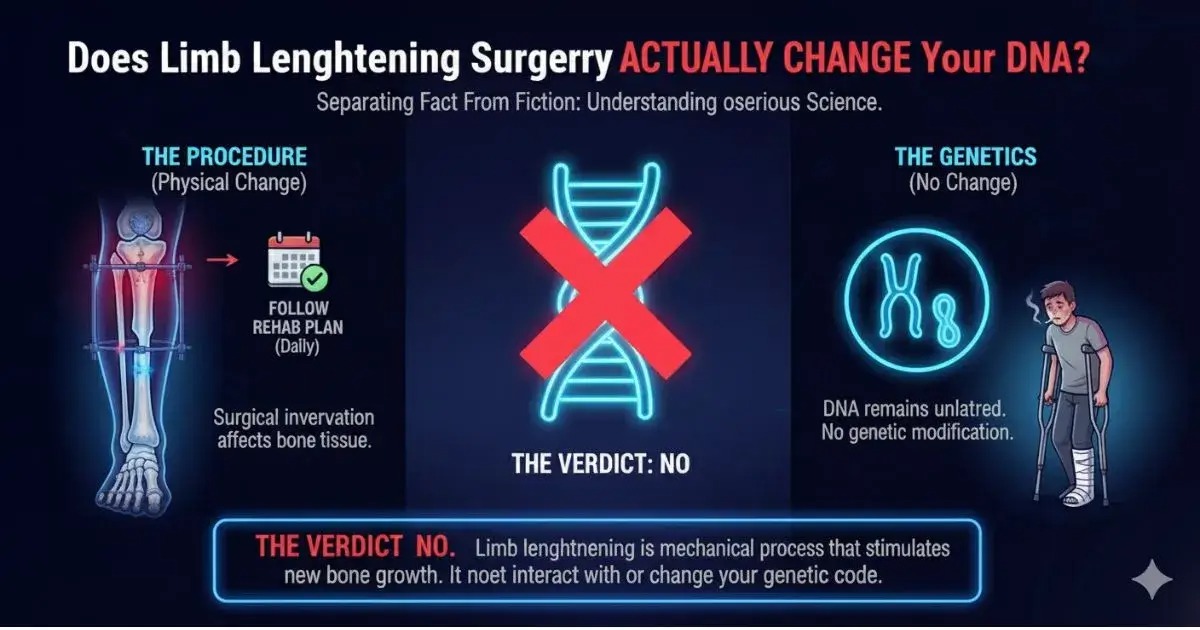
This leads to the question of what does limb lengthening surgery do to DNA?
It is interesting, especially for people who grew up hoping they were taller, or for people who thought their height was determined by how their genetic system always behaves. Let us go through science and clear this question out atop all hell and wood.
Understanding DNA: The Unchanging Blueprint
It is important to start with the basics of DNA to answer the question. Imagine your DNA as your blueprint for everything else that you have ever been born with. It determines your eye color, hair texture, and yes your maximum height.
DNA is stored within almost every cell in your body. When the cell divides, its exact copy of that blueprint is made. This blueprint is fixed. It is the source code of who you are.
When you have limb lengthening surgery, bone cutting is used and the body will regenerate new bone tissue on the gap. This is complete mechanical process called distraction osteogenesis. It is a physical stressor that triggers a healing response.
Does this mechanical process get into the nucleus of your bone cells and edit the genetic code? Absolutely not. The surgery is working with the materials provided by the DNA; it is not rewriting the blueprint itself.
You might be 5 inches taller, but the genetic instructions you pass on to your children will still be the same ones you inherited from your parents. You are overriding the expression of your height potential, not the code that defined the potential in the first place.
The Myth of the Epiphyseal Plates
Another area of confusion revolves around growth itself. People often look back to their childhood and wish they had done something differently to influence their height.
In the ends of long bones, the epiphyseal plates or growth plates, are the source of true height growth. Hormones like HGH and the plates instruct these plates to produce new bone tissue, driving the ends of the bone apart. This is how to get taller. When these epiphyseal plates fuse, natural growth stops.
Limb lengthening surgery works completely differently. It bypasses the fused epiphyseal plates entirely. It cuts the diaphysis (the shaft) of the bone, where there are no growth plates, and relies on the body's natural ability to heal a fracture. The body treats the gap as a wound and fills it with new bone.
The surgery is a highly sophisticated surgical treatment that works on fused epiphyseal plates and little genetic width. It does not reactivate them, and it certainly does not change the genetic instructions behind the way those plates fused in the first place.
Addressing Cultural and Regional Factors
The genetic question is often fueled by cultural pressure. For example, a person researching limb lengthening surgery might be frustrated by feeling significantly shorter than the average person in their social circle or even shorter than the national average.
In cultures that are rich in the desire to increase the height, height is a very pronounced part of social status or success. By doing surgery, for instance, someone who is short of the average height of an Indian male usually feels the surgery is a way to escape the genetic destiny that leaves them in social hardship.
But even in this context, the surgery is only changing the physical outcome, not the genetic lineage. If the average height of an Indian male is 5'7", and you genetically were destined for 5'5", you might use limb lengthening surgery to reach 5'10". You have dramatically altered your life and physical appearance, but your genes still carry the original 5'5" instruction.
What Does Change After Limb Lengthening?
While your DNA remains the same, several things absolutely do change in a very profound and lasting way:
- Phenotype (Physical Appearance): This is the obvious one. Your height measurement is physically different. This change is permanent.
- Muscula & Nerve Adaptation: Your soft tissues adapt. Your muscles and nerves are permanently stretched back to a new length. This adaptation is a massive change but it is cell and mechanical not genetic.
- Psychology: This may be the most significant change, psychology. These patients often report massive shift in their self-confidence and perception. A sense of finally ending an insecurity that has lasted for generations is a profound change in yourself, but not in your DNA.
Conclusion: The Triumph of Mechanics Over Genetics
So, rest assured. If you doubt whether lengthening surgery will change your genes or possibly cause your children to inherit genes, it is ultimately no use.
The procedure is a testament to the incredible healing power of the human body and the ingenuity of orthopedic surgery. It is a brilliant mechanical intervention that overrides the physical limit imposed by fused epiphyseal plates and predetermined genetic potential. You are working with your biology's healing capacity, not against your DNA.
You get to keep your genetic blueprint exactly as it is, while getting to enjoy life from a few inches higher. That is the true marvel of limb lengthening surgery.