
Table of Contents
- Growth Plate Disorders That Lead to Limb Deformities
- Understanding the Engine of Bone Growth
- Common Types of Growth Plate Disorders
- How Disorders Translate into Deformities
- Diagnosis and Modern Management
- The Path Forward
- General FAQs
Growth Plate Disorders That Lead to Limb Deformities
Watching a child grow is one of the best experiences a parent can have. We measure their height on door frames, celebrate each new inch, but we seldom consider the complex biological “engines” that make that growth possible. These engines are called growth plates or physes, specialized areas of cartilage developing near the ends of long bones. They are very efficient, but delicate. When things go wrong in these areas then growth plate disorders can emerge which can lead to visible limb deformities that affect the mobility and self-esteem of a child.
Understanding the Engine of Bone Growth
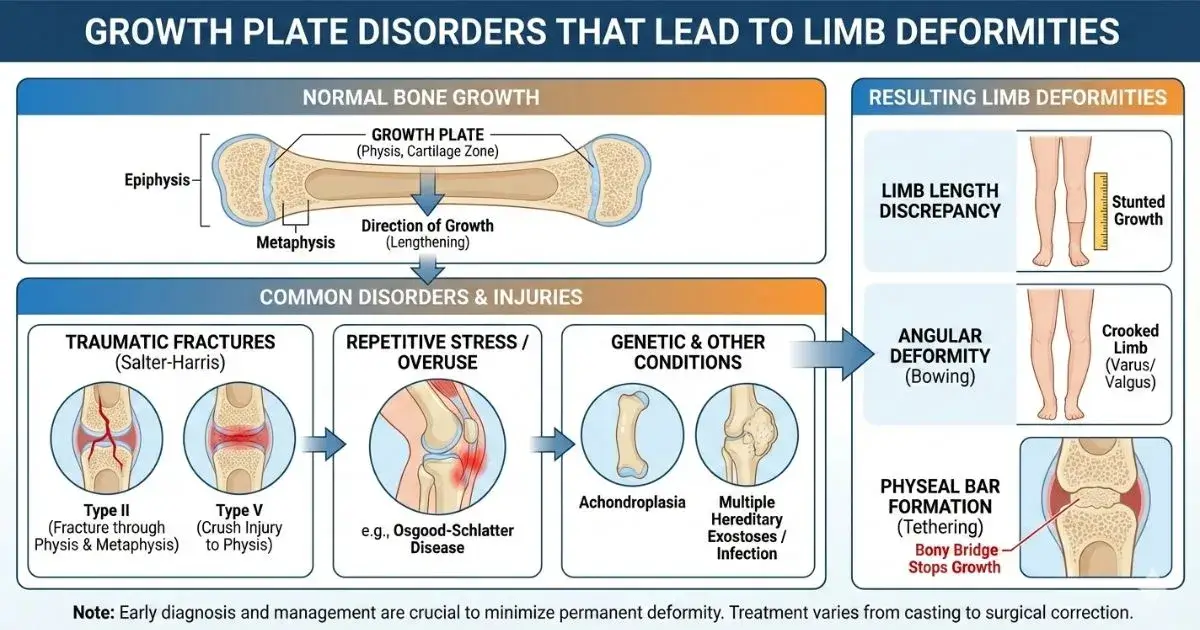
To understand how deformities happen, we must first understand what a growth plate does. Unlike adult bones, which are solid and stable, child bones are still “under construction.” The growth plate is the softest and weakest part of the skeleton, as well as the ligaments connecting bones to muscles nearby. This vulnerability means that the force that may cause a sprain in an adult could also cause a serious injury to a child.
Because these plates are responsible for determining the final length and shape of the mature bone, any disruption to their function can have a cascading effect. When growth plate disorders occur, the bone may stop growing entirely, or it may grow unevenly. This uneven growth is what eventually manifests as a limb deformity.
Common Types of Growth Plate Disorders
There isn't just one way for a growth plate to be compromised. The issues can stem from sudden trauma, repetitive stress, or even underlying genetic conditions.
1. Traumatic Fractures (Salter-Harris Injuries)
The most common cause of growth plate issues is a fracture. Orthopedic surgeons often use the Salter-Harris classification system to grade these injuries. If a fracture runs through the "proliferative zone" of the plate where cells are actively dividing, the risk of a permanent deformity increases significantly.
2. Blount’s Disease
This is a specific condition affecting the growth plate at the top of the shinbone (tibia). In children with Blount’s disease, the inner part of the growth plate stalls while the outer part continues to grow normally. This discrepancy causes the legs to bow outward severely, a condition known as tibia vara.
3. Chronic Stress and Overuse
In our modern world of competitive youth sports, we are seeing more growth plate disorders caused by repetitive stress. Gymnasts, pitchers, and runners may experience "stress fractures" in the growth plates that, if left untreated, can lead to permanent changes in the bone's alignment.
How Disorders Translate into Deformities
A limb deformity does not usually appear overnight. Instead, it is a slow process of "asymmetric growth." Imagine a car’s wheel alignment; if one side is slightly off, the entire vehicle eventually pulls in one direction.
Angular Deformities: If only one side of a growth plate is damaged, the healthy side grows and the injured side remains stuck. This produces “knock-knees” (valgus), or “bow-legs” (varus), which lead to the bone tilting.
Length Discrepancies: If the entire growth plate closes prematurely (a condition called epiphysiodesis), that limb will stop getting longer. As the child’s other limb continues its natural growth, a significant difference in leg or arm length can develop.
The physical impact of growth plate disorders is often most visible as a child approaches a major growth spurt, as this is when the disparity between healthy and damaged tissue becomes most exaggerated.
Diagnosis and Modern Management
The good news for parents is that pediatric orthopedics has advanced tremendously. Diagnosis usually begins with a physical exam and an X-ray, though an MRI may be necessary to see the soft cartilage of the growth plate in detail.
Treatment depends entirely on the "growth primacy" remaining. If a child still has several years of growth left, doctors can often use a technique called "guided growth." This involves placing a small metal plate and screws on one side of the growth plate to temporarily slow it down, allowing the "crooked" side to catch up and straighten the limb naturally.
Note: Early intervention is critical to a successful diagnosis of growth plate disorders. The less invasive the surgical correction, usually, the sooner the difference is observed.
The Path Forward
The experience of a limb deformity is emotionally demanding for the child and the parent. But the human body is exceptionally strong particularly in childhood. Most children who develop these diseases live active, pain free lives under the right medical care. One way to make sure that your child does well and thrive in life is to understand growth plate disorders.
General FAQs
1. Can a growth plate injury heal on its own without causing a deformity?
Indeed, a large number of small growth plate injuries can recover completely after a simple immobilization with a cast or rest is done. The risk of deformity is only becoming considerable when the injury impairs the blood supply to the plate or leads to "bony bridging," that is when a bridge of solid bone connecting the two sides of the flexible plate is formed.
2. How do I know if my child’s growth plate is damaged?
Signs include long, lasting pain, a swelling near a joint, or a visibly abnormal shape of the arm or leg. If a child after a fall is not putting weight on one of the limbs and that limb looks twisted as compared to the other, then a pediatric orthopedist should be contacted without delay.
3. At what age do growth plates usually close?
Growth plates generally close at the end of puberty. The exact age varies, but in many children this happens during the mid-to-late teenage years, with girls usually closing slightly earlier than boys.
4. Are growth plate disorders always caused by an injury?
No, not always. While injuries and trauma are common causes, growth plate disorders can also arise from underlying medical conditions, genetic factors, infections, or repetitive stress from sports and other activities.
5. What is "guided growth" surgery?
Guided growth surgery is a minimally invasive procedure in which a small metal plate and screws are placed on one side of a growth plate to slow growth on that side. Over time, the opposite side continues to grow, allowing the limb to gradually straighten as the child grows.