
Contents
- How Distraction Osteogenesis Makes Bones Grow Longer
- What Is Distraction Osteogenesis?
- Why Distraction Osteogenesis Is Used for Bone Lengthening
- The Journey: Phases of Distraction Osteogenesis
- Exploring the Types of Distraction Osteogenesis
- The Human Reality: Is Distraction Osteogenesis Painful?
- The Mindset of a "Limb Lengthener"
- Final Thoughts on the Path Forward
- General FAQs
How Distraction Osteogenesis Makes Bones Grow Longer
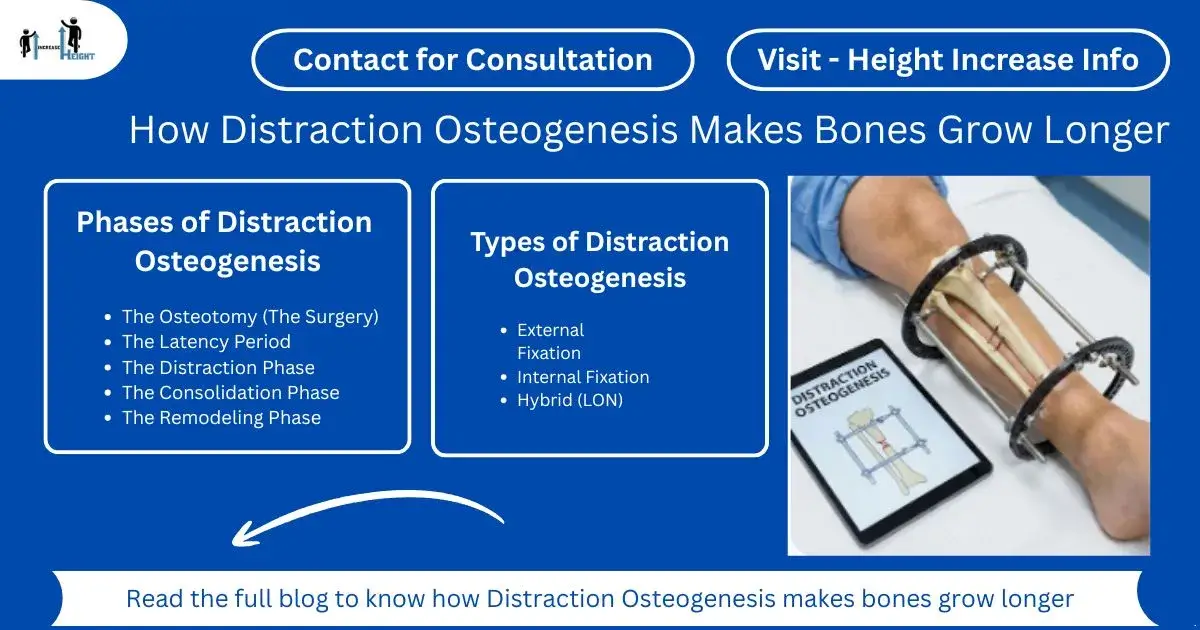
There is something inherently still and miraculous about the way that the human body repairs itself. We don't notice it usually enough. We scratch the knee, and the skin knits back together. We break a bone, and it fuses back into a solid piece. However, there is a specific medical process that takes this natural healing power and turns the volume all the way up. This process is called Distraction Osteogenesis. While the name sounds like something out of a dense medical textbook, the concept is actually quite beautiful. It is the art of tricking the body into growing new bone in a specific direction and at a specific pace to correct a deformity or add length to a limb.
When patients or parents come to an orthopedic clinic, they often arrive with a combination of hope and extreme anxiety. They have heard that it is possible to grow a limb by several inches, but the “how” is unclear. Understanding the science and the human experience of this journey is the first step in moving from a place of fear to a place of empowerment.
What Is Distraction Osteogenesis?
In simple words, Distraction Osteogenesis is a process for restoring bones. The word distraction is used when two pieces of bone are pulled apart, while osteogenesis is used when creating new bone. It comes from an immutable feature of human biology, that if you leave a small gap in a bone and then pull the pieces apart very slowly, the body will not know it’s being “stretched.” Instead, it will attempt to fill that space with new tissue, as if a spider is spinning a web to fill a space.
This is not a new discovery. The development of this research began in the 1950s with Dr. Gavriil Ilizarov, a Soviet doctor who realized that tension could also stimulate growth. He found that if he removed bone segments about a millimeter per day, the body would be able to handle the demands for new bone, nerves, and blood vessels. Today, we have modernized his tools, but the biological principle remains exactly the same. We are harnessing the body’s innate desire to be whole.
Why Distraction Osteogenesis Is Used for Bone Lengthening
You may wonder why a surgeon would choose this intensive procedure over other procedures. Why Distraction Osteogenesis is Used for Bone Lengthening is because it allows for a "total package" of growth. If we had to take a large piece of bone from a donor or a metal spacer, the muscles, skin, and nerves would not have time to adapt. This would cause severe stress, nerve damage, and loss of function.
We are growing everything at the same time with Distraction Osteogenesis. The bones separate, the muscles relax, nerves grow longer, and new branches sprout in the blood vessels. This holistic growth is what makes the procedure functional rather than just structural. It is used to correct limb length discrepancies where one leg is shorter than the other, to fix complex deformities where a bone is twisted or curved, and in some cases, to increase a person's overall stature.
The Journey: Phases of Distraction Osteogenesis
This is not just one event, but a long-term undertaking. Perhaps more useful is to think of the phases of distraction osteogenesis as a series of chapters in a book. Each phase has goals, struggles, and milestones.
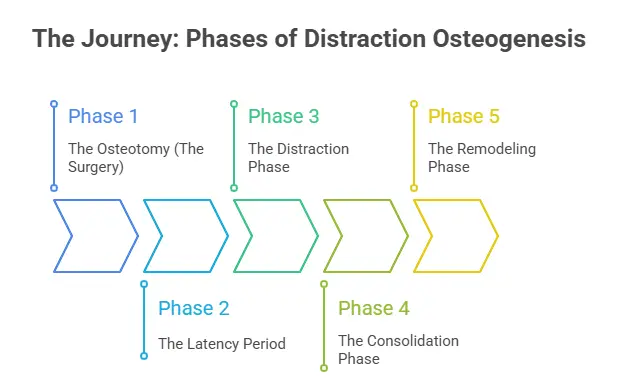
Phase 1: The Osteotomy (The Surgery)
The journey begins in the operating room. The surgeon performing the limb lengthening surgery makes a precise cut in the bone, known as an osteotomy. This creates two separate segments. At the same time, the lengthening device, whether it is an external frame or an internal rod, is surgically attached to these segments.
Phase 2: The Latency Period
After the surgery, we don't start lengthening right away. We wait for about five to seven days. This is the latency period. During this time, the body begins its initial repair work. It forms a soft bridge of blood and early healing cells, known as a callus, between the bone ends. We want this bridge to be present but not yet "hard" before we start the next phase.
Phase 3: The Distraction Phase
This is the "active" part of the process. The patient or a caregiver begins making small adjustments to the device, usually four times a day. Each adjustment moves the bone segments apart by a fraction of a millimeter. Over the course of a day, the bone is moved exactly one millimeter. This is the stage where the new height or correction is actually achieved.
Phase 4: The Consolidation Phase
Once the desired length is reached, the adjustments stop. Now, the waiting game begins. The new tissue in the gap is currently the consistency of soft gelatin. The body deposits calcium and minerals into this space in the consolidation phase, which slowly converts that soft tissue into hard, load-bearing bone.
Phase 5: The Remodeling Phase
It is always changing, even after the bone is "hard." The body repairs the new bone back to its original shape and function over the next year or more. This is when the bone really forms part of the skeleton of the person.
Exploring the Types of Distraction Osteogenesis
Technology has given us several ways to achieve this growth. The types of distraction osteogenesis generally fall into two categories: external and internal.
| Type | Device Used | Key Characteristics |
|---|---|---|
| External Fixation | Metal frames/rings outside the skin | Highly adjustable: great for complex deformity correction. |
| Internal Fixation | Motorized rods inside the bone | Discreet: no pins through the skin, but requires a certain bone size. |
| Hybrid (LON) | A mix of both | Uses a rod and a frame to shorten the time the external frame is needed. |
Alternatives to these types of distraction osteogenesis will be determined by the anatomy of the patient, the severity of the correction, and their lifestyle. A child with a twisted shin bone might want the precision of an outside frame, but an adult who seeks height may want the hiddenness of an internal rod.
The Human Reality: Is Distraction Osteogenesis Painful?
This is the question that every single patient asks, and it deserves an honest, human answer. Is Distraction Osteogenesis Painful? The answer is that it is uncomfortable, but it is rarely a "sharp" or "agonizing" type of pain.
The majority of patients describe the sensation during the distraction period as a painful, dull ache or intense tightness. Think of it as “growing pains” you might have suffered as a teenager, but concentrated. These muscles feel like they have had a very long workout. The modern approach to pain management focuses on "pre-empting" the discomfort. Most patients seem to be able to control the process very well when they are consistent with physical therapy, heat, and gentle movement. The most difficult part is often the mental fatigue of the daily routine rather than the physical pain itself.
"The biggest pain is not in the operation itself; it is in learning to be able to keep going when you want to be able to keep moving." - Common advice from physical therapists.
The Mindset of a "Limb Lengthener"
Beyond the biology of Distraction Osteogenesis, there is a massive psychological component. For months, your life is dictated by the clock. You have to clean pin sites, do your stretches, and make your turns. It can feel isolating.
But there is also a real resilience that grows along with the bone. Patients learn to defend themselves, they learn the importance of small incremental improvements, and they form a unique bond with their medical team. This procedure is a testimony to what can be done when human imagination meets the body’s instinct for healing. It is a slow and steady climb towards a better life.
Final Thoughts on the Path Forward
Distraction Osteogenesis is much more than a surgery: it is collaboration between the surgeon and a patient’s own biology. It is a process that rewards patience, punishes shortcuts, and, ultimately, offers correction to an extent that previously seemed impossible. The basic work is the same whether you are correcting a leg that has been shortened due to an accident, or first helping a child walk in a straight stride. We are giving the body the space it needs to do what it does best: grow.
General FAQs
1. Can I walk during the distraction phase?
This depends heavily on the type of device you have. With some internal nails, you may be limited to very light-weight bearing, while some external frames are designed to allow you to walk almost immediately. Your surgeon will give you a very specific weight-bearing "prescription" to protect the new, soft bone.
2. Will the new bone be as strong as my old bone?
Yes. Once the stage of consolidation is finished and the bone is fully mineralized, the grafted bone is not distinguishable from your natural bone from a biological perspective. It also begins to produce its own bloodstream and marrow; hence, its strength is equal to the strength of the neighboring bone.
3. Are there risks of infection?
With external frames, the most common problem would be a mild infection of the skin where the pins are placed. This is why it is important to clean the braces every day. This can be easily treated using oral antibiotics. The chances of an infection are low in the case of internal systems since there are no areas where the pathogens can enter.
4. How long does the whole process take?
As a general guideline, a two-month recovery time for each centimeter of growth is a general rule of thumb for the overall time it takes for the total limb lengthening surgery. This is for the lengthening phase and the time it takes for the bone to harden.
5. What happens if the bone grows too slowly?
If X-rays show that the body is not creating enough calluses, the surgeon may ask you to slow down your turns or even "reverse" the distraction for a few days to let the tissue catch up. This is a common adjustment and is why frequent check-ups are so important.
Also Read: