
Contents
Life with an External Fixator - A Guide to Sleeping, Dressing, and Staying Positive
The first time you wake up after surgery, and look down at your leg, the system is shocked. No sugar coating, an external fixator looks like a garage and not a hospital room. It’s a process to see metal rods and pins sticking out of your skin. It is heavy, strange, and it sounds like a building site. But the visual is intense, but it’s this metal frame that is your body’s best friend right now. It is doing the heavy lifting while your bones are in the delicate process of knitting back together.
When the hospital fog fades and you get home, the real work begins. Soon you find that your world has changed in small, painful ways. It can be difficult to put on socks or lay down without feeling like a porcupine. Living with an external fixator is a lesson in patience and creative problem solving.
Building the Perfect Pillow Fort
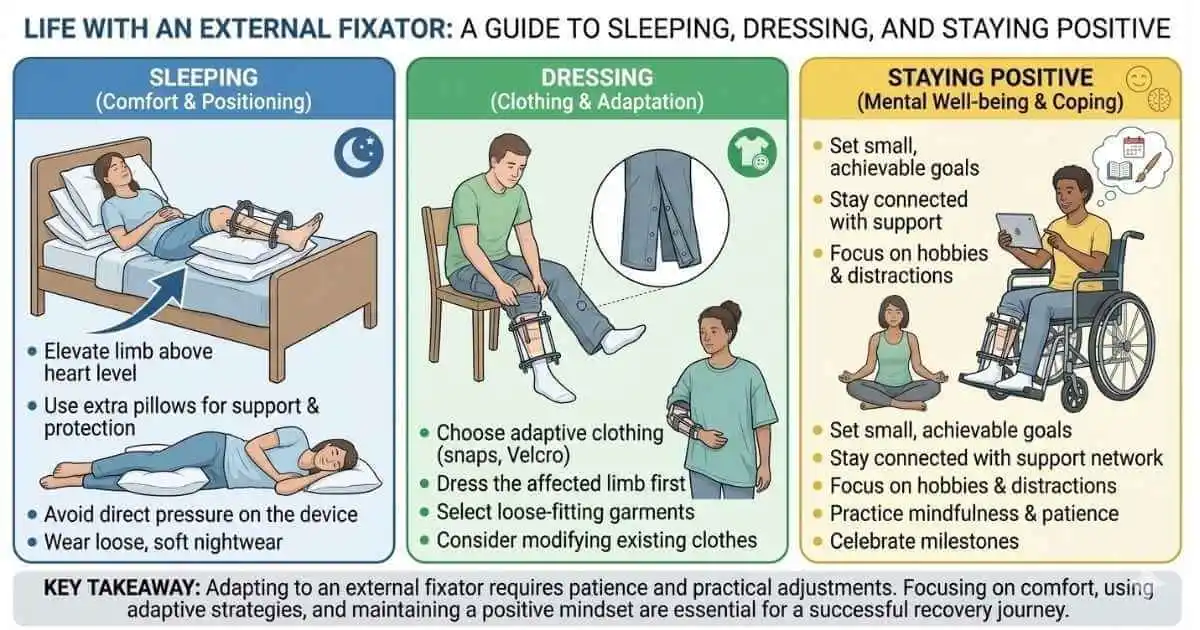
Sleep is usually the first thing that feels impossible. If you are someone who likes to roll around or sleep on your stomach, the frame is a rude awakening. You cannot just flop onto the mattress anymore. Instead, you have to become an architect of pillows. Most people find that they need to create a specialized nest to keep the frame stable.
Elevation is the golden rule here. Keeping your limb propped up helps with that deep, rhythmic throbbing that usually kicks in at the end of a long day. You want to use firm pillows to create a ramp so your leg stays above your heart. If you sleep on your side, you will need a thick "buffer" pillow between your knees to keep the metal from clanking against your other leg. One trick many patients use is to "tent" their blankets. You can put a cardboard box or stiff pillow at the foot of the bed to hold the covers up and give it a little cave for your foot. That prevents the heavy blankets from slipping down on the pins, which can be surprisingly painful.
The DIY Wardrobe
Your current wardrobe was likely not designed with a metal cage in mind. If you are recovering from external fixation tibia surgery, your favourite jeans are going to be stuck in the closet for a while. The goal is to find clothes that you do not have to "thread" through the frame.
This is where you get to be a bit of a designer. Many people head to a thrift store and buy cheap sweatpants specifically to cut them up. You can slice the side seam all the way up to the waistband and then use Velcro strips, snaps, or even simple safety pins to close the fabric around the external fixator. This way, you can wrap your clothes around your leg rather than trying to pull a pant leg over a bunch of metal bolts. Wide-leg basketball shorts are your best friend during the summer. In the winter, you may find that one leg of your pants is pinned up permanently and the other is straight. It seems a bit troll, but it works and today comfort has more power than fashion.
The Ritual of the Pins
There is a specific smell to the cleaning solution and a specific routine to the cotton swabs that becomes a permanent part of your day. Cleaning the pin sites is an intimate and slightly surreal experience. These are the spots where the metal enters your body, and they are the front lines of your recovery.
At first, it may be scary to touch them. But looking at something in the mirror makes you feel like you could break it or sneeze an infection off. But within a week or two it is a chore, just like washing your face. You learn to look for the “good” signs and watch for redness or heat. This daily check-in is actually a great way to stay connected to your progress. When you see the skin looking healthy and the sites staying calm, it is a tangible reminder that your body is doing exactly what it is supposed to do. For those with external fixation tibia hardware, keeping those sites pristine is the fastest ticket to getting the frame removed on schedule.
Keeping Your Head in the Game
The mental side of this journey is often much heavier than the metal itself. There will be days when you get to feel like a prisoner to the hardware. You may feel depressed when you go to the store and people stare, or you might just get bored by how long everything takes. On those days, it is important to remember that the external fixator is a temporary bridge.
You need a “why” that you can carry. Obituating this to walk without a limp, to fix a deformity, or to save a limb from an accident: that is the goal you want in your mind. Talk to people who have had it. There are online communities of "fixer" patients who share tips on everything from the best cleaning kits to how to deal with the itchiness under the pins. Understanding that your frustrations are normal can take a lot of the burden off of you.
The Finish Line
A day you’ll come to the clinic and walk out without the metal. The holes will heal, the scars will turn into small white dots and the frame will be a memory. But what you learned as you navigated life with an outside fixator will always be with you. You are learning to be a graceful and creative person in a hard, uncomfortable situation. That strength is worth just as much as the bone in it. Be patient with yourself, keep your pillows propped, and remember that every single day is one day closer to the frame coming off.
Also Read: