
Contents
After knee surgery, the first day you get home is generally filled with relief and a long list of instructions. You have done the hard part of the process, and now you are ready to pay off. But many come upon this surprise and frustration: A joint that resembles an Oregon. This knee stiffness after surgery can be gruesome. You expect to be walking, but your leg feels like a rusty hinge that has no movement.
If you are sitting on your sofa staring at a knee that isn’t quite straightening or bending, you’re not doing anything wrong. Stiffness is the body’s very loud way of communicating that it is still in the middle of a massive internal construction project. Understanding why this happens can take some of the fear out of the recovery process.
Why Your Knee Feels Like Concrete
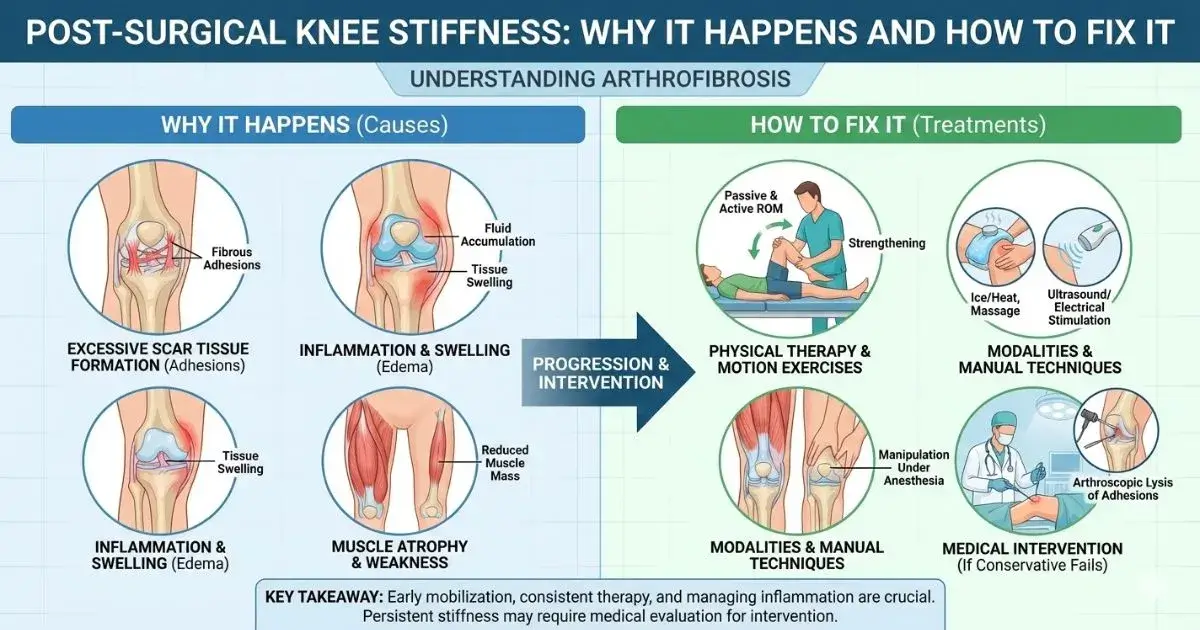
For example, stiffness can only be understood by looking at what is happening in the joint capsule. Surgery is a major event for your body. Even when it is performed perfectly by a skilled surgeon, your internal tissues perceive the "incisions and adjustments" as an injury. Your body’s immediate response is to send a surge of fluid to the area. This swelling is actually a protective cushion, but it takes up valuable real estate inside the joint. When the space is full of fluid, there is physically no room for the bones to slide and rotate as they should.
Then comes the "biological glue" known as scar tissue. Scar tissue helps to heal the surgical site in a healthy recovery. But some patients are more aggressive to healing than others. This tissue can begin to form bridges between the different layers of the joint, i.e. things that should move independently. This internal webbing is a primary driver of knee stiffness after surgery, especially if the joint isn't moved frequently in those first few critical weeks.
The Cycle of Discomfort and Guarding
There is a very real psychological component to stiffness as well. Your brain tells your muscles to “guard” the area when a movement hurts. Your hamstrings and quadriceps can tighten up like a drumhead so you don’t go into a painful range. This creates a confusing cycle: you hurt to move, the muscles tighten, the joint becomes stiffer and movement becomes painful.
This is particularly a challenge encountered by those with knee pain after knee replacement. Because the operation involves changing the motors of the limb, the nerves are often on high alert. If you are suffering from pain after knee replacement, remember that “toughness is not enough” to control your discomfort. It is about letting that nerves run so that your muscles relax. When your muscles stop fighting the movement, you will find that the mechanical stiffness becomes much easier to work through during your therapy sessions.
The Road Back to Flexibility
If you feel stuck, the most important thing to do is keep the joint "honest" with consistent, gentle motion. You don't need to win a marathon in your first month. Instead, think of your recovery as a slow, steady persistent effort. Physical therapy is often where the real magic happens. The therapist can use manual means to stretch the capsule and break up early adhesions before they develop into permanent ones.
One of the best ways to combat knee stiffness after surgery is to find low-impact ways to move throughout the day. A stationary bike is a fantastic tool for this. Even if you cannot make a full circle with the pedals, simply rocking back and forth can help "pump" the swelling out of the joint. Consistency is your friend here. A few minutes of gentle movement an hour is often much more effective than a big, painful exercise one morning.
When to Seek Extra Help
Sometimes your knee is stubbornly locked in spite of your best efforts and faithful attendance at physical therapy. If you have had no improvement in your movements for several weeks, your surgeon may recommend a “Manipulation Under Anaesthesia.” This is much scarier than it really is. It’s that they’ll give you a few drops of sedative to make your muscles limp, and the doctor can manually move the knee and disintegrate those bands of scar tissue.
Many patients find that this procedure provides the "reset" they need to finally make progress. It clears the path so that your daily exercises can actually start working again.
Keeping a Positive Outlook
Recovery is rarely a straight line. There will be days when your knee feels loose and mobile, and days when you wake up feeling like you have gone backward. This is a normal part of the healing arc. The knee stiffness after surgery is a test of patience as much as it is of physical strength. You will eventually stumble back into your stride by sticking to your stretches and being kind to yourself during the “stiff” days. Your body works to heal; it may need a little more time and a little bit of gentle encouragement.
Also Read: