
Table of Contents
- The Double Dip: The Serious Risks of Lengthening the Same Bone Twice
- The "Used" Rubber Band Theory
- The Swiss Cheese Effect on Your Bones
- The Nerve Limit
- The Aesthetic Nightmare
- The "Dormant" Infection Risk
- Is It Ever Okay?
- The Verdict
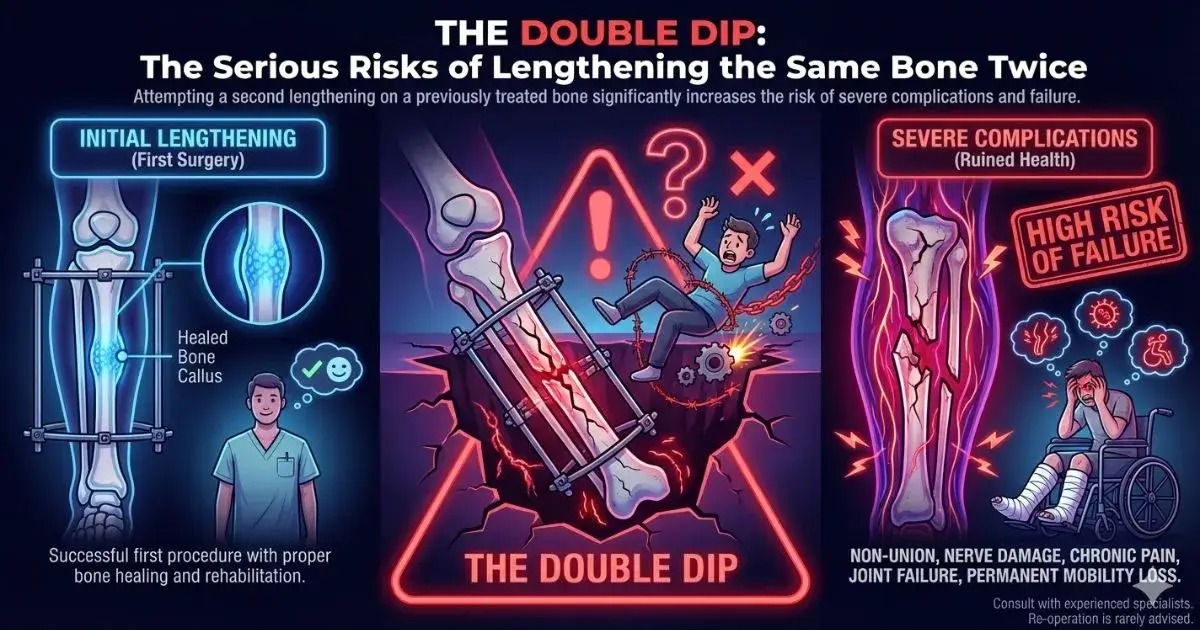
The Double Dip: The Serious Risks of Lengthening the Same Bone Twice
There is a phenomenon in the world of height increasing procedures that surgeons whisper about. It is called height dysphoria, or sometimes just plain old "height greed."
You undergo the procedure once. You survive the pain. You do the rehab. You walk away 3 inches taller. It is amazing. But you then, a year or two later, look in the mirror and think, I could take more.
Maybe you lengthened your femurs (thighs) and hit the safe limit of 8 centimeters. But you want another 5 centimeters. You don't want to touch your tibias (shins) because you heard the recovery is harder. So you ask the dangerous question. Can I just go back and lengthen my femurs again?
I mean technically yes. But the most risky, most complicated, option is to do limb lengthening surgery twice for the same bone segment on the same side. It is a completely different ballgame than the first time around.
Here is the honest truth about why doubling down on the same bone is often a recipe for disaster.
The "Used" Rubber Band Theory
When you understand the risk, you must not dwell on your leg as a construction project but instead consider it as a biological ecosystem.
In the first surgery, you’re stretching virgin tissue. Your muscles, nerves and blood vessels have never been traumatized before. They are elastic. They are fresh. They have plenty of "give."
When you try to do limb lengthening surgery on that same segment a second time, you are operating on scarred terrain. The soft tissues are no longer fresh rubber bands. They are stiff, old, dried-out rubber bands.
The first surgery creates internal scar tissue and adhesions. Your muscles might be slightly stuck to the bone. Your fascia is tighter. If you try to stretch them again, they do not stretch gracefully. They tear. They resist. This leads to excruciating stiffness and a much higher risk of permanent contractures, where your joints get locked in place.
The Swiss Cheese Effect on Your Bones
Bone is amazing at healing, but it is not magic.
During the first procedure, the surgeon drills into the canal of your bone to insert the nail. They cut holes for the locking screws. Your body heals those holes and reconstructs the bone over two years.
However, the structure of that bone is forever changed. It is often denser and harder (sclerotic) in some places and weaker in others. If you go back in for a second round of limb lengthening surgery, the surgeon has to remove the old hardware and put in new hardware.
They have to drill new holes. They have to ream the canal again. This turns your femur or tibia into something resembling Swiss cheese. The structural integrity of the bone is compromised. The risk of the bone cracking or shattering during the surgery or the lengthening process goes up significantly because you are working with a patchwork of old repairs.
The Nerve Limit
This is the scariest risk.
Your nerves are the limiting factor of height. During the first surgery, you stretched your sciatic nerve or peroneal nerve by, say, 8 centimeters. That nerve is now under a new baseline of tension. It has adapted, but it does not have unlimited slack.
If you go back to the same segment and try to pull another 4 or 5 centimeters out of it, you are pushing that nerve into the danger zone. The risk of nerve damage does not just double; it skyrockets.
We’re talking about foot drop - you lose the ability to lift your foot. We are talking about permanent numbness or burning nerve pain that will never be eliminated. You might get the height, but you might lose the ability to feel your feet.
The Aesthetic Nightmare
Let’s talk about looks.
There is a concept in orthopedics called segmental limb length measurement. This is the ratio of your thigh length to your shin length.
Human bodies follow a certain ratio that our brains perceive as "normal" or "beautiful." Usually, the femur is longer than the tibia, but there is a balance.
If you lengthen femurs by 8cm, you are pushing the threshold of that ratio, but then you usually look normal. If you go back and add 5cm more to the femurs you have added 13cm to only the thighs.
You will look bizarre. Your knees are too far down your leg. In a chair, the knees may stick out far outward than your body is. At the feet, you will look smaller than those at the top of the hips. Ignoring segmental limb length measurement ratios turns you into a caricature. You won't look like a tall person; you will look like a person who had surgery.
The "Dormant" Infection Risk
Here is a risk that almost nobody thinks about.
When you have metal in your body, bacteria can sometimes hide under it. They form a “biofilm,” a thin layer of slime that is shielded from your immune system. They might sit there for years. You feel fine. You have no symptoms.
But when you go back in for a second limb lengthening surgery, you disturb that environment. You are ripping out the old nail and reaming the canal. This violence can wake up those dormant bacteria.
You are now dealing with an arid deep bone infection, osteomyelitis in a leg that has just been broken. This is a nightmare and can result in multiple surgeries, months of IV antibiotics, or even the complete removal of hardware completely, and the bone crumbling back down.
Is It Ever Okay?
Are there exceptions? Yes.
Sometimes, a patient only gets 3 or 4 centimeters on their first try because of complications or pain. In those cases, going back years later to "finish the job" and get another 3 centimeters might be safe because the total amount of lengthening is still within the biological limit of the soft tissue.
But for the patient who maxed out their femurs at 8cm and wants to go back for more? Almost every reputable surgeon will say no. They will tell you to lengthen your tibias instead. Switching segments spreads the stress. Doubling down on one segment concentrates the risk.
The Verdict
Finally, limb lengthening surgery is about helping you live well, not destroying your body. The goal is to stand tall, and not to roll around in a wheelchair because your nerves are shot and your knees don't bend.
If you have already done your femurs and you still want to be taller, look at your tibias. If you have done both and you still aren't happy, the solution isn't more surgery. It might be learning to love the height you have already earned. Do not let greed cost you your legs.