
Table of Contents
- Bow Legs vs. Knock Knees - Understanding the Long-Term Impact on Your Health
- What Bow Legs and Knock Knees Actually Mean
- Why Knock Knees Often Cause Trouble Later
- Living as a Bow Legged Adult
- The Chain Reaction through the Body
- Can You Fix Knock Knees without Surgery
- When Orthopedic Surgery Enters the Conversation
- The Emotional Side That Rarely Gets Talked About
- Choosing Awareness over Ignoring Symptoms
- Final Thoughts
Bow Legs vs. Knock Knees
Most people don’t think much about the placement of
their legs until something starts to go wrong. Perhaps
it’s knee pain after a long day. Perhaps it’s your jeans
sitting, or how you need before your feet when you stand
still. For some, the legs curve outward. For others, the
knees lean in. These things are often dismissed early
on, especially if there is no real pain at the start.
What gets missed is how much alignment matters over
time. Bow legs and knock knees make the movement of
weight through the body very quietly. They influence the
development of the knees, hips and ankles, and how
discomfort slowly reaches the everyday. This is not
simply about legs. It’s about how they function after
years of walking, standing, and compensating without
realizing.
What Bow Legs and Knock Knees Actually Mean
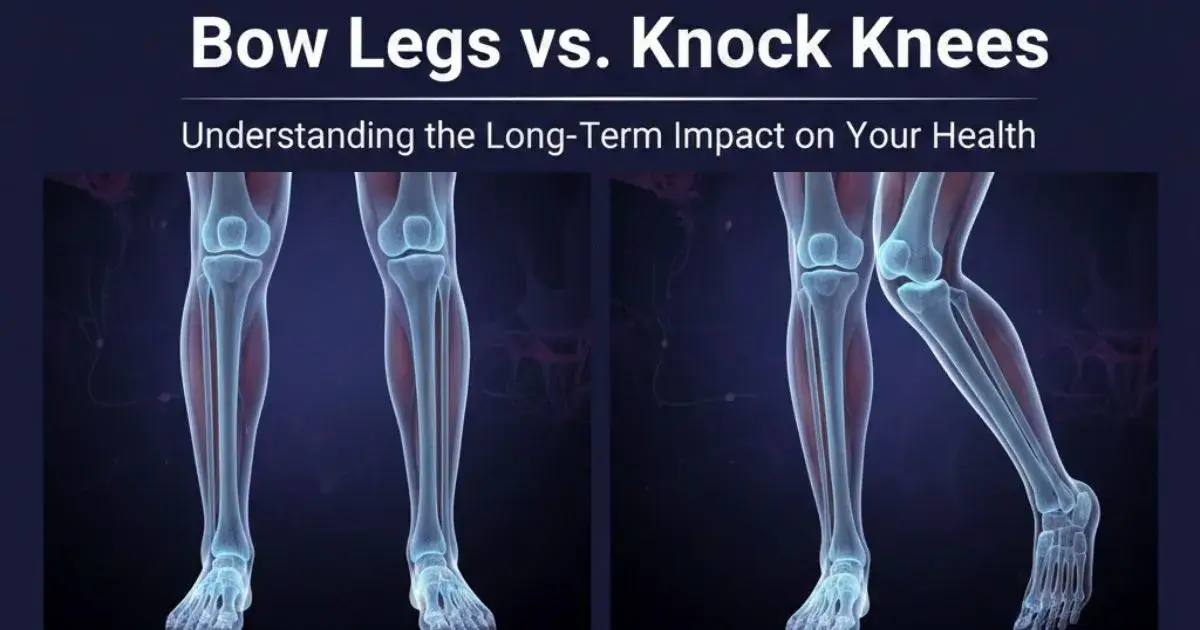
Bow legs are common in bow legged adults and narrow the
gap between the knees when standing with feet joined.
The legs bend over and pressure is directed toward the
inside of the knee joint. Many adults with bow legs grew
up being told it was just how their body was built.
Knock knees work the opposite way. The knees lie down,
touch, and the ankles lie apart. This alignment pushes
stress toward the outer knee. Knock knees are not
uncommon among children and they often correct
themselves. They lead to more problems in the long run
than expected.
Both alignments alter how force travels from the hips to
the feet. Over years, those altered forces matter.
Why Knock Knees Often Cause Trouble Later
Knock knees rarely feel dramatic early on. Many people
walk, run, and exercise without obvious pain for years.
The issue shows up gradually. Longer walks feel tiring.
Knees ache after standing too long. Stairs become
uncomfortable.
The inward angle in knock knees causes more weight to be
transferred to the outer knee cartilage than it was
originally meant to support. The hips are normally
affected by rotating inward during knock knees. This
interferes with the way we stand upright, causing more
pressure on the lower part of the back. The ankles and
feet react by rotating inward and can eventually cause
pain in the feet.
This is usually when people start asking you, can you
fix knock knees once you are an adult. The answer is not
simple but also not hopeless.
Living as a Bow Legged Adult
Being a bow legged adult has its own set of
difficulties. Because weight shifted toward the inner
knee, that part of the body wears more quickly.
Stiffness is common. So is aching after activity. Some
people notice their knees feeling unstable on uneven
ground.
What makes bow legs tricky is how normal they can feel.
Many adults never realize their alignment plays a role
in their knee pain. They blame age, workload, or lack of
fitness. By the time the connection becomes obvious,
joint changes may already be present.
That does not mean nothing can be done. It does mean
earlier awareness makes a difference.
The Chain Reaction through the Body
Leg alignment does not stop at the knees. The hips
respond. The ankles respond. Even the spine adjusts.
With knock knees, the pelvis often tips and rotates
inward. With bow legs, the outer hip muscles work harder
to stabilize the body. These patterns repeat with every
step. Over decades, they shape how the body moves and
how fatigue sets in.
This is why alignment issues often appear not only as
knee pain but also as hip pain, back discomfort or foot
pain. The body is compensating, quietly and
continuously.
Can You Fix Knock Knees without Surgery
This is one of the most asked questions. Can you fix
knock knees? And that is the realistic answer, it
depends what you mean by fix.
Exercise and physical therapy can help you achieve
control. Strengthening the hips, and especially the
glute muscles, may reduce the amount of knee collapse
inward during movement. Gait retraining may make walking
and running more stable. Orthotics may help guide foot
alignment.
What exercise usually cannot do is change bone structure
in adults. It can reduce stress and symptoms, but it
does not straighten the legs completely. For many
people, that is enough. Pain decreases. Function
improves. Life feels normal again.
When Orthopedic Surgery Enters the Conversation
In advanced cases, the topic could involve orthopedic
surgery. This usually occurs when there is pain,
mobility loss, or early arthritis is present.
Corrective osteotomy, for example, tries to align the
leg to ensure that weight can pass across the knee more
evenly. While surgery may sound extreme, it is
frequently done in order to preserve the joint and not
replace it. Surgical treatment in orthopedics is
concerned with maintaining function and slowing down
degeneration.
Surgery is never the first step, but for some it is the
best one.
The Emotional Side That Rarely Gets Talked About
Leg alignment affects more than joints. Many people grow
up feeling awkward about how their legs look. They avoid
certain clothes. They change how they stand. Some stop
participating in sports or social activities without
fully realizing why.
Adults often carry this quietly. Addressing alignment,
whether through therapy or surgery, can improve
confidence along with comfort. That psychological shift
is real and valid.
Choosing Awareness over Ignoring Symptoms
Not everyone with knock knees or bow legs will develop
arthritis. Not everyone needs intervention. But ignoring
recurring pain or instability usually limits future
options.
Understanding alignment early allows for better
decisions. Sometimes that means exercise and monitoring.
Sometimes it means imaging and medical guidance. Either
way, informed choices protect long term mobility.
Final Thoughts
Leg alignment is one of those things people ignore until
it becomes hard to ignore. When pain sets in, the body
has been compensating for years already. Bow legs and
knock knees are not a problem, but they’re also not
dandy little things.
If you have knock knees, it pays to take precautions
rather than wait for symptoms to worsen. I would also go
for anyone who is a bow legged adult who has stiffness
or fatigue on his/her knees. Sometimes it is easy to
change.
Sometimes guidance is needed. And in some cases,
orthopedic surgery becomes part of protecting long term
joint health.
The goal is not perfect legs. It is keeping your joints
working well for as long as possible. The earlier
alignment is understood, the more options you usually
have. That alone makes it worth taking seriously.