
Contents
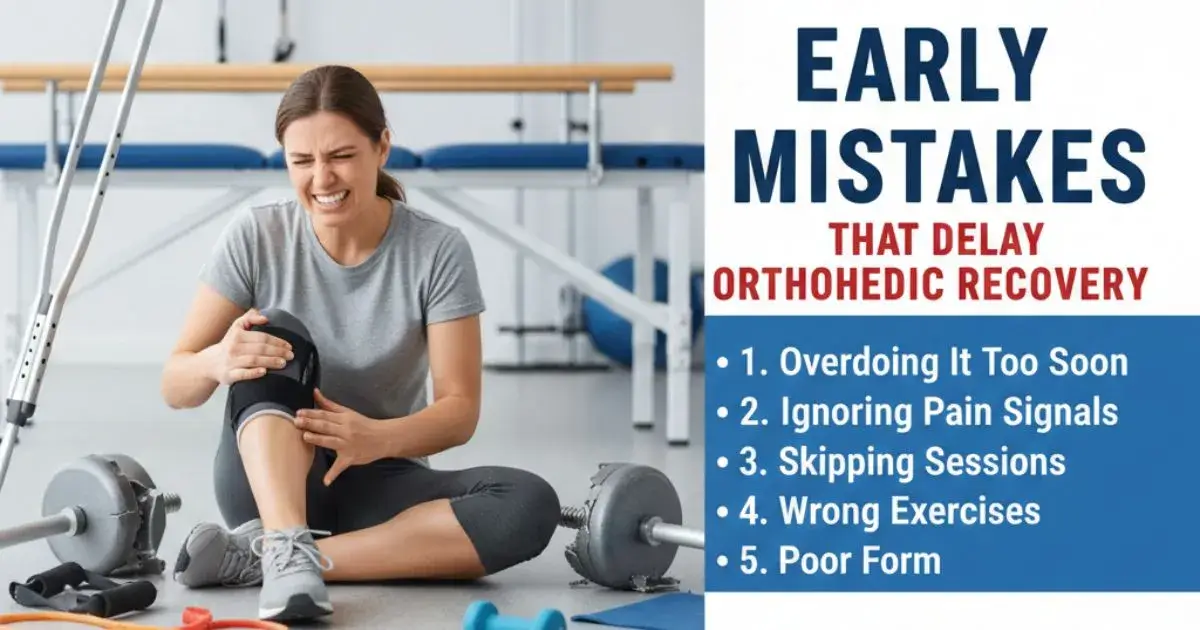
- Early Rehab Mistakes That Delay Orthopedic Recovery
- The All or Nothing Mindset: The "Boom and Bust" Cycle
- Misunderstanding Bone Healing and Rehab Timing
- Ignoring the "Quiet" Muscles: The Inhibition Problem
- The Fear of "Productive" Pain
- Neglecting the "Chain" Above and Below the Surgery
- Poor Sleep and Nutritional "Fueling"
- Conclusion: The Marathon, Not the Sprint
Early Rehab Mistakes That Delay Orthopedic Recovery
There’s a metaphorical clock in your room when you wake up from orthopedic surgery. The surgeon may have repaired a torn ligament or replaced a worn-out joint, but the biological work of recovery has only just begun. Surgery can create the conditions for healing, but what happens during rehabilitation plays an important role in how that recovery progresses.
Orthopedic recovery is rarely a straight path. It involves a combination of biology, movement, physical therapy, and psychology. Unfortunately, some patients fall into common traps during the first few weeks, unknowingly slowing their progress. What may seem like a small mistake early on can sometimes affect mobility, strength, and overall recovery later.
That’s why avoiding critical mistakes early in therapy is key. For an in-depth look at one of the most important recovery pitfalls, read our detailed guide on why skipping rehab will ruin your limb lengthening results.
If you want your surgical recovery to progress as safely and effectively as possible, understanding these early rehabilitation mistakes—and knowing how to avoid them—can make a meaningful difference.
The All or Nothing Mindset: The "Boom and Bust" Cycle
One of the most frequent hurdles in orthopedic recovery is a lack of balance in activity levels. Patients often fall into two camps: those who are terrified to move and those who try to "conquer" their recovery through sheer willpower.The “over-achievers” often think that if three sets of 10 exercises are good, then thirty sets should be better. They force through intense, stabbing pain believing they can beat the biological process. This is a huge error. If you over-stress too early in the procedure, you over-inflame the site. This inflammation causes intracellular pressure that, in reality, slows down the circulation of oxygenated blood to tissues.
On the other hand, the “under-achievers” are simply sedentary. They wait until the pain is gone before they begin moving. This leads to the “Bust” side of the cycle where joints stiffen and muscles contract. What’s important is to find the “Goldilocks Zone.” You need enough stress to stimulate tissue growth, but not so much that you strip out the small new fibers your body is trying to stitch together.
Misunderstanding Bone Healing and Rehab Timing
When a surgery involves the skeletal system, the relationship between bone healing and rehab timing becomes the most important factor in your success. Unlike skin or muscle, bone takes a significant amount of time to reach structural "maturity."A common mistake is assuming that because the surgical incision has closed, the bone underneath is ready for full weight-bearing. In the early stages of healing, the body creates "callus," which is essentially a soft bridge of cartilage and immature bone. If you apply heavy loads too soon, you can cause "micro-motion" at the fracture or surgical site. This micro-motion can prevent the bone from ever fully hardening, leading to a "non-union" where the bone fails to heal.
On the other hand, waiting too long to apply any weight can be detrimental as well. Bone is a living tissue that “reactively reacts to Wolff’s Law,” which states that bone “extenders and expands” when charged. If you stay off your feet for too long, the body begins to reabsorb minerals from the bone, making it weaker.
Working closely with a physical therapist to hit the exact windows of bone healing and rehab timing is what separates a successful recovery from a lifelong limp.
Ignoring the "Quiet" Muscles: The Inhibition Problem
After an orthopedic procedure, your brain enters a protective mode. It views the surgical site as a zone of trauma and often "shuts down" the muscles surrounding that area to prevent further movement. This is known as Arthrogenic Muscle Inhibition.One of the major post-operative rehab mistakes is to focus on the “big” movements and not on those quiet, suppressed muscles. For example, the quadriceps do not “fire” often after knee surgery. A patient may be able to walk with a stiff-legged gait but they are not actually using their thigh muscles.
If you don't spend the first week of rehab performing "boring" isometric contractions - simply squeezing the muscle without moving the joint - the brain will eventually "erase" that muscle from its movement map. This leads to a permanent loss of strength that becomes much harder to fix six months down the line.
The Fear of "Productive" Pain
Pain is a complicated signal. In our daily lives, we are taught that pain means "stop." However, in the context of orthopedic recovery, some level of discomfort is actually a sign of progress.Many patients delay their recovery because they are unwilling to move into the "discomfort zone." If you are recovering from a surgery that affects your range of motion, such as a shoulder repair or a knee replacement, the process of breaking down early adhesions will hurt.
If you stop moving the moment you feel a "stretch" or a "pull," you are allowing scar tissue to win. This tissue, called collagen, starts to cross-link and harden within days of surgery. If you don't consistently move the joint to its end-range, the scar tissue will "shrink-wrap" the joint.
Learning to distinguish between "protective pain" (a sharp, hot, or tearing sensation) and "productive pain" (a deep ache or a tight stretch) is essential. If you wait for a pain-free window to do your rehab, that window may never arrive.
Neglecting the "Chain" Above and Below the Surgery
The body does not move in isolation. It moves in
"kinetic chains." A surgery on the ankle is never just
an ankle problem; it is a foot, knee, hip, and lower
back problem.
A classic mistake in orthopedic recovery is focusing
exclusively on the joint that was operated on. If you
have been using crutches for six weeks, your hips have
likely become tight and your core has become weak. If
you simply start walking once the ankle is "healed"
without addressing the hip stiffness, the ankle will be
forced to take on extra stress to compensate.
This often leads to "secondary injuries." It is
incredibly common for a patient to have a successful ACL
reconstruction only to return to the doctor six months
later with chronic lower back pain because they never
re-balanced their pelvis during rehab. Comprehensive
rehab must address the entire limb and the core to
ensure the surgical site isn't being overloaded by
dysfunctions elsewhere.
Poor Sleep and Nutritional "Fueling"
We often think of rehab as something that happens at the
physical therapy clinic. In reality, the most important
"rehab" happens while you are asleep.
Operation and the healing process need considerable
amounts of metabolic energy. One of the recurring
post-operative rehab mistakes is failure to adapt to
nutritional and sleep needs. The body requires more
protein, vitamin C, zinc and calcium to knit bone and
repair soft tissue.
Plus, most “Growth Hormone” - the chemical that drives
tissue repair - is released deep sleep. When patients
wake up late or take medications that disrupt the sleep
cycle, they are offsetting the body’s primary repair
mechanism. You can’t out-race a malnourished or sleepy
body.
Conclusion: The Marathon, Not the Sprint
The best humanized advice any therapist can give is: Be
patient with the biology, but be disciplined with the
movement. Orthopedic recovery is a long-term project,
that requires you to be part of rather than the
observer.
By respecting the timeline of bone healing and rehab
timing, staying vigilant against muscle inhibition, and
viewing the body as a whole system rather than just a
collection of parts, you can avoid the "stall" that many
patients experience.
Surgery gives you a new start, but it is the quality of
your daily rehab that gives you your life back. Don't
let a "perfect" surgery be undermined by "avoidable"
mistakes in the weeks that follow.
Also Read