
Contents
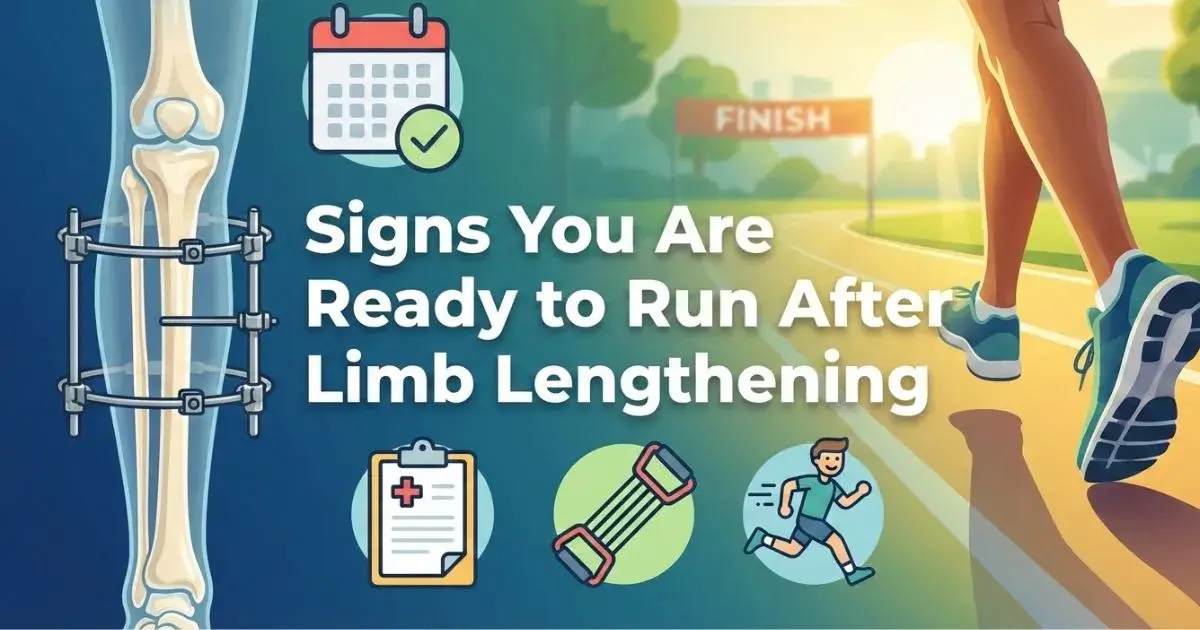
Signs You Are Ready to Run After Limb Lengthening
The journey through a limb correction process is often
defined by milestones that feel like slow-motion
victories. First, there is the day you stand up for the
first time. Then you take your first steps unaided. But
for many, the ultimate goal is to return to high-impact
movement. There’s a huge psychological and physical
barrier to the transition from running and jumping,
whether you want to chase your children into the garden,
return to a sport you like, or just walk for a bus
without thinking twice.
The total
limb lengthening surgery recovery time
can feel like a long stretch of "waiting," but it is
actually a period of intense internal construction.
Running and jumping require enormous amounts of pressure
on your bones, between three and five times your body
weight. This is why rushing back too early is not just
painful, it can be risky. Knowing which signs to look
for will enable you to move from the “walking” phase
into the “impact” phase confidently.
The X-Ray Foundation: The Three-Cortex Rule
Before you even think about lace-up sneakers, your
surgeon will be looking at your progress through the
lens of an X-ray. During the limb lengthening surgery
recovery time, the new bone in the gap goes through a
process called consolidation. In the beginning, this
"new" bone is soft and cloudy on the image. As it heals,
it becomes dense and white, matching the strength of the
original bone.
Most surgeons look for what is called the
"three-cortex" sign. Long bones like
the femur or tibia have four sides, or cortices. The
X-ray must show that at least three of those four faces
are solid and continuous before you are allowed to run
or jump. This is the structural foundation. Without this
biological “green light,” the bone could bend or
“stress” when a jump hits it. This is a non-negotiable
step that will make sure that your new height is solid
on a rock.
The Functional Test: Squatting Without Pain
Your daily movements tell us about your muscles and
joints, while the X-ray tells us about the bone. One of
the best indicators of readiness is your ability to do a
deep controlled squat. This movement requires both ankle
flexibility, knee stability and quadriceps strength.
If you feel significant
knee pain while squatting, that is
often because your muscles are too tight, or that your
joints haven’t yet been able to accommodate the new
length of the limb. If you can do a full squat with your
heels on the ground and when you can’t feel sharp knee
pain, you are demonstrating that your soft tissues are
healthily flexible and strong.
Considerations for Younger Patients
For parents of children undergoing this procedure, there
is an extra layer of care involved. In paediatric cases,
the surgeon is often working near the
growth plate of bone
. This is the specialized area of developing tissue near
the ends of long bones that determines how long and
strong the bones will ultimately become.
In children, impact activities are usually introduced
more cautiously because the growth plate of bone is
thinner than the hard bone around the curve. If a child
starts jumping or doing contact sports before the area
around the growth plate has fully stabilized, it may
become irritated or trouble with future natural growth.
Following a long walk, it is important to observe if a
child is limping or “guarding” after a long walk to know
if the body is ready for the next level of activity.
The Single-Leg Balance and Strength Test
Running is simply some small, controlled jumps from one
foot to the other. This means that your “good” leg and
“repaired” leg both must be capable of carrying full
body weight independently. One of the best ways to test
your readiness at home is a single-leg balance test.
Can you stand on your surgical leg for thirty seconds
without getting tense or needing to grab a chair? If you
can, it signifies that your “proprioception” - the
intelligence of your brain to tell where your limb is in
space - has returned. Once you can balance, do a single
leg calf raise. If your calf muscle can lift your body
weight, then that means the “spring” of your step is
starting to start returning. These small indicators are
often more important than the calendar when determining
the true
limb lengthening surgery recovery time.
Managing the Psychological "Jump"
The first few jumps after surgery are somewhat of a
mental barrier. If you have been protecting your leg for
months and treating it like a fragile object, your brain
may be unwilling to let go. This "fear of impact" is a
natural protective mechanism.
This can best be overcome by “impact loading” in a
controlled environment. That might mean starting with a
short walk, moving onto a “power walk”, and eventually a
very small jog on a treadmill or on a soft grass
surface. Listening to your body is critical during this
transition. A little bit of "new" muscle soreness is
normal, but sharp, localized pain in the bone is a sign
to scale back and give the body another week or two of
consolidation.
Celebrating the Finish Line
The final transition back to an active lifestyle is the
most rewarding part of the entire limb lengthening
surgery recovery time. It is when the surgery stops
being a medical event and begins to become a part of
your past. By watching for clear X-ray signs, ensuring
you can move without knee pain while squatting, and
respecting the health of the growth plate of bone, you
ensure that your return to activity is permanent.
Remember that your body has done something incredible.
It has grown new tissue and is adapted to a big shift.
Give it time to complete the job. When you finally get
that first pain free run, you will know it was worth
every day of patient waiting.
Also Read: