
Contents
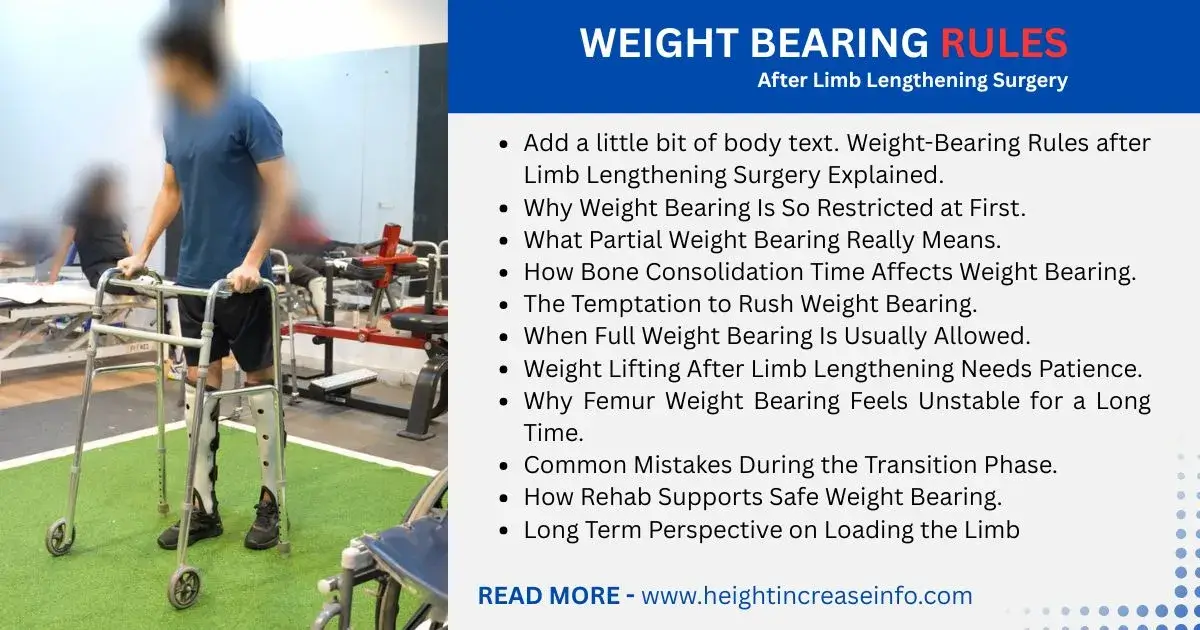
- Weight Bearing Rules After Limb Lengthening Surgery Explained
- Why Weight Bearing Is So Restricted at First
- What Partial Weight Bearing Really Means
- How Bone Consolidation Time Affects Weight Bearing
- The Temptation to Rush Weight Bearing
- When Full Weight Bearing Is Usually Allowed
- Weight Lifting After Limb Lengthening Needs Patience
- Why Femur Weight Bearing Feels Unstable for a Long Time
- Common Mistakes During the Transition Phase
- How Rehab Supports Safe Weight Bearing
- Long Term Perspective on Loading the Limb
- Final Thoughts
One of the most debatable aspects of limb lengthening surgery is not the surgery itself. And then there is the question. How much weight can I put on my leg and how much is safe? Everyone seems to answer differently. Surgeons explain it one way. Rehab protocols say something else. Other patients share completely different experiences. Weight bearing sounds simple, but after limb lengthening surgery, it becomes a moving target. What feels easy one week may be unsafe the next. What looks strong on an X ray may still feel fragile in real life. Understanding weight bearing rules properly is important, especially if you are thinking about weight lifting after limb lengthening at some point in your recovery.
Why Weight Bearing Is So Restricted at First
The bone does not heal properly after the surgery in the usual sense. It is grabbing attention in a gradual fashion, the ends of bones being cut off so that new bone can settle in between. This early bone is soft. It’s more scar tissue than bone.
During this phase, weight bearing is limited because too much force can collapse the new bone. That does not always cause immediate pain, which makes it dangerous. Damage can happen quietly.
For femur weight bearing
in particular, caution is critical. The femur carries the load of the entire body. Even standing up transfers significant force through it. This is why most patients start with either no weight bearing or very minimal partial weight bearing using crutches or a walker.
What Partial Weight Bearing Really Means
Partial weight bearing is one of the most misunderstood terms in recovery. Many people assume it means standing lightly or touching the foot to the ground. In reality, it usually means a very specific percentage of body weight. Some surgeons allow 20 percent. Others allow 30 percent. The number depends on the bone involved, the device used, and how the regenerate bone looks on imaging. Most patients are not good at estimating percentages. This is why therapists often use scales during rehab sessions. You step on the scale and practice loading only the allowed amount. It feels awkward at first, and honestly frustrating. The goal during this phase is not strength. It is stimulation. Controlled loading encourages bone formation without overwhelming it.
How Bone Consolidation Time Affects Weight Bearing
bone consolidation time refers to how long it takes for the new bone to harden and become structurally reliable. This process takes much longer than people expect. Even after distraction stops, consolidation continues for months. Early consolidation looks solid on scans but can still be weak under stress. This is where many people make mistakes. Feeling better does not mean the bone is ready. Pain levels drop before strength returns. This gap between comfort and structural readiness is risky. For femur lengthening, bone consolidation time is usually longer than for the tibia. The femur experiences higher loads during walking, standing, and even sitting down.
The Temptation to Rush Weight Bearing
There is a strong mental push to walk normally again. Crutches are tiring. Walkers feel limiting. Many patients start testing their limits quietly. This is where setbacks happen. Putting extra weight through the leg too early can slow consolidation. In some cases, it can bend internal devices or delay healing. The frustrating part is that damage may not show symptoms immediately. A common sign of overload is deep aching pain that appears later in the day. Swelling that does not settle overnight is another warning sign.
When Full Weight Bearing Is Usually Allowed
Full weight bearing is usually introduced gradually, not all at once. One crutch becomes two. Two become one. One becomes none. Imaging and clinical testing are important factors in assessing this stage. Surgeons search for bone formation all along the regenerate’s length. Gaps or weak zones mean restrictions continue. Even when full weight bearing is allowed, it does not mean the leg is ready for stress. Walking and loading are very different from impact or resistance.
Weight Lifting After Limb Lengthening Needs Patience
Weight lifting after limb lengthening is a long term goal, not an early milestone. Many people misunderstand this and think gym work equals recovery. Early on, resistance training is limited to non weight bearing or supported exercises. Upper body training is usually allowed first. Core work comes next. Lower limb loading is introduced carefully. Bodyweight exercises come before external weights. Even then, movements are controlled and slow. Squats, lunges, and leg presses force large compressive forces through the femur. These should only be introduced when bone consolidation time is well advanced and cleared by the medical team.
Why Femur Weight Bearing Feels Unstable for a Long Time
Even when the bone is healing well, muscles lag behind. The femur is surrounded by powerful muscles that weaken during prolonged limited weight bearing. This weakness causes instability. The leg may feel like it cannot trust itself. This sensation often scares patients, but it is normal. Rehab focuses on retraining these muscles gradually. Stability improves before strength. Strength improves before endurance. Rushing any of these steps creates compensation patterns.
Common Mistakes During the Transition Phase
One common mistake is comparing progress to others. Bone healing varies widely. Two people with the same surgery can have very different timelines. Another mistake is adding Weight lifting after limb lengthening too early because pain is low. Pain is not a reliable indicator of readiness. Ignoring fatigue is also risky. Muscles tire faster than expected, especially during the consolidation phase. Fatigue leads to poor movement and uneven loading.
How Rehab Supports Safe Weight Bearing
activation. Small corrections prevent long term issues. Exercises focus on alignment, control, and symmetry. Strength is added only when movement quality is good. This phase can feel slow and repetitive. But it protects joint health and prevents secondary problems in the knee, hip, or lower back.
Long Term Perspective on Loading the Limb
Despite technically completed time for bone consolidation, the bone continues to remodel. It grows stronger as it adapts to everyday stresses. This is why high impact activities and heavy lifting are delayed even further. The goal is durability, not just healing. Weight lifting after limb lengthening eventually becomes safe for most people, but it should progress conservatively. Loads increase slowly. Recovery days matter.
Final Thoughts
Weight bearing after limb lengthening surgery is not about toughness or speed. It is about timing and respect for biology. Femur weight bearing carries unique demands. Bone consolidation time cannot be rushed. Strength returns in layers, not all at once. If there is one rule to remember, it is this. Feeling ready is not ready. Progress is made with patience, consistency, and listen to the doctor’s instructions and your body. The long term results are far better when weight bearing is practiced correctly.
Also Read: