
Contents
- Why Proper Movement Feels Awkward at First After Limb Lengthening Surgery
- The Brain-Body Disconnect: Proprioception and Sensory Mapping
- Altered Joint Kinematics and Muscle Length
- The Role of Visual Input vs Internal Feedback
- Gait Mechanics and the Compensation Cycle
- The Psychological Barrier: Fear and Motor Learning
- The Role of Physical Therapy in Re-Calibration
- Conclusion
Why Proper Movement Feels Awkward at First After Limb Lengthening Surgery
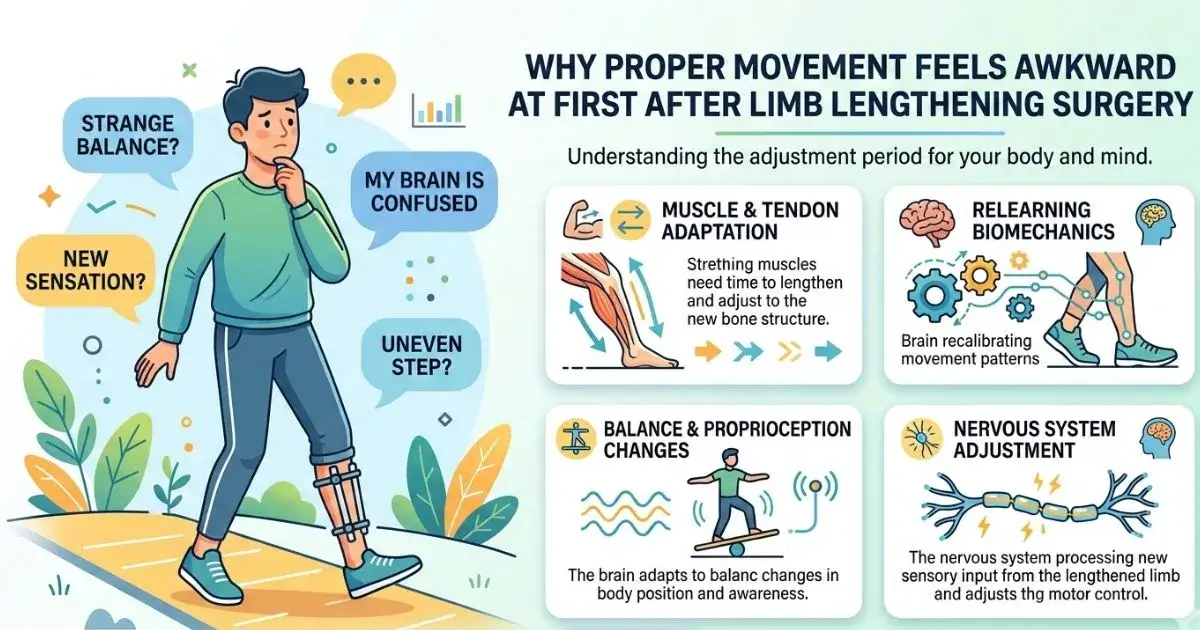
You have just undergone limb lengthening surgery. You stand up and try to walk. Your steps seem clumsy; you feel as if you are learning to walk for the first time. Many patients experience this immediately following surgery. It is not a complication but a normal reaction to the surgery. Your body and brain need some time to adapt to the new limb length.
In this article, we break down why proper movement feels so strange at first. We'll look at the brain's role in sensing your body. You'll learn about gait changes and how fear plays a part. Plus, we'll cover ways physical therapy helps. By the end, you'll see this phase as temporary. It leads to smoother strides ahead.
The Brain-Body Disconnect: Proprioception and Sensory Mapping
Your brain keeps a mental picture of your body. This map guides every move you make. After limb lengthening surgery, that map doesn't match anymore. The surgery stretches bones, but your brain clings to old info. This mismatch makes simple actions feel wrong and complicates movement after limb lengthening surgery.
Redefining the Body Schema
The body schema is a constantly updated record of the position of the limbs and body joints. A sudden increase in limb length will result in a greater bone size with an unchanged brain map. This will cause a reaching mismatch with an object.
Proprioceptors act like tiny sensors in your muscles and joints. They send signals to your brain about position and stretch. Post-surgery, these signals shift. The new length sends fresh data. Your central nervous system scrambles to process it. At first, this leads to jerky or hesitant motions. Over time, the brain updates the schema. But it takes weeks of practice.
Studies show this recalibration can last from a few weeks to months. One report from orthopedic journals notes that 80% of patients feel this disconnect early on. Patience helps as your brain rewires.
Altered Joint Kinematics and Muscle Length
Actually, limb lengthening surgery pulls muscles and tendons along with the bones. They adapt to the extra length. But their tension changes. What felt easy before now takes more work. These biomechanical shifts are the primary reason why movement after limb lengthening surgery feels stiff and heavy.
Take bending your knee. Before, muscles had just the right slack. Now, they're longer. They fire at odd times. This throws off smooth motion. Your hip might overcompensate, making walks wobbly.
Nerves stretch too. They send mixed messages about where your foot lands. Even if everything heals well, these shifts cause fatigue fast. Patients often say stairs feel like a puzzle. The key is gradual strengthening to reset these patterns.
The Role of Visual Input vs Internal Feedback
You look down and see a longer leg. But inside, it doesn't feel that way yet. This clash between eyes and senses amps up the awkwardness.
Visual cues help at first. You might stare at your feet to guide steps. But true balance comes from internal feedback. Proprioception should handle that without looking. The mismatch tricks your brain into doubt.
Imagine driving with a foggy windshield. You see the road but can't trust the feel. That's gait after limb lengthening. As therapy progresses, senses align. Soon, you move without second-guessing.
Gait Mechanics and the Compensation Cycle
Walking isn't just lifting feet. It's a rhythm of balance and push. After limb lengthening surgery, your gait cycle breaks. The new length disrupts this flow. You end up compensating in ways that feel clumsy.
The Shift in Center of Gravity and Balance
Longer limbs raise your height a bit. This nudges your center of gravity up and forward. Your body auto-adjusts posture. But it's not smooth.
On flat ground, you might lean back without noticing. Stairs or turns make it worse. Balance wavers because your base feels wider or off. Early on, many lean on walls for support.
Visual input takes over. You watch your steps closely. This tires you out quick. But it buys time while your inner balance catches up. Experts say core exercises help stabilize this shift fast.
Muscle Guarding and Protective Gait Patterns
Your muscles go into guard mode. They tighten around the surgery site to shield it. This stiffens joints and limits swing.
In walking, your leg drags a tad. Or you shuffle to avoid full extension. These patterns protect but slow recovery. They make natural strides feel forced.
Spot this by noting tight calves or hips. Physical therapy offers slow stretches. Try gentle holds: stand and ease into a lunge, hold five seconds, release. Do this daily under guidance. It loosens guards over time.
- Recognize tension: Pause during walks. Feel for tight spots.
- Breathe through it: Deep breaths relax muscles.
- Build slowly: Add range bit by bit.
Analysis of the Swing Phase vs. Stance Phase
Gait splits into swing and stance. Swing lifts your leg forward. Stance plants it down.
Post-surgery, swing feels dragged out. Your brain expects the old length. So, you hike your hip higher for clearance. It looks like a limp.
Stance hits unstable. Foot lands later than before. This rocks your weight. You might shorten steps to steady up. Breaking it down in therapy helps. Practice swing with mirrors. For stance, focus on even pressure.
One study found gait normalizes in 3-6 months with targeted drills. Split phases make retraining easier.
The Psychological Barrier: Fear and Motor Learning
Awkwardness isn't just physical. Your mind adds hurdles. Fear creeps in, stiffening moves. But understanding this helps push through.
Fear of Re-Injury or Hardware Failure
After limb lengthening surgery, worry lingers. What if a bold step snaps something? This fear, called kinesiophobia, freezes you.
You move careful, like testing thin ice. Hesitant steps override smooth habits. Pain from early healing fuels it. But most fears fade as strength builds
Talk to your doc about risks. They often say normal use aids consolidation. Gentle exposure cuts fear. Start with short walks. Build confidence step by step.
Motor Learning Theory: Repetition Overrides Awkwardness
Movement is a learned skill. Your brain runs old programs first. New ones need reps to stick.
The old gait feels safe. The new one? Clunky. Repetition rewires nerves. Neurons that fire together wire together, helping you master movement after limb lengthening surgery.
Focus on quality. Try single-leg stands for 10 seconds. Then add steps. Do 5-10 reps daily.
- Isolate moves: Practice knee bends alone.
- Mirror work: Watch form to build trust.
- Track progress: Note smoother days.
Rhetorical question: How long till it clicks? Often 4-8 weeks with steady practice.
The Role of Physical Therapy in Re-Calibration
Therapy isn't optional. It's your roadmap to normal. Pros guide the brain-body sync. They turn awkward into automatic.
Targeted Proprioceptive Training
PT zeros in on senses. Exercises wake up those proprioceptors.
Stand on foam pads. It challenges balance. Or use a wobble board. Walk to targets on the floor. These build the new map.
Weight-bearing on uneven spots sharpens feedback. Start simple: eyes open, then closed. Adhere to sessions. Twice weekly speeds gains.
Tip: Home add-ons like balance apps reinforce clinic work. Consistency trumps intensity.
Biofeedback and Conscious Control Integration
Biofeedback shows your moves in real time. Screens or sounds cue adjustments.
You see your gait on video. It highlights hitches. Therapists tweak till it flows.
At first, think "lift foot this high." It's effort. But reps make it habit. Automaticity hits when thought fades.
Patients report less awkwardness after 10 sessions. Tools bridge the gap till your brain owns it.
Conclusion: Embracing the Process of Re-Acquisition
Awkward movement after limb lengthening surgery stems from a brain-body mismatch. Your sensory map updates slow. Gait shifts and muscle changes add to it. Fear can stall progress, but therapy counters all this.
Fluidity returns through practice. The brain rewrites its blueprint. Patience pays off as old patterns yield to new.
Key Takeaways:
- View awkwardness as temporary. It's your system's way of adapting.
- Stick to physical therapy. It's the fast track to normal.
- Practice deliberate, slow moves. Quality reps build skills.
Embrace this phase. Soon, your strides will feel right again. Consult your team for tailored plans. You've got this - keep moving forward.
Also Read: Real Patient’s Limb Lengthening Journey & Insights: Cross Lengthening 11 CM