
Contents
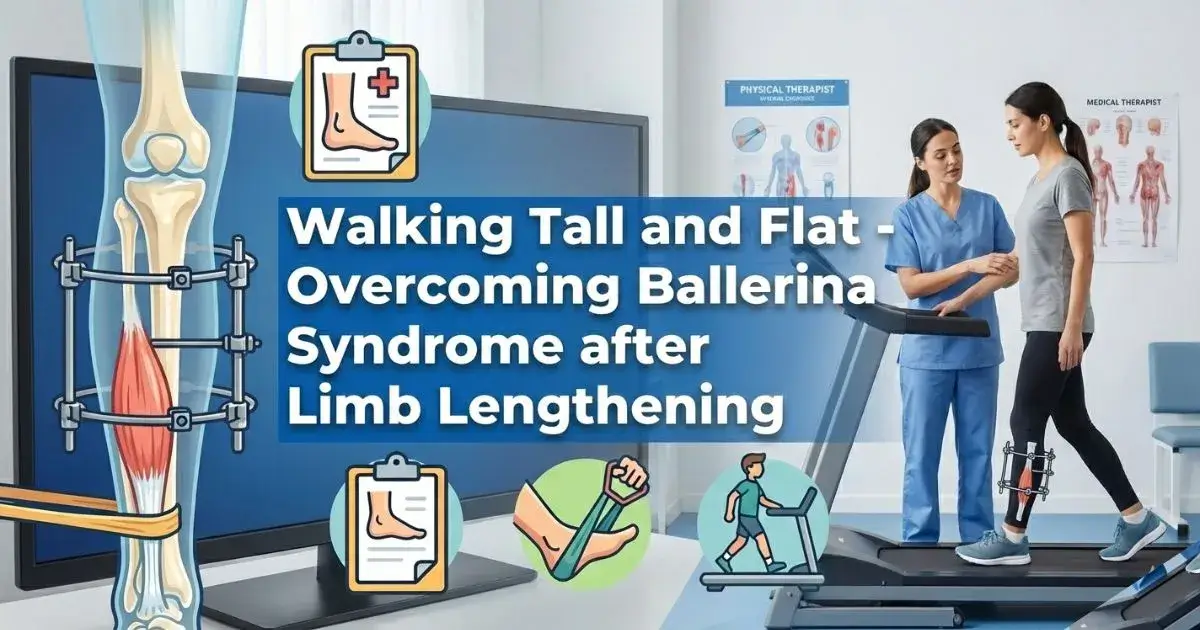
Walking Tall and Flat - Overcoming ballerina syndrome after Limb Lengthening
The name “ballerina syndrome” is ironic. It is graceful, maybe elegant. It invokes images of dancers floating across a stage. For anyone recovering from limb lengthening surgery, however, the experience is far from a performance. It is a fast, furious battle against your own anatomy.You wake up one morning and realize that your heel will never touch the ground. You’re on tiptoes, not because you want to be, but because your muscles have decided to strike.
This condition, medically known as an equinus contracture, is perhaps the single most common speed bump on the road to getting taller or correcting a deformity. It’s because biology is a bit of a mismatch. Bone is very good at regenerating; you will fill in the gap you create if you allow it time. Muscle is stubborn, on the other. It hates being stretched. The calf muscles and Achilles tendon must physically expand to support the growth of the bone. They tend to fall behind.
The result is a foot that points downward. It may seem like a minor nuisance but it can compel your walking mechanics to the brink. Plus, it can cause a nasty pinching sensation at the back of the ankle, posterior impingement syndrome of ankle. If you are currently fighting to get your heel flat, you need a game plan that is aggressive, consistent, and smart.
The Mechanics of the "Stuck" Foot
To fix the problem, you need to know what’s happening beneath your skin. Imagine that you wear a bow, and that the string is your Achilles tendon. The longer the bow, the longer the string. It finally gets so tension that it pulls the foot down.
This tightness is not just about muscle length. It changes the geometry of your ankle joint. When you put your foot out of that pointed position for weeks at a time, the structures behind the ankle start to bind together. Here things get complicated. The space around the ankle is tight and there is little room for error. If the soft tissues compress between the heel bone and the shin bone, they become inflammatory. This inflammation takes up space, and this further comprimes, causing a vicious circle of pain and stiffness.
The Hidden Culprit - equinus
For some people, the pain at the back of the ankle is
not just soft tissue. It is bone hitting bone. About ten
to fifteen percent of the population has a small, extra
accessory bone behind the ankle called the ostrigonum.
In a normal life, you might never know you have it. It
sits there quietly and causes no trouble.
But limb lengthening surgery changes the environment. As
your tight calf muscles pull your foot into that
ballerina point, this little extra bone gets caught in
the "nutcracker" of the ankle joint. It gets squeezed
aggressively every time you try to push your heel down
or even when you push off to take a step.
This is equinus. It is a distinct, sharp pain that feels
like a pinch deep inside the back of the ankle. It is
different from the burn of a stretch; it feels like a
mechanical block. If you have this, you can actually
make it worse by just pushing the stretch because you
are grinding the bone against the inflamed tissue. This
difference is important to understand because the way
you treat a tight muscle is different from the way you
treat an impinged bone.
The Daily Grind - Stretching as a Job
If your issue is primarily muscle tightness, the
solution is unglamorous and repetitive work. You cannot
rely on a few minutes of stretching at physical therapy
to save you. You have to treat stretching like a second
job.
The goal is to convince your nervous system that it is
safe to let the muscle lengthen. When you stretch a
muscle that is already under the tension of lengthening,
it will naturally try to fight back and contract. This
is a protective reflex. To overcome it, you need
low-load, long-duration stretching.
This means resting with your leg straight and a towel or
strap around the ball of your foot, pulling your toes
over your nose. You aren’t looking for a tear-swelling
yank. You want a firm, steady pull that you can hold for
five or ten minutes while you watch TV. You need to
accumulate time under tension. Doing this for thirty
seconds is useless. Doing it for thirty minutes
throughout the day changes the tissue.
The Night Shift - Sleeping in Boots
Here is the hard truth that no one wants to hear: you
sleep most of your progress. When you lie down in bed,
your feet tend to get pointed. If you spend eight hours
like that, your muscles relax and you wake up right back
at the start of the day.
To beat ballerina syndrome, you have to embrace the
night splint. This is a rigid brace that holds your foot
at a ninety-degree angle (or as close as you can get)
while you sleep. It is not comfortable. It is clunky, it
can get hot, and it makes turning over in bed a chore.
But it is non-negotiable.
The night splint acts as a passive stretch that works
for hours at a time. It prevents the calf from shrinking
back down overnight. If you are dealing with posterior
impingement syndrome of ankle, you might need to adjust
the angle of the splint so it isn't forcing you into a
painful pinch, but you still need that support. Many
patients find that wearing the splint is the single
biggest factor in whether they keep their heels flat or
not.
When the Pinch Won't Go Away
Sometimes, despite your best efforts, the anatomy just
wins. If you have equinus, all the stretching in the
world might not stop the pain because that little bone
is physically blocking the movement.
Talk to your surgeon if you have a sharp bony block that
stops you suddenly from moving. They might prescribe
corticosteroids to relax the inflammation. This may
shrink the swollen tissues so that you can stop pinching
and continue therapy.
In more stubborn cases, you might need a small procedure
to release the tight tendon. It sounds scary to have
another surgery when you are already in the middle of
one, but these are usually minor interventions. A heel
cord release is a quick procedure that lengthens the
tendon instantly. That’s like cutting a taut rubber
band. The tension in the leg disappears, the heel fell
to the floor, and the “ballerina” walk disappears.
The Mental Game of the "Tip-Toe"
Walking on your toes does something to your head. It
makes you feel vulnerable. You are unstable, you can't
walk fast, and you feel like everyone is watching your
strange gait. It is easy to get discouraged and feel
like the surgery was a mistake.
Remember this is a temporary mechanical problem not a
permanent disability. Your body is trying to protect
itself as best it knows how. Be patient. If you are
dealing with ballerina syndrome, don't panic. It is the
most solvable problem in the limb lengthening world.
Listen to your body. If it is a muscular burn, stretch
it out. If it is a sharp pinch of equinus, rest it and
ice it. Use your splints, do your homework and watch out
for the prize. Your heel will hit the pavement one day,
you will roll to your toe, and you will walk out taller
than you were before.
Also Read: