
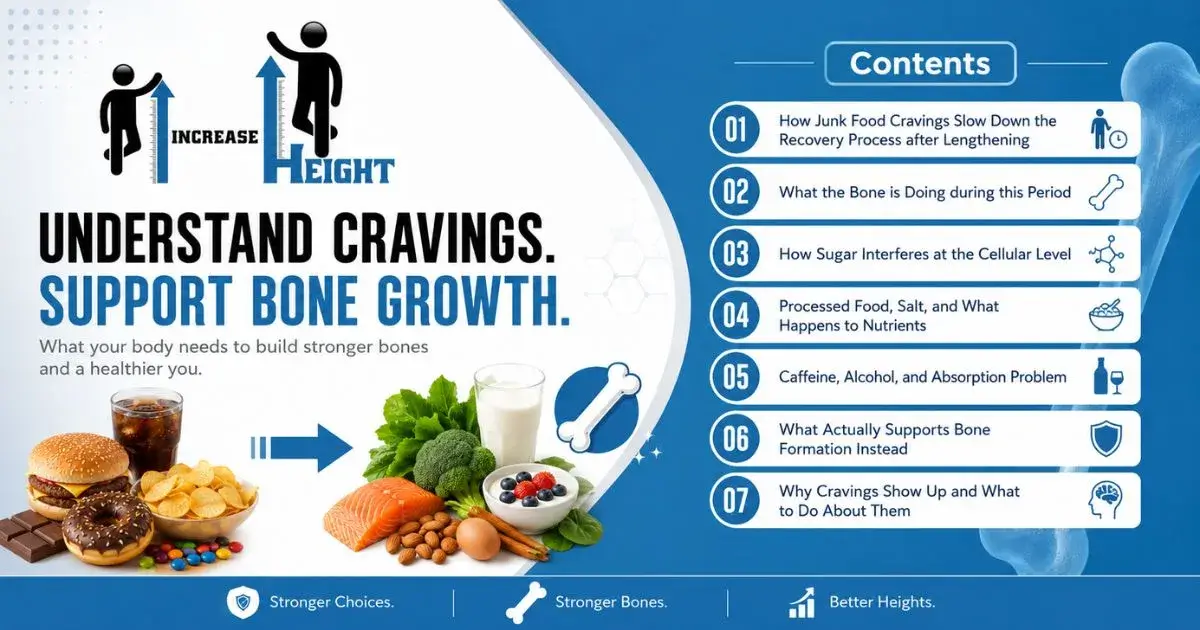
Contents
- The 20-Year Outlook: Does Lengthening Increase the Risk of Early Arthritis
- What the Bone is Doing during this Period
- How Sugar Interferes at the Cellular Level
- Processed Food, Salt, and What Happens to Nutrients
- Caffeine, Alcohol, and Absorption Problem
- What Actually Supports Bone Formation Instead
- Why Cravings Show Up and What to Do About Them
Leg-lengthening recovery runs for months. Not weeks. The distraction phase alone can stretch across two to three months, depending on how much length is being added, and consolidation, the phase where soft new bone hardens into something the body can actually load and walk on, takes just as long or longer. That's months of sitting still, getting frustrated, wanting something that actually tastes good instead of another bowl of spinach. Junk food isn't a mystery to most patients. They know it's not ideal. Few understand why it specifically slows bone formation, or how much it can actually set a recovery back.
What the Bone is Doing during this Period
After the corticotomy, the cut that starts the whole process, the body immediately begins trying to repair itself. The same response that kicks in after a fracture shows up here. Inflammatory cells rush in first, then a soft callus begins forming at the distraction gap, and eventually, if the conditions are right, that soft tissue mineralizes into dense, mature bone. Every single step of that sequence depends on raw materials from food. Take collagen, the protein that scaffolds new bone tissue. You can't build it without vitamin C and protein working together. Mineralization won't happen without calcium and vitamin D either. And zinc, magnesium? Easy to overlook, but they're behind cell regeneration, and somewhere around 300 enzyme reactions, the repair process leans on. Junk food doesn't just fail to provide these things. It actively competes with them.
How Sugar Interferes at the Cellular Level
High sugar intake does a few things that are directly
relevant to bone healing. It drives up inflammation,
which sounds counterintuitive since the early healing
phase involves inflammation anyway. But post-injury
inflammation is tightly regulated and has a purpose. The
kind of chronic low-grade inflammation that a high-sugar
diet triggers is different. It floods the system with
inflammatory signaling that can slow down the tissue
repair phase rather than support it.
There's also the calcium problem. Diets high in refined
sugar are associated with increased calcium loss through
urine, which matters because calcium is one of the
primary minerals the body is trying to deposit into the
distraction gap during consolidation. A 2019 study
examining the effects of high glucose on bone's
collagenous matrix found disrupted collagen fibril
architecture, including altered fibril diameter and
alignment, in bone tissue exposed to elevated glucose.
That's a structural problem, not a minor one.
This is part of why junk food and limb lengthening
surgery are a combination that surgeons discourage from
the first postoperative week. The issue isn't calories.
It's the specific interference at the cellular level,
where the bone is trying to do precise,
resource-intensive work and the diet is getting in the
way.
Processed Food, Salt, and What Happens to Nutrients
As with sugar, most junk food is high in sodium. When
eaten frequently, the body excretes more calcium. Over
weeks and months, this creates a slow calcium drain that
works directly against what the bone needs during
consolidation. Heavily processed foods also tend to be
full of phosphoric acid, particularly colas and
carbonated drinks, which can further disrupt the calcium
balance by pulling it away from bone tissue.
Understanding foods to avoid after limb lengthening
surgery isn't really about identifying a short
blacklist. It's about recognizing that most processed
foods are working against bone formation on multiple
fronts at once. Blood sugar spikes. Inflammation climbs.
Calcium gets pulled out through the kidneys. And in
return, the bone gets almost nothing it can actually
use.
The same logic applies to sugary drinks. Colas with
phosphoric acid, packaged fruit juices loaded with
refined sugar, and energy drinks with high caffeine
content are all on the list of foods to avoid after limb
lengthening surgery, and for different but overlapping
reasons. The phosphoric acid in carbonated drinks
disrupts the calcium balance. The sugar drives up
inflammation. The caffeine increases calcium excretion.
A patient drinking two or three of these a day during
consolidation is stacking those problems on top of each
other.
Caffeine, Alcohol, and Absorption Problem
But I also want to mention caffeine because patients
recovering from limb lengthening drink plenty of coffee
and energy drink to combat the fatigue associated with
months of immobility. Too much caffeine causes calcium
to be lost through urine, as high salt intake does. It's
not about cutting out coffee. But two or three coffees a
day during a period when calcium demand is already high
is worth reconsidering.
Alcohol is a more direct problem. Even moderate intakes
of it can cause vitamin D levels to decline, and vitamin
D is required to regulate calcium absorption in the gut.
Without adequate vitamin D, most dietary calcium is
wasted rather than absorbed. A small portion of wine is
known to cause osteoblastic cell death. These are the
cells that lay down new bone matrix in the distraction
gap. Slowing osteoblast function during the
consolidation phase is one of the clearest ways to
extend the timeline before the bone is ready for full
weight-bearing.
What Actually Supports Bone Formation Instead
Here's a better way to think about foods to avoid after
limb lengthening surgery: pair the list with what the
bone is actually asking for. Start with protein. Eggs,
lentils, paneer, chicken, fish, and any of these
supplies the amino acids needed to build collagen. Then
there's vitamin C, from citrus, guava, or tomatoes, and
without enough of it, collagen simply won't form the way
it's supposed to. Dairy, leafy greens and almonds bring
the calcium itself, the actual raw material going into
the bone. None of it moves anywhere useful without
vitamin D, though. That's what shuttles the calcium from
the gut into the bone, and a bit of sun or some fatty
fish covers it.
Nutrition during the bone regeneration process is not a
supplement strategy. It's a food strategy. Supplements
can fill gaps, but they don't replace a diet that's
consistently providing these nutrients across the full
recovery period.
Why Cravings Show Up and What to Do About Them
Think about what's actually happening. Movement is
limited for months. Sleep gets disrupted by discomfort.
There's the psychological weight of watching a recovery
move slowly. Put all of that together, and cravings for
junk food are almost inevitable. It's well known that
sedentary people eat more calories overall, not less.
Boredom and pain are both independently associated with
eating patterns that lean toward processed food. None of
this is a character flaw. It's a predictable response to
a difficult physical situation.
The issue is that the consequences of giving in to those
cravings compound over a long recovery. A few weeks of
poor eating during consolidation can translate into
slower mineralization, a longer consolidation period,
and more time before the treating surgeon is satisfied
with the x-ray. Patients sometimes attribute a slow
consolidation to something the surgeon did or didn't do,
when the diet over the previous two months was quietly
working against the process.
What foods to avoid after limb lengthening surgery comes
in handy most during consolidation, when the soft bone
that is now growing in the space has to harden. It pays
to have some snacks with protein in them, keep sugar out
of the house during recovery, and drink plenty of water
in between physiotherapy and active training sessions.
The connection between junk food and limb lengthening
surgery outcomes is real, and it operates quietly.
There's no dramatic symptom when someone eats a bag of
chips. But the bone notices, at the cellular level, over
months. That's the timeline that matters here. Every
recovery journey is unique. If you need personalized
advice, have concerns, or want to learn more about
optimizing your healing, contact our team today. We're
committed to helping you recover with confidence and
care.