
Contents
- What is High Tibial Osteotomy?
- How HTO is a Type of Osteotomy Surgery
- When is High Tibial Osteotomy Recommended?
- High Tibial Osteotomy Procedure Overview
- Benefits of High Tibial Osteotomy
- Risks and Complications of HTO
- Recovery After High Tibial Osteotomy
- Is High Tibial Osteotomy Used for Height Increase?
- Conclusion
When dealing with knee pain on a constant basis, doing the most basic things would appear to be totally out of reach. In case walking up some stairs or strolling in your neighborhood is a challenge for you each day, you should definitely go see a doctor because that indicates the problem has reached a level at which treatment is necessary. It is a misconception to think that the only thing you could do in this case was getting a knee surgery.
This is where a High Tibial Osteotomy comes into the picture. It is a powerful joint preservation surgery designed to relieve pain, correct structural issues, and keep your natural knee intact for as long as possible.
What is High Tibial Osteotomy?
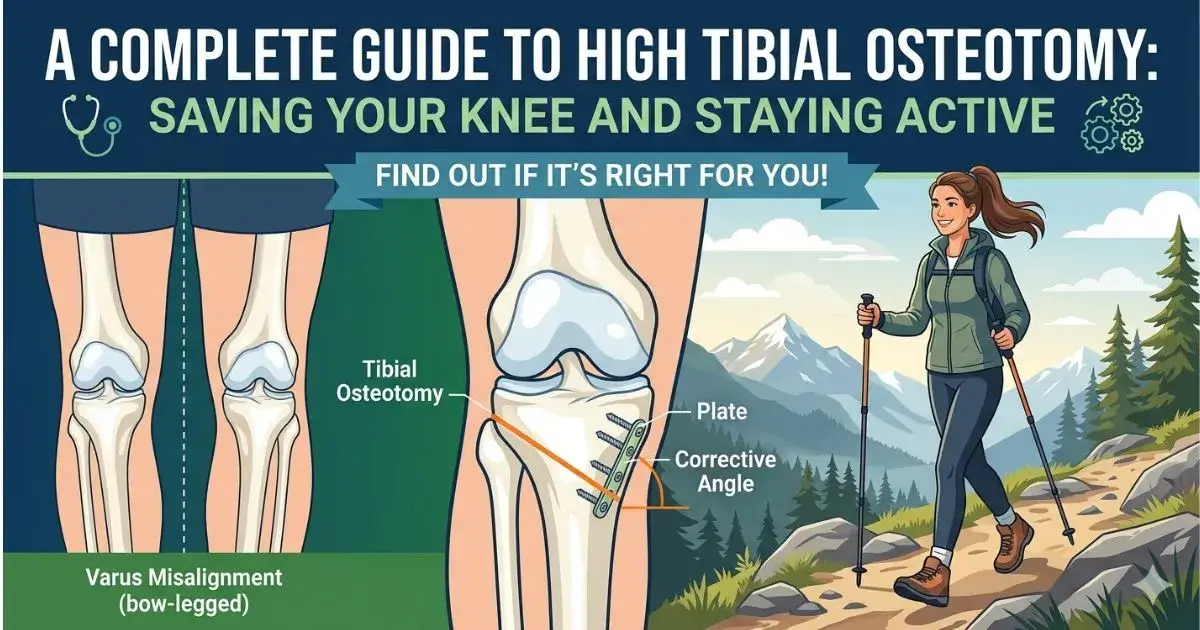
Let us break down what High Tibial Osteotomy actually means in simple terms. Simply put, it is a surgical procedure that reshapes the shinbone just below the knee joint.
The soft pad inside your knee keeps your joint safe. It wears thin from old sports injuries or the stress of daily life. Your family history also plays a big role in how it lasts. Once the padding is gone, your bones will grind against each other. This creates intense, burning pain and often leads to a visible bow legged appearance.
A High Tibial Osteotomy aims to fix this uneven wear and tear. During the procedure, the surgeon carefully cuts and realigns the shinbone. This physical realignment shifts your body weight away from the damaged, painful tissue and forces it to rest on the healthy cartilage on the outside of your knee.
It's like fixing the wheel alignment on your car. When tires are out of line, one side wears down fast. This makes every single drive feel very shaky and rough. Getting things back in line makes the trip feel smooth. It helps the parts last for a much longer time.
How HTO is a Type of Osteotomy Surgery
The term osteotomy is a broad medical word used across many different specialties. It comes from ancient Greek origins where "osteo" means bone and "tomy" translates to the act of cutting. Therefore, any surgery where a doctor deliberately cuts and reshapes a bone is considered an osteotomy.
A High Tibial Osteotomy is simply a highly specific version of this procedure. This surgery works on the top part of your shin bone. That is the large bone in your lower leg. Other bone cuts fix the hip, jaw, or upper thigh. This one is different. It changes how your leg lines up to protect the knee joint.
When is High Tibial Osteotomy Recommended?
Orthopedic doctors do not recommend this surgery for every patient complaining of knee pain. It is a highly specialized procedure meant for a very specific type of individual.
Most people who get a High Tibial Osteotomy are under sixty years old. They lead busy lives and stay on the go every single day. If you run or play sports like basketball, this surgery works well. It also helps people with tough jobs, like those in building or on farms. You can keep your busy habits and your own knee joint. Choosing this path helps you get back to the work and play you love.
It is also an absolute requirement that the arthritis damage is limited to just one side of the knee. If the arthritic disease has spread completely across the entire joint, shifting your body weight will not solve the problem. In those widespread cases, a partial or total knee replacement is usually necessary. Good candidates must also be non smokers with a strong mental commitment to handling the rigorous physical therapy required during the long recovery phase.
High Tibial Osteotomy Procedure Overview
Understanding exactly what happens inside the operating room can relieve a lot of pre surgery anxiety and fear. While your surgeon will customize the operation to your exact body, the standard process is very straightforward.
On the day of your High Tibial Osteotomy, you will receive anesthesia from a specialized doctor so you will not feel any pain or remember the procedure. Once you are asleep or completely numb, the surgeon begins by making a precise incision on the front or the side of your lower knee area.
There are two primary techniques used to realign the bone. The most common method today is called the opening wedge technique. Here, the surgeon makes a single clean cut completely across the tibia bone and literally opens a small gap or wedge to straighten the leg. They often fill this newly created gap with a specialized bone graft. This graft acts like a bridge to help your body generate new bone tissue faster.
The other method is known as a closing wedge technique. In this version, the surgeon removes a tiny piece of bone to correct the awkward angle and brings the two remaining edges closely together.
After the doctor gets the bone aligned either way, they must hold it steady. These metal plates and screws made of titanium hold the parts in place. After that, the doctor sews or staples up the wound. Then he applies an antiseptic dressing over it to protect it from any kind of contamination.
Benefits of High Tibial Osteotomy
The benefits of choosing a High Tibial Osteotomy are significant, especially for younger adults who refuse to slow down. The most immediate and life changing benefit is a massive reduction in daily joint pain. By fixing the structural balance of your leg, the painful bone on bone friction is stopped entirely.
Another major advantage is that you get to keep your own native knee joint. Modern knee replacements use metal and plastic parts. These materials wear down after a few years. You often face lifelong rules against running and jumping. This surgery keeps your natural body intact. It lets you return to heavy lifting and hard sports. You can move fast without the constant fear of a fake joint breaking.
Lastly, it successfully delays the need for a total knee replacement by ten to fifteen years. This allows you to live your most active decades without limitations.
Risks and Complications of HTO
Every big surgery has some risks. It is just part of the process. Knowing what to watch for helps you and your team stay alert. You can catch problems early while you heal.
The most common complications include bacterial infections around the surgical wound or deep inside near the metal hardware. Patients also face a risk of developing dangerous blood clots in their legs due to staying in bed and lacking mobility during the early recovery days.
Because the main leg bone is physically cut in half, there is always a small chance of a condition called delayed union or non union. Sometimes a bone takes a long time to heal. It might even fail to join back together at all. You could also feel some numbness near your surgical scar. This happens when a small nerve gets hurt during surgery. The feeling may go away or stay for a long time. Follow your doctor's plan to stay safe and avoid these risks.
Recovery After High Tibial Osteotomy
You need to know right away that recovering from a High Tibial Osteotomy requires immense patience and hard work. You cannot rush the biological healing of a major bone.
You will stay in the hospital for a night or two. Nurses will check your vital signs and help with your pain. Once you leave, use crutches or a walker for at least six to eight weeks. You must not put any weight on your leg during this time. Resting gives the bone time to fuse and grow back strong.
But rest is not lying absolutely still for the entire day. Soon after you wake up from the surgery, physical therapy starts right away. You will be asked to perform simple movements to ensure that the movement of the knee joint is maintained and scar tissue does not form in it. You cannot skip these daily exercise routines. Pushing through the initial discomfort of physical therapy is the absolute only way to regain your full range of motion.
It generally takes a full six months to an entire year before you feel completely back to normal and have the green light to return to heavy competitive sports.
Is High Tibial Osteotomy Used for Height Increase?
Because this specific surgery involves cutting the leg bone and creating physical space, many people naturally wonder if a High Tibial Osteotomy is used to make a person taller.
While the opening wedge technique does technically add a tiny fraction of length to the shinbone to correct the angle, it is absolutely not designed or performed for cosmetic height enhancement. Its singular purpose is to fix knee alignment, save the joint, and treat painful arthritis.
As far as modern limb lengthening goes, the science behind cutting a bone and letting it heal in a new stretched position is the exact same science behind modern limb lengthening. If you want to permanently grow taller, orthopedic surgeons use a different type of procedure wherein they insert either internal magnetic nails or external circular frames that are used to slowly pull the cut bone apart, millimeter by millimeter, over several months. This steady tension encourages the body to grow entirely new bone tissue, resulting in a significant and permanent increase in overall human stature.
Conclusion
A knee injury can be an overwhelming pain. Modern medicine has created many wonderful and effective treatments that can help keep you moving. By realigning your leg and preserving the healthy cartilage, a High Tibial Osteotomy can give you the opportunity to get back into your active routine without having to sacrifice your natural joint for artificial devices.
It certainly requires a serious mental and physical commitment to rehabilitation, but the long term payoff of living pain free is truly life changing. If you are also interested in learning how similar surgical principles are safely used for cosmetic growth, you can read more about using osteotomy for height increase to deeply understand the full scope of what bone surgery can achieve today.