
Contents
- Where the Discrepancy Actually Comes from Matters Enormously
- Severity Shapes the Entire Treatment Path
- Growing Children Require an Entirely Different Calculation
- Epiphysiodesis is a Simpler Option in Some Pediatric Cases
- When Lengthening Becomes the Right Call
- Deformity Often Travels Alongside the Length Difference
- What a Full Correction Actually Involves
- Muscle and Gait Patterns Need Real Attention Too
- What Patients Should Genuinely Expect Going In
- Bringing it Together
Not every patient walking into a limb lengthening consultation wants more height on both sides equally. A meaningful number arrive with one leg already shorter than the other, sometimes by a little, sometimes by a lot, and they're looking for a way to walk, stand, and move without compensating for a mismatch their body has carried for years.
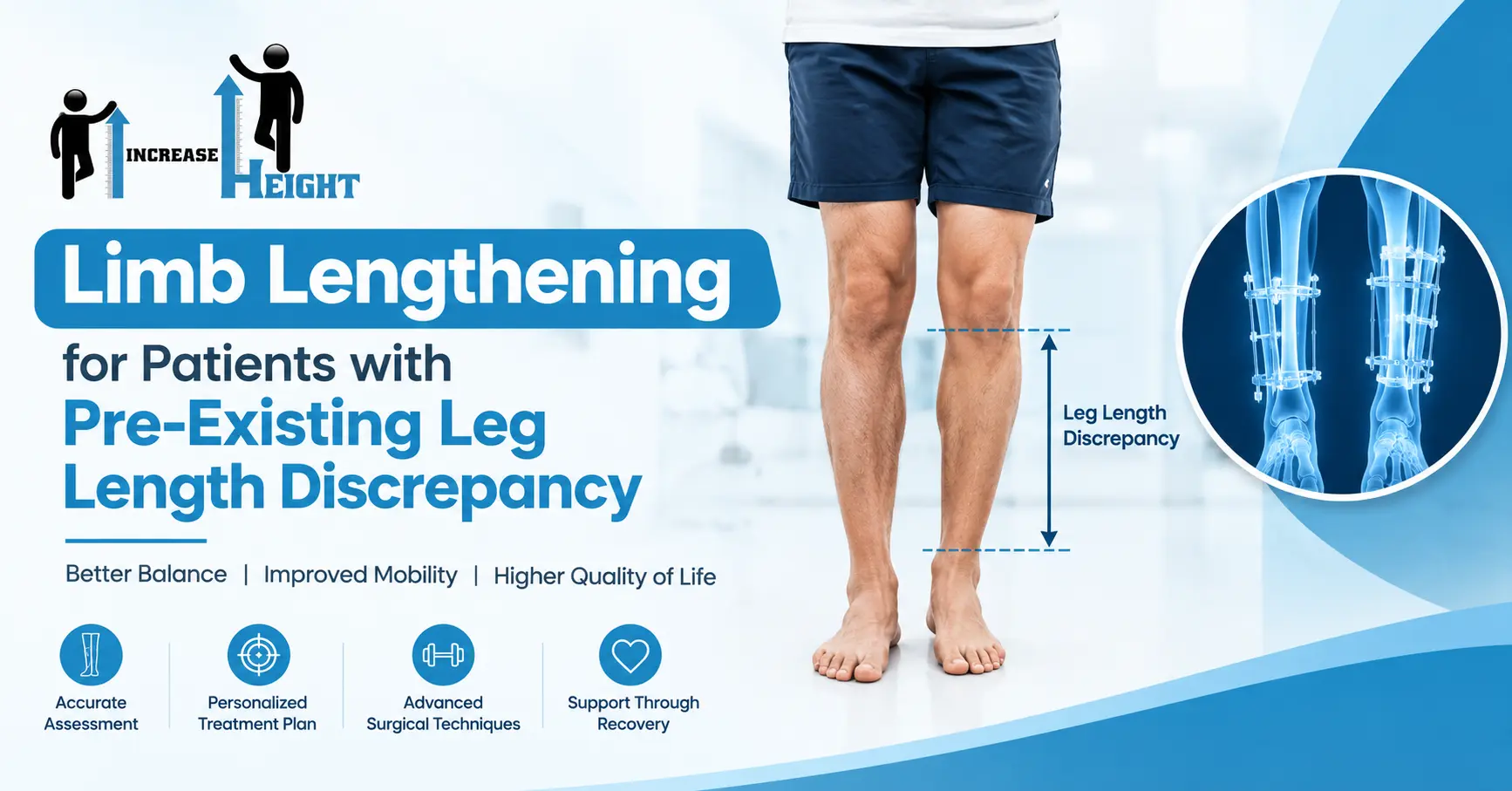
Leg lengthening surgery for leg length discrepancy is a genuinely different conversation from cosmetic bilateral lengthening, and it comes with its own set of questions that need answering before anyone touches a bone. Patients researching this option online often find that generic lengthening content doesn't quite address their situation, since so much of it assumes both legs start off structurally identical.
Where the Discrepancy Actually Comes from Matters Enormously
Before any leg length inequality treatment gets mapped out, figuring out the underlying cause has to come first. Some of these cases start at birth, a congenital limb defect like fibular hemimelia, or a femur that just never matched growth speed with the other leg. Others show up down the line instead. A fracture in childhood that damaged a growth plate, an infection in the bone, or a neurological condition that disrupts muscle balance. Sometimes even a prior surgery that only partly fixed what it was meant to fix. Cases that trace back to birth usually come with more baggage than length alone, joint instability in some, missing ligaments in others, which is why the treatment conversation looks so different from one that developed years after birth.
Severity Shapes the Entire Treatment Path
Not every leg length discrepancy needs surgery, and it's worth saying that plainly upfront. Small differences, generally under two centimeters, are frequently managed with a shoe lift or orthotic insert, since committing to leg lengthening surgery for leg length discrepancy this minor often isn't worth the risk involved. Moderate differences start to change that calculation, and once a discrepancy crosses into a range that noticeably affects gait, posture, or long-term joint health, leg lengthening surgery for leg length discrepancy becomes a genuinely reasonable option worth discussing seriously with a specialist. Severe discrepancies, several centimeters or more, usually require surgical correction because non-surgical options simply can't compensate for that much of a gap without creating their own problems in the back, hips, and knees.
Growing Children Require an Entirely Different Calculation
With pediatric patients, timing matters just as much as the actual treatment chosen. Growth plates are still open in a child, so a discrepancy that seems manageable right now can grow considerably by the time growth actually stops, especially if whatever's causing it keeps progressing rather than staying fixed. Surgeons rely on growth remaining charts, paired with repeated imaging over time, to estimate how much wider the gap is likely to get, and leg length inequality treatment gets planned around that projection rather than a single snapshot measurement. Sometimes that means a staged plan, handling part of the correction now and scheduling a second procedure closer to skeletal maturity instead of trying to fix everything in one go.
Epiphysiodesis is a Simpler Option in Some Pediatric Cases
For children with a moderate, well-predicted discrepancy and enough remaining growth in the longer leg, a procedure called epiphysiodesis is sometimes used instead of lengthening the shorter side. This involves selectively slowing growth at the longer leg's growth plate, allowing the shorter leg to gradually catch up as the child continues growing. It's a much smaller procedure than a full lengthening surgery, but it only works within a fairly specific window of remaining growth and discrepancy size, which is why accurate growth prediction matters so much in these cases.
When Lengthening Becomes the Right Call
For larger discrepancies, discrepancies detected too late for epiphysiodesis to work, or cases in adults who've stopped growing entirely, limb lengthening surgery for leg length discrepancy becomes the primary path forward. The same distraction osteogenesis principles used in cosmetic cases apply here: a precisely controlled bone cut followed by slow separation using either an internal nail or an external frame, giving new bone weeks and months to gradually fill the widening gap. For adults dealing with more moderate discrepancies, shortening the longer leg sometimes gets chosen instead, mainly because it skips the drawn-out consolidation period lengthening requires, even though it costs a bit of height on the leg that was never the problem to begin with.
Deformity Often Travels Alongside the Length Difference
Rarely does a leg length discrepancy show up completely on its own, particularly when a birth-related structural issue or a serious childhood injury is behind it. Angular and rotational deformities, joint alignment troubles, all of these tend to tag along with the length gap, meaning the fix usually has to go beyond simply matching one leg to the other. That's exactly the point where leg length inequality treatment starts overlapping heavily with deformity correction work more broadly, sometimes calling for a hexapod frame that can adjust length, angle, and rotation all together rather than a simpler device meant only for straightforward lengthening.
What a Full Correction Actually Involves
When a discrepancy is significant and genuinely complex, a full limb length equalization procedure usually pulls several treatment elements together into one coordinated plan rather than tackling them separately. That can mean correcting an angular deformity at the same time length is being added, working out joint contractures built up from years of compensating for the shorter leg, and layering in an extended physiotherapy program built specifically around the muscle imbalances that develop after years of one leg being shorter than the other. These cases genuinely require more planning than a straightforward cosmetic case, and patients benefit from working with a surgical team specifically experienced in this kind of combined correction work.
Muscle and Gait Patterns Need Real Attention Too
Spend years walking on a leg that's shorter than the other, and the body picks up habits that stick around long after the reason for them is gone: a tilted pelvis, hip mechanics that never quite reset, occasionally even a spine that develops its own curve to compensate. None of that resolves itself just because the bone length gets corrected. Physical therapy after leg lengthening surgery for leg length discrepancy needs to specifically address gait retraining, not just general strengthening, since old compensatory habits can persist out of muscle memory even after the actual mechanical problem has been resolved.
What Patients Should Genuinely Expect Going In
When leg length inequality treatment is well managed from the start, outcomes tend to be genuinely strong, especially once the underlying cause has been properly diagnosed and any related deformity has been addressed alongside the length gap itself. That said, patients dealing with congenital conditions or discrepancies they've had for years often need more patience than someone going through a straightforward cosmetic case, partly because the correction itself runs more complex and partly because there's simply more compensatory habit to unlearn. Setting realistic expectations clearly during the planning stage, rather than stumbling onto them mid-treatment, tends to make the whole experience go more smoothly.
Bringing it Together
There's no single fix for leg length discrepancy, because it's not a single problem to begin with. It spans everything from a minor gap solved with a simple insole to a genuinely complex correction involving surgery, deformity management, and months of dedicated physiotherapy. Anyone weighing this decision benefits from a thorough look at what's actually causing the discrepancy, an honest read on how severe it really is, and a plan built around their specific case rather than something borrowed wholesale from cosmetic lengthening protocols. In situations where leg lengthening surgery for leg length discrepancy turns out to be the right move, walking in with accurate expectations and a genuinely experienced limb lengthening team makes the whole process considerably more manageable. Get that foundation right early on, and everything downstream becomes a lot easier to handle.
Schedule a consultation with the Height Increase Info team to discuss your leg discrepancy and how we can assist you with your orthopedic journey.