
Contents
- 1. Introduction to Lower Femoral Osteotomy (Knee Realignment Surgery)
- 2. What is Lower Femoral Osteotomy (Distal Femoral Osteotomy DFO)?
- 3. When is Lower Femoral Osteotomy Recommended?
- 4. Types of Lower Femoral Osteotomy Procedures
- 5. Pre-Surgical Planning for Knee Alignment Correction
- 6. Lower Femoral Osteotomy Surgery Procedure Explained
- 7. Benefits of Distal Femoral Osteotomy for Knee Pain Relief
- 8. Risks and Complications of Femoral Osteotomy Surgery
- 9. Recovery After Lower Femoral Osteotomy Surgery
- 10. Success Rate of Lower Femoral Osteotomy Surgery
- 11. Lower Femoral Osteotomy vs High Tibial Osteotomy (HTO)
- 12. Who is the Ideal Candidate for Knee Realignment Surgery?
- 13. Cost of Lower Femoral Osteotomy in India
- 14. Lower Femoral Osteotomy vs Knee Replacement Surgery
- 15. Conclusion
- 16. FAQs on Lower Femoral Osteotomy (DFO Surgery)
Bad knee pain really changes the way you live your life. Does a simple walk in the park feel like too much work? Even climbing a few steps at home starts to cause a sharp sting. Many folks think they need a big surgery to feel better. Just thinking about a new joint is enough to scare anyone. You still have plenty of life left to live.
Doctors can help you save your knee with a Lower Femoral Osteotomy. This surgery is a great choice for active people. It lets you keep your own joint. You will find real relief from your pain. The surgeon fixes how your leg bones line up. This stops the damage from getting worse. You can get back to the hobbies and sports you love.
1. Introduction to Lower Femoral Osteotomy (Knee Realignment Surgery)
A lower femoral osteotomy shifts your leg bones to fix your body's alignment. Think of your leg like a car with wheels that tilt the wrong way. The tires wear down on one side much too fast. A mechanic does not toss a good tire out when this happens. They adjust the frame so the wheels sit flat and run true to the road. This surgery does the same thing for your knee joint to stop the ache. It straightens your leg to save the joint and keep you walking. They adjust the alignment so the tire strikes the road evenly. Knee realignment surgery applies this exact same logic to your body. By shifting the mechanical weight of your leg, the surgeon rescues the damaged side of your knee and allows the joint to function smoothly once again.
2. What is Lower Femoral Osteotomy (Distal Femoral Osteotomy DFO)?
You can look at the medical name to see what this surgery does. A doctor uses the word distal to point to the lower part of a bone. Your femur is simply the heavy bone found inside your thigh. An osteotomy means a doctor cuts a bone to change its shape. During a DFO, a surgeon reshapes the thigh bone right above the knee.
The main goal of this surgery is a complete redistribution of your body weight. If the protective cartilage on the outer side of your knee is worn away, your bare bones will begin to rub together. This creates intense, burning pain. By reshaping the thigh bone, the surgeon shifts the mechanical weight of your body away from the damaged outer area and places it directly onto the healthy cartilage on the inside of your knee.
3. When is Lower Femoral Osteotomy Recommended?
Orthopedic doctors do not recommend this surgery for every type of knee pain. It is a highly specific tool designed to treat conditions where the leg is visibly or mechanically out of alignment.
Valgus Knee Deformity (Knock Knees Treatment)
Knock knees happen when your knees touch but your ankles stay apart. This leg shape puts a lot of stress on the outside of the joint. Constant weight causes pain and wears the knee down. A DFO surgery fixes the bone to make the leg straight. This change moves the heavy weight to the healthy side. It gives the damaged part a chance to heal.
Lateral Compartment Knee Osteoarthritis
Osteoarthritis slowly tears down the smooth cartilage that protects your bones. If the damage is only on the lateral side of your knee, you may benefit from an osteotomy. The good cartilage on the inner side of your knee is still healthy so the surgeon may just shift the weight over to the new cartilage.
Post-Traumatic Knee Malalignment
Sometimes, a severe bone fracture in the thigh heals at a slightly incorrect angle. Over time, this poor alignment forces the knee joint to bear weight unevenly. Surgeons use a DFO to correct the angle and restore proper joint mechanics after a major traumatic injury.
4. Types of Lower Femoral Osteotomy Procedures
Distal Femoral Osteotomy (DFO)
This is the overarching term for the procedure, but the exact surgical technique depends entirely on the patient's specific bone density, the severity of the angle, and the surgeon's personal preference.
Opening Wedge vs Closing Wedge Osteotomy
Surgeons use two main ways to fix leg bone alignment. In an opening wedge surgery, the doctor cuts the bone to create a gap. They fill this space with a bone graft to help it heal fast. A closing wedge surgery involves removing a tiny piece of the bone. The surgeon pulls the bone sides back together to straighten the leg. Both surgery types are safe and work well for many people.
5. Pre-Surgical Planning for Knee Alignment Correction
Careful preparation is a critical part of a successful knee realignment. Long before you enter the operating room, your medical team will take full length standing X-rays of your legs. This allows them to measure your exact mechanical axis. You can then calculate precisely the angles needed to correct your alignment to the millimeter. With modern 3D images and computer modeling, the surgeon can custom-create a surgical plan for you. This technology allows them to calculate precisely how much bone to adjust.
6. Lower Femoral Osteotomy Surgery Procedure Explained
Doctors give you medicine to help you sleep through the whole visit. You will stay resting and will not feel any pain while the doctor works. The surgeon starts by making a small, clean cut on the side of your lower thigh. They use steady tools and guides to follow the plan. Then, the doctor makes the exact cut in your leg bone.
After the bone is opened or closed to a new angle, the surgeon will secure it to heal. The surgeon uses strong titanium plates and medical screws to secure the bone in position. He or she will then close the skin incision with stitches or medical staples and apply a sterile bandage. This procedure can take between one and two hours.
7. Benefits of Distal Femoral Osteotomy for Knee Pain Relief
The absolute biggest advantage of a DFO is that it preserves your own natural anatomy. Because you get to keep your native knee joint, you do not face the permanent physical restrictions that always come with a metal and plastic knee replacement. This means you can eventually return to running, heavy lifting, and demanding physical careers. It provides massive daily pain relief and typically delays the need for a total joint replacement by a full ten to fifteen years.
8. Risks and Complications of Femoral Osteotomy Surgery
Every surgical operation carries a set of risks. The most common concerns include bacterial infections at the incision site or deep around the titanium hardware. There is also a risk of dangerous blood clots forming in the leg due to resting in bed during the early recovery days.
Specific to bone surgery, there is a small chance of delayed healing or a non-union. This happens when the cut bone simply fails to fuse back together properly. Some patients might also experience minor nerve irritation or temporary stiffness in the knee joint. Following your doctor's instructions closely will greatly minimize these risks.
9. Recovery After Lower Femoral Osteotomy Surgery
Rehabilitation Timeline
You will likely stay in the hospital recovery wing for one to three days. The initial bone healing phase takes about six to eight weeks. However, building back your muscle and achieving a full recovery often takes six to twelve entire months before you feel completely normal and strong again.
Weight-Bearing Guidelines
For the first six weeks, you will need to rely on crutches or a medical walker. Your doctor will explicitly restrict you from putting your full body weight on the operated leg to ensure the freshly cut bone heals without shifting out of place.
Physiotherapy for Knee Recovery
Physical therapy is not optional. You will start gentle knee movements almost immediately after waking up from surgery to prevent severe joint stiffness. Once the bone shows signs of solid healing on a follow up X-ray, your physiotherapist will guide you through intense strength training exercises to rebuild your thigh muscles and restore your full physical range of motion.
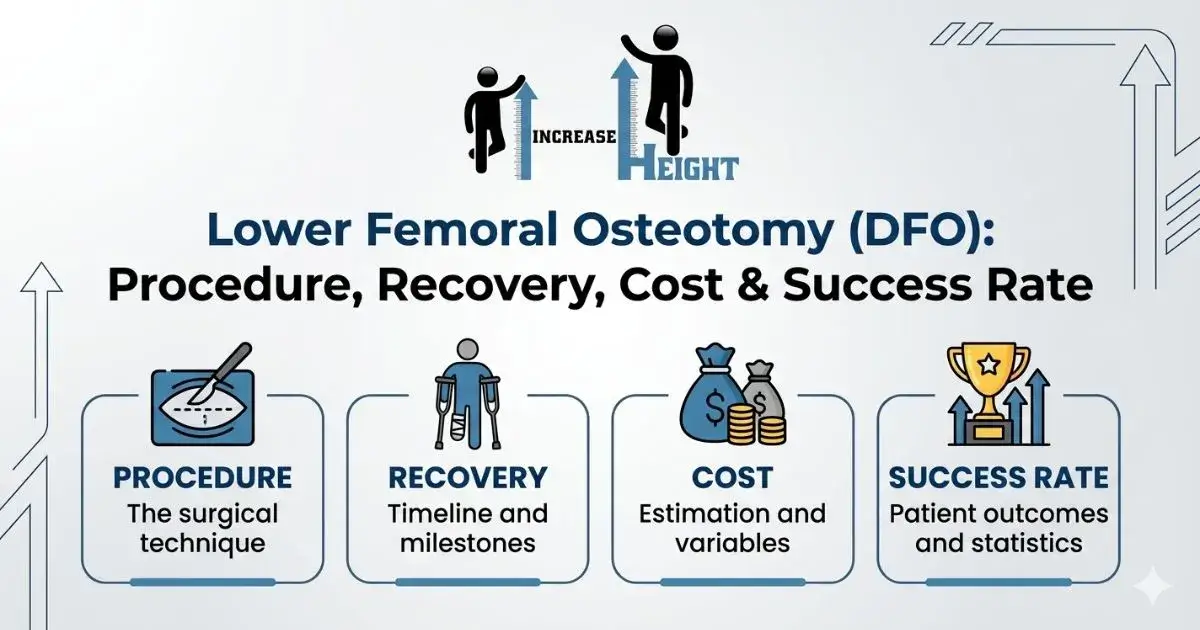
10. Success Rate of Lower Femoral Osteotomy Surgery
The success rate for this surgery is extremely high. Up to eighty five percent of patients who undergo this procedure report lasting relief from pain and improved joint function. This surgery is a great option for treating valgus deformities and for giving young patients a pain free decade before considering replacing their joints artificially.
11. Lower Femoral Osteotomy vs High Tibial Osteotomy (HTO)
Both work on realigning the leg but they target completely different bones and solve entirely different problems. The Lower Femoral Osteotomy focuses on the heavy bone of the thigh and is used to fix knock knees where weight is shifted to the outside of the knee.
A High Tibial Osteotomy targets the shin bone just below the knee. It is primarily used to fix bow legs, shifting weight away from the inner side of the knee. Your specific cartilage wear pattern and bone structure will dictate which surgery is right for you.
12. Who is the Ideal Candidate for Knee Realignment Surgery?
The perfect candidate is usually a highly active adult under the age of sixty. They must have arthritis isolated to just one side of the knee joint, while the rest of the cartilage remains healthy and intact. Good candidates must also possess a strong mental commitment to physical therapy and must stop smoking completely, as nicotine severely chokes off the blood supply needed for bone healing.
13. Cost of Lower Femoral Osteotomy in India
India is a top choice for people needing bone surgery. Skilled doctors and low costs make it a smart pick. While costs for a DFO surgery range from 1,50,000 to 3,50,000, final bills vary. The city you choose and your time in the hospital matter. Imported metal plates and screws cost more than local ones. You will get expert care for a very low price. The cost of a DFO in India is significantly lower than out-of-pocket expenses in Western healthcare systems.
14. Lower Femoral Osteotomy vs Knee Replacement Surgery
The primary difference between these two paths lies in joint preservation versus total joint replacement. A DFO actively preserves your natural joint by altering the bone structure around it. A total knee replacement physically removes your diseased joint entirely and inserts an artificial implant.
Joint replacements provide excellent and immediate pain relief but are usually reserved for older patients with widespread arthritis. This is because artificial joints have a limited lifespan and can wear out or loosen from high impact activities. A DFO is strictly for younger, active patients who want to keep running, jumping, and playing sports.
15. Conclusion
Knee pain does not have to end your active days. You do not have to rush into a total joint replacement. A lower femoral osteotomy fixes how your leg bones line up to stop pain. This surgery shifts your weight to protect the joint you were born with. The recovery process takes many months of hard work and very steady focus. If you stick to the plan, you can move freely and feel great. Living without that constant ache is a goal you can finally reach.
16. FAQs on Lower Femoral Osteotomy (DFO Surgery)
Is the surgery painful?
You will definitely experience some pain directly after the operation, but your medical team will provide strong pain medication to keep you comfortable. As the bone begins to knit together over the first few weeks, the surgical pain decreases rapidly, and you will soon notice that your original arthritis pain is completely gone.
How long do the titanium plates stay in my leg?
You will likely feel sore right after your surgery. Your care team will give you strong meds so you stay at ease. The sharp pain fades fast as the bone heals during the first month. Soon, you will find that your old joint pain is gone.
Can I play sports after a DFO?
Absolutely. Keeping your real knee joint means you can stay active. Healing and rehab take nine to twelve months. Your doctor will track your progress. Once you get the okay, you can return to high impact sports. Enjoy tennis, skiing, or running again.
Also Read: