
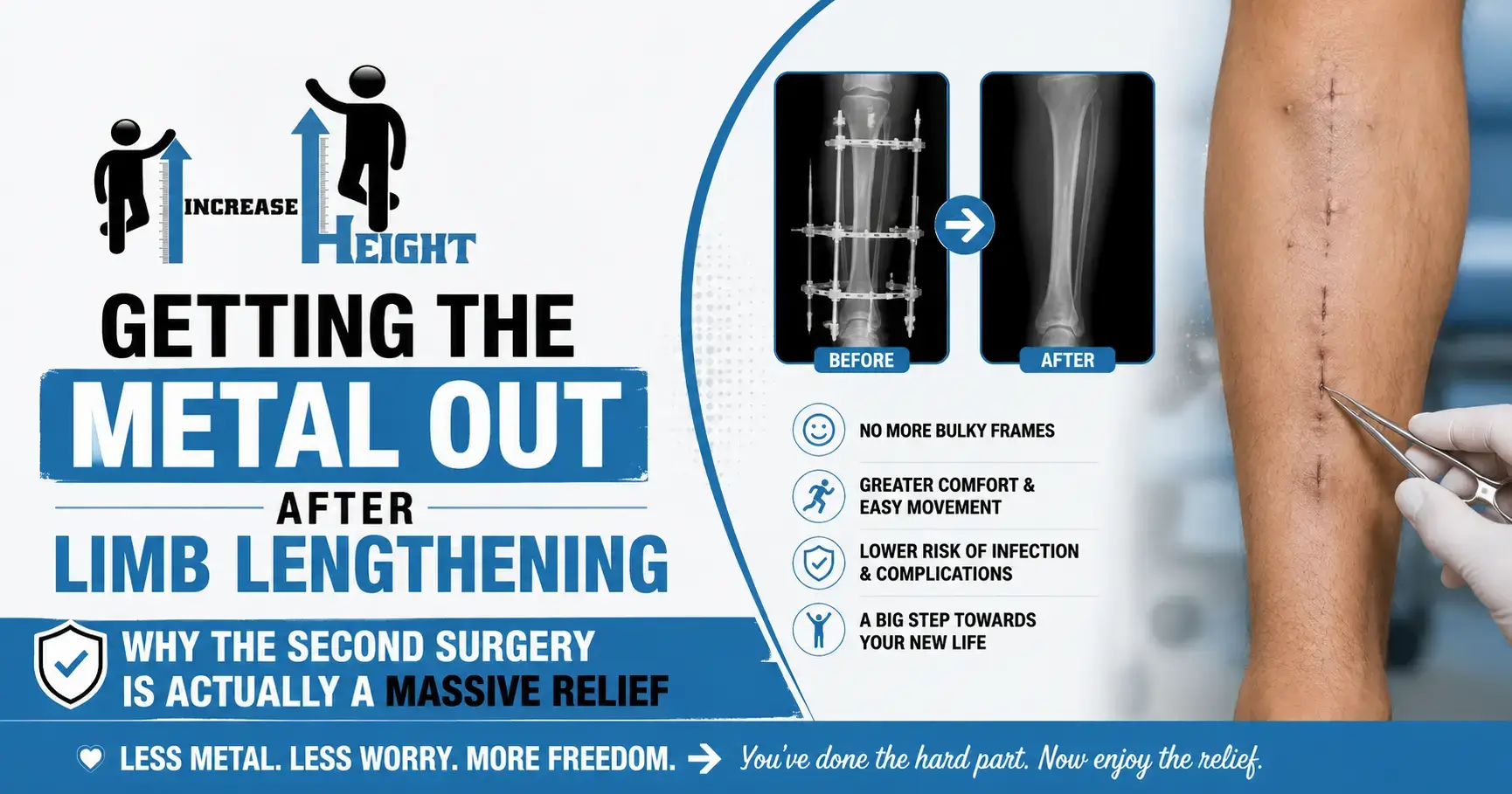
You spent months stretching your bones. You hit milestones, managed intense pain, and stayed patient while your body adapted to a new structure. Now, you stand at the finish line. Many patients view the second surgery - getting the metal out after limb lengthening - as another scary hospital visit. It is not. Instead, it is the final step of the reconstruction process.
You had an implant like PRECICE, FITBONE, or intramedullary nails to hold your bone together internally as you grew. Now that your bone has grown in, the rods, nails, and screws have been removed. While the procedure itself may be a little complicated, the physical and mental relief of nail removal after limb lengthening surgery outweighs its short recovery time.
The Necessity of Hardware Removal: Beyond Cosmetic Concerns
Getting the metal out is not just about cleaning up the site or fixing a minor cosmetic concern. It is a medical requirement. You cannot leave internal fixation devices in your body forever.
Why Internal Fixation Devices Cannot Remain Indefinitely
When you have a metal rod inside your bone, that rod bears much of the weight and stress that your natural bone usually handles. This phenomenon is called stress shielding. If the metal takes the stress, the bone stops working as hard to maintain its density. Bone density drops over time when it's not doing its own load-bearing work.
Leaving hardware in for too long also invites complications. Metal can eventually loosen as the body tries to encapsulate the foreign object. Infection risk stays low, but it climbs the longer hardware sits in the body. And if bone starts growing over the screw heads, the surgeon ends up doing significantly more work during removal just to find them.
Timing the Second Surgery: When Is It Safe to Remove the Metal?
Surgeons generally wait until they see total bone consolidation. This means the bone has filled in completely where the distraction occurred. The gap you created to gain length must be solid cortical bone.
For most people, it's somewhere between one and two years after the initial surgery. But that range shifts depending on a few things. Femur cases often consolidate differently than tibia. Your bone density plays a role. So does how consistent you were with physical therapy during the consolidation phase.
Your surgeon confirms readiness with X-rays, and sometimes a CT scan if there's any question. Don't push to undergo nail removal after limb lengthening surgery prematurely. Rush it and the bone can crack under its own load once the rod is gone. Not worth the risk.
Understanding Hardware Types: Different Implants, Different Removal Procedures
The complexity of removal depends on what hardware is inside you. Most modern limb lengthening uses internal intramedullary nails. These nails sit inside the marrow canal of the bone. Removal is fairly routine, but it requires the surgeon to locate and remove the locking screws first.
External fixators, if used, are typically removed much earlier than internal nails. External pins can cause skin irritation and scarring, so removal of these usually provides immediate relief from skin irritation. Internal nails do not cause skin issues, but they can still feel uncomfortable when cold weather hits.
Preparing for the Hardware Removal Procedure
Coming into this surgery feels different. You're not fragile anymore. You've been walking, moving, living your life. The whole mindset has shifted.
Pre-Operative Assessments and Imaging
Your surgical team will need updated imaging. Plain X-rays often work fine. But bone can grow over the screw heads and hide them. If that happens, you probably need a CT scan. It shows the surgeon exactly where the metal sits so they do not have to spend time hunting for it or cutting through extra tissue. That saves time. A clear map makes the job easier for all.
You should also list any symptoms you have felt. Do you have clicking in your leg? Is there a spot that hurts when the weather changes? Tell your team. These details help the surgeon understand what they might face during the procedure.
Managing Expectations: The Day-of Experience
The removal surgery is usually shorter and less invasive than the lengthening surgery. You will likely be under anesthesia, but the operating time is significantly reduced.
- Fast as instructed to ensure anesthesia safety.
- Bring a list of all your current medications.
- Prepare for a brief hospital stay, often just a day or two.
- Expect to be mobile much sooner than you were after the first procedure.
Psychological Readiness: Shifting Focus from Growth to Recovery
The first surgery was a big deal. Anxiety, hope, a lot of unknowns. By the time the second one comes around, most of that has settled. But some people still feel unexpectedly nervous going back in.
You've had this hardware in your body for over a year. That's not nothing. Preparing for nail removal after limb lengthening surgery isn't about growing anymore though. It's just the cleanup. Getting back to baseline.
The Surgical Process: What Happens During Removal
The goal is straightforward: get the hardware out without stirring up more than necessary.
Anesthesia Protocols and Surgical Technique
The anesthesia administered will be similar to that received during your first procedure, although a lighter dose may be used since the surgery is of shorter duration. The surgeon will make small incisions where the locking screws were originally placed. These incisions will then be used to remove the locking screws.
Once the screws have been removed, the surgeon will then proceed to remove the nail itself from the nail channel. This requires precision, but it is a routine process for any experienced orthopedic surgeon.
Navigating Scar Tissue and Adhesions
This is the most common challenge during removal. Since the metal has been in your body for months, the surrounding muscle and tissue have formed layers of scar tissue around it.
This is why you might feel soreness immediately after the removal. Getting through that scar tissue is the real work. The surgeon has to carefully work through layers of it to reach the hardware. It's not a major procedure, but disturbing that tissue is what causes the soreness and swelling you feel afterward.
Addressing Minor Complications Unique to Removal
Sometimes things do not go perfectly. A screw head might break off if it has been in for a very long time, or the nail might be stuck due to dense bone growth.
Not every removal goes cleanly. A screw head can break if it's been in long enough. A nail can sit tight against dense bone growth. Neither is a crisis. There are specific tools for both situations, and surgeons who run these procedures regularly have dealt with them plenty of times before.
The Immediate Aftermath: Post-Operative Recovery and Relief
The pain profile after removal is very different from the lengthening phase. You are no longer dealing with bone distraction pain.
Pain Management: The Shift from Bone Pain to Incision Soreness
During lengthening, you felt deep, internal pain from the bone separation. That is gone. After removal, your pain is localized at the incision sites. It is superficial. Most patients find this much easier to manage.
- Use ice packs on the incision sites to reduce swelling.
- Keep the leg elevated to help with blood flow.
- Use prescribed pain medication for the first 24 to 48 hours, then transition to over-the-counter options if needed.
Mobility Reintroduction: Accelerated Return to Normal Function
You can put weight on your legs a lot sooner this time around. Since the bone is already solid, you don't have to worry about losing any of that length.
Start moving your joints right now. If you wait, they get stiff. The faster you get into physical therapy after nail removal after limb lengthening surgery, the quicker you'll move like normal again. It helps a ton.
The True Relief: Freedom from Hardware Sensation
Many patients report a massive psychological weight lifting once the metal is gone. If you had an internal nail, chances are you noticed it. A click when walking. Odd pressure when lying a certain way. Cold sensitivity that other people don't have.
Once the nail is out, those sensations just stop. Your body feels like yours again, just taller.
Long-Term Outlook: Embracing Full Recovery
Returning to High-Impact Activities
Wait for your surgeon to say you are ready before you go back to running or playing soccer. It takes time. You often need a few months for the screw holes in your bone to fill back in.
Do not rush into lifting heavy weights or playing hard in those first few weeks. If you go too fast, you might break the bone right where the screws used to be and end up back at the start. Let it heal. Be patient.
The Final Physical Therapy Push: Maximizing Gains
Physical therapy after removal is different. You are no longer just stretching; you are strengthening. Your muscles may have atrophied slightly due to the initial procedure and the consolidation phase.
Focus on:
- Building back quad and hamstring strength.
- Improving gait mechanics.
- Restoring full range of motion in the knees and ankles.
Real-World Perspectives on Hardware Removal Success
Most patients look back on the removal surgery as the best part of the whole process. It marks the day they stop being a "patient" and start being an athlete again.
The feedback is consistently positive. People consistently say the same thing after: they feel lighter. Like they got something back they didn't realize they'd lost.
Conclusion: The Finish Line Achieved
Getting the metal out isn't just a procedure. It's the last chapter. Hardware gone, checkups done, the whole apparatus of the past year or two finally over.
You put in the hard time long before this point. This surgery just closes it out. Go home, let the incisions heal, and at some point you'll realize you've stopped thinking about your legs entirely. That's when you know it worked.
Ready to Reach Your Desired Height? Contact Height Increase Info Today.