
Contents
The "Second Recovery" - Trusting Your Body After the Hardware Comes Out
For many survivors of a serious bone fracture, the metal rod inside their limb becomes a strange companion. It was there the hardest days of the first injury, providing the internal scaffolding needed to keep things stable as the body threw away its miracles of healing. But as the months or years go by, that same metal can start to feel like a foreign object. Maybe it feels awful when the temperature drops, or maybe it’s something that you’re not ready to lift off. When the day comes to take that metal out, you enter what many patients call the “second recovery.”
This phase of the journey is often overlooked in medical brochures, yet it is where the most profound emotional healing happens. It is the moment you move from being a person with a "fixed" leg to a person with a "whole" leg again.
The Physical Transition of Removal
The decision to undergo intramedullary nail removal is usually driven by a few specific factors. For some, the hardware causes irritation to the surrounding tendons or a muscle, leading to a nagging discomfort that never quite goes away. for others, the goal is to return to high-impact sports where the presence of a rigid metal rod inside a flexible bone could theoretically create a stress riser.
The procedure itself is often much less intense than the original surgery that put the hardware in. Because the bone has already healed, the surgeon is not trying to "set" anything. Instead, they are carefully extracting the device through the original entry points. While the surgery is simpler, the recovery still requires respect. The bone now has small "screw holes" and a hollow center where the rod once sat. These spaces will be filled with strong, new bone, but within a few weeks of intramedullary nail removal, the limb needs a little grace to learn to bear 100 percent of the load on its own again.
Reclaiming Your Natural Stride
The most surprising part of this second recovery is often the "phantom" sensation of the hardware. For a long time, your brain has factored that metal into every step you took. Your body may become oddly light, or even vulnerable when it disappears. Usually, you'll limp slightly, not because of pain, but because your brain is still working to protect a “broken” limb that is actually quite strong.
Trusting your body after intramedullary nail removal is a gradual process of re-negotiation. You have to convince your nervous system that the bone is capable of supporting you without its titanium crutch. This is why physical therapy is just as important now as it was after the initial break. Re-learning how to balance, jump, and pivot without the internal support system requires a conscious effort to rebuild the "proprioception" or the brain-to-limb connection that often goes dormant when hardware is doing the heavy lifting.
The Emotional Weight of the Final Step
There is a powerful sense of closure that comes with this procedure. For many, the metal was a constant reminder of an accident or difficult time in life. Once you can finally feel the soreness of the intramedullary nail removal, you may find some sense of freedom that you hadn’t been aware of. The “second recovery” is less about clinical milestones like X-rays but more about the moment you realize you haven’t thought about your injury all day.
This is the time to be patient with you. In the first week of surgery, you may have some “buyer’s remorse” when the knee or hip stiffens again due to surgical swelling. But when that inflammation fades, the actual benefit of the procedure begins to emerge. The long-term success of intramedullary nail removal is measured in the years of pain-free movement and the ability to move through the world without a piece of metal reminding you of your past.
Closing the Chapter
Healing is rarely a straight line and orthopedics is as much an art as a science. Hardware is taken out, and that’s the last punctuation mark in a long, often difficult sentence. It is a return to your own selves. You aren’t undergoing surgery; you are living life as an active, capable human being as these screw holes fill in and your muscles start to recover from their old weaknesses. The metal deserved to be there, but your body always was the hero of the story.
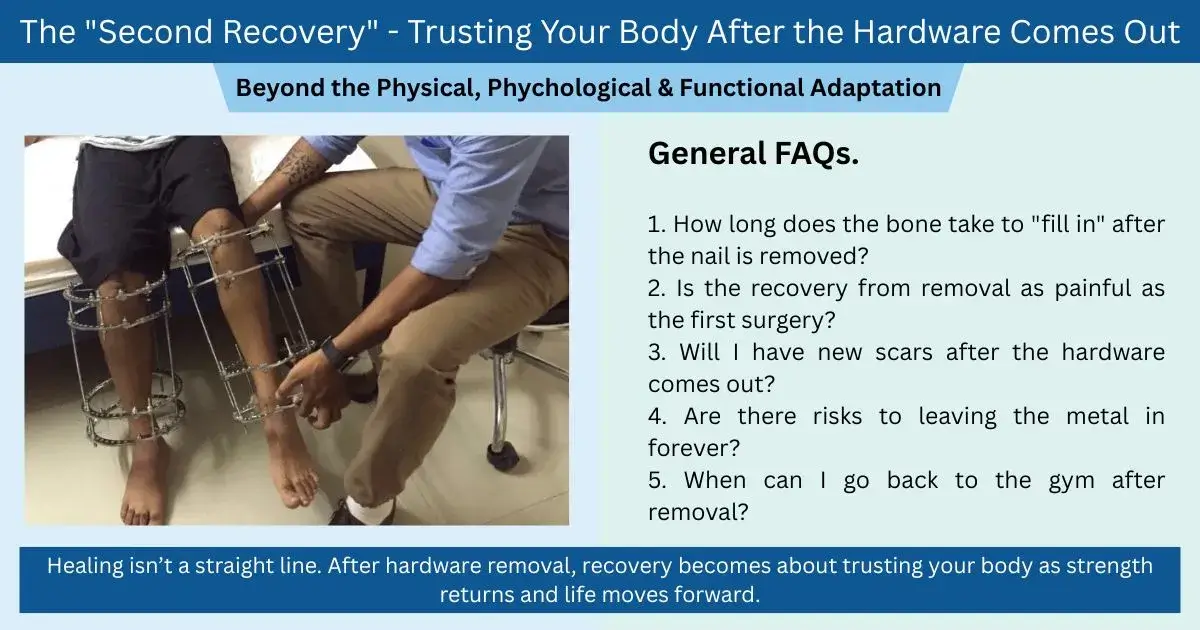
General FAQs
1. How long does the bone take to "fill in" after the nail is removed?
The small holes from the screws and the central canal itself usually fill with new bone within a few months. The bone can safely handle most day-to-day activities. Still, one should avoid performing loaded high-velocity or heavy weight-bearing exercises for about 6-12 weeks after surgery to allow sufficient time for bone remodeling.
2. Is the recovery from removal as painful as the first surgery?
In most cases they do not do so because there is no injury to the bones; therefore, the majority of the pain actually comes from the soft tissue and from the incision made to perform the surgery. Many patients are able to walk independently after a few days and the initial injury would have prevented them from walking for weeks.
3. Will I have new scars after the hardware comes out?
Typically, the surgeon will follow the same incision lines when removing hardware from the site of your initial surgery. Scars may look red or a little raised right after the operation, but they most often become less noticeable as time goes by (almost like the ones before the surgery).
4. Are there risks to leaving the metal in forever?
Leaving hardware implanted long term presents no significant safety risk in the majority of cases; however, due to concerns over future complications associated with "stress shielding," doctors may remove it from younger patients’ bodies sooner rather than later. Stress shielding results from the bone becoming weakened due to being less active than it should be due to metal's ability to support weight and/or prevent movement.
5. When can I go back to the gym after removal?
Most people are allowed to return to light activities such as walking or swimming in about two weeks. To ensure the bone regains its full structural integrity, your surgeon will most probably advise you to refrain from heavy squatting, running, or contact sports for at least six weeks.
Also Read: