
Contents
- The Reason He Did This
- How the Surgery Was Structured
- Pain Was Not the Biggest Problem
- The First Time He Went Outside
- What He'd Tell Someone Before Starting
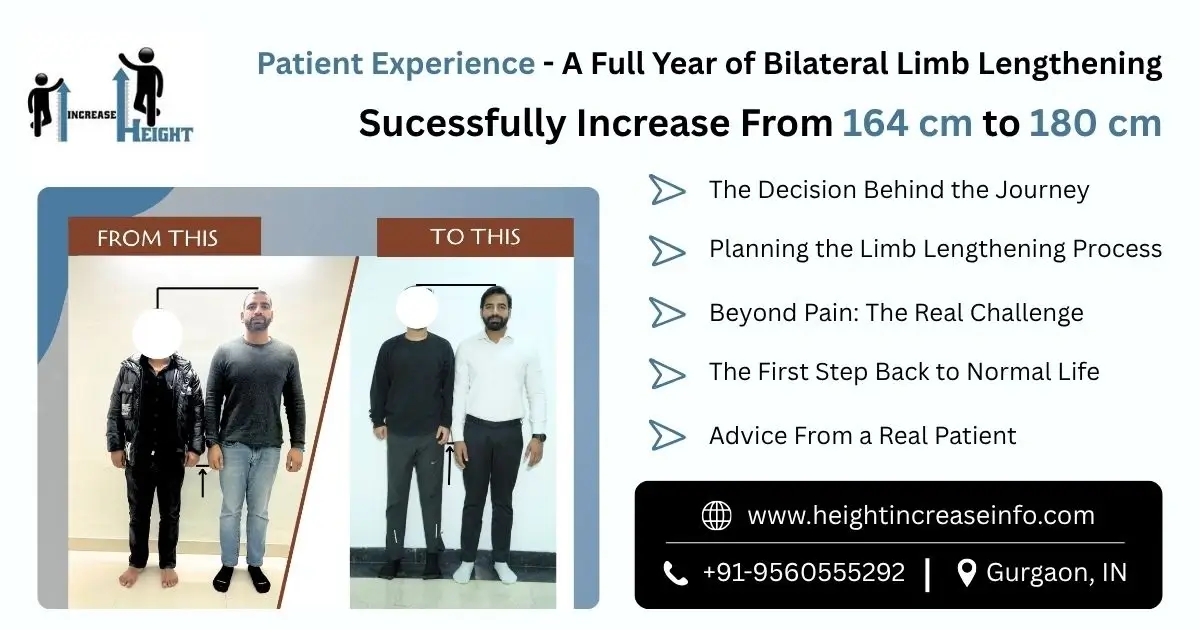
He came in at 164 cm with a plan to be done in eight months. He left a year later at approximately 180 cm, with 16.5 centimeters gained across bilateral femur and tibia. At the time of this review, it was the largest total lengthening the center had recorded. The extra months weren't a complication. His bone growth ran ahead of schedule, his callus consolidated well, and the team pushed the daily distraction rate to 1.5 mm on some days rather than the standard 1 mm. That pace brought its own issue toward the end, a muscle-related condition called SFD, but even that he described as manageable. A minor FFD remained at the time of this conversation, with full recovery expected within one to three more months.
This is Yash's account of the full year.
The Reason He Did This
He doesn't point to one event. He says there were hundreds.
Strangers on the street commenting on his height. Friends, group situations, every setting where the gap between him and the people around him was visible and noted out loud. The line that kept repeating itself, regardless of who said it, was always some version of the same thing: you have everything; only the height is missing. It came from enough people, often enough, that it stopped feeling like an observation and started being something he carried around.
He was 25 or 26 when he went through with surgery. His view was that height was never in his control, so falling short of some imagined goal wasn't really the point. The comments kept coming anyway. One day, he decided to take the whole experience as a challenge. He says he’s someone who takes challenges well. That decision about framing mattered more than he probably expected when he made it.
How the Surgery Was Structured
Total lengthening was 16.5 cm, done in two segments.
The first covered the bilateral femur at 8.5 cm. The second covered the bilateral tibia at 8 cm. Between segments, there was a recovery break, and it was during that first break, roughly three months in, that Yash says the height change hit him most directly. He had gained around three inches and hadn't adapted to it yet. He measured his height with almost everyone he came across at the center: other patients, physiotherapists, staff. He says the first segment had a different quality of feeling than the second, because by the time the tibia work was done, he was already used to being in that height range.
His original target was 16 cm. He crossed it. The strong bone consolidation is what allowed the distraction rate to go above 1 mm on certain days, which pushed the final number past the plan. That faster pace also contributed to the SFD that appeared later. Both things came from the same source: a bone that responded faster than expected.
Pain Was Not the Biggest Problem
When asked directly what was hardest about the year, he said at first that it was a question because he hadn't thought about it that way before. Then he said: psychological.
His reasoning was concrete. Pain is time-limited. The frames come off. When they do, the pain goes with them. The height stays. If you hold that clearly in your mind, the physical discomfort becomes a fixed problem with a known end, not an open-ended one. Sleep was disrupted during the process. Food was an issue at the start because he's from South India and the local food didn't suit him early on. By the end of the year, he said he'd actually miss the food after leaving. That shift took the full twelve months, but it happened.
The genuinely hard part was watching people leave. Friends he'd made at the center who arrived after him but recovered faster and went home first. That was something else entirely. Not physical, just the slow weight of being the one who stayed.
He also made a point that stands out from the rest of the conversation. Money isn't enough to finish this. He'd seen it. Patients with full resources who couldn't reach their target because the will to push through the difficult stretches wasn't there. His view is that you need to have suffered from your height enough to build the determination that carries you through the hard phases. The surgery gives you the structure. You supply the rest.
The First Time He Went Outside
He went out during recovery at roughly 50% mobility. Not walking fully independently, still dealing with the frame and everything that comes with it. He said he felt good. Not because his insecurities played out exactly as imagined, but because the reality was different from the imagined version. His eye level had changed. His posture was different. The specific scenarios he'd built up in his head about what being taller would feel like turned out not to match the actual experience. Better, but different.
He'd been chronicling the journey on Instagram since the beginning. He started because he wanted others dealing with that feeling of insecurity to see a real account going in real time, not a before-and-after without the middle. He still gets messages asking whether the money and the time were worth it. His answer doesn't change. At 34 or 50, he'll have more money and probably more time than he does now. He won't get back this window. Whatever comes next happens at a different height, and that difference affects what those experiences actually feel like. That's the calculation he made and says he'd make again.
What He'd Tell Someone Before Starting
He's specific rather than general about this.
Mental strength first, and he means it practically. If the mind isn't settled going in, the smaller difficulties, bad sleep, unfamiliar food, and a slow consolidation week start to feel larger than they are. You need to arrive with the decision fully made. Not still being negotiated with yourself.
Trust the medical team and not the internet. He said this directly: asking ChatGPT about your specific situation gives you random information with no context. The surgeon and physio have the actual picture. Your job is to follow their guidance, not to find a second opinion from an algorithm that doesn't know your case.
And choose the center based on what you can actually verify. Look at documented results on YouTube and Instagram. Talk to patients when you come for a consultation and find out what their experience was. The question that you want to ask prior to committing to something is not only whether the center can deliver a positive outcome, but also whether it is able to handle the complications if they do not. That capability is what separates centers, more than anything else.
Yash leaves with 180 cm, a minor residual issue that should clear up, and one year behind him that he says he'd repeat without hesitation. He started documenting on day one so that people watching could see it was possible. By his own account, some of them are now going through it themselves after watching him walk.
The 16.5 cm number came up several times in the conversation. At the center, it was the highest total anyone had achieved at that point. For Yash, it's just the distance between where he started and where he needed to be.