
Contents
- Why He Chose the Cross-Lengthening Route
- Pain through the Process
- What the Scars Look Like
- How He Got Mentally Ready
- Living at the Center During Treatment
- Where He Stands Now
Four months ago, this patient walked into a second surgery with no fear. It’s something he probably would have not imagined when he started researching limb lengthening surgery in 2020. At the time, he was in 12th grade, taking height-growth medicines that didn’t do anything, and watching Dr. Hirdesh’s channel trying to figure out if this was real or not.
His starting height was 157 cm. He wanted more. Not just a little more.
Why He Chose the Cross-Lengthening Route
For people unfamiliar with how limb lengthening surgery works, there are different approaches depending on how much height a patient wants to gain. A single segment addresses one bone. Cross-lengthening goes further. It means working on the femur of one leg and the tibia of the other leg simultaneously, and then repeating the process with the remaining bones in a second segment.
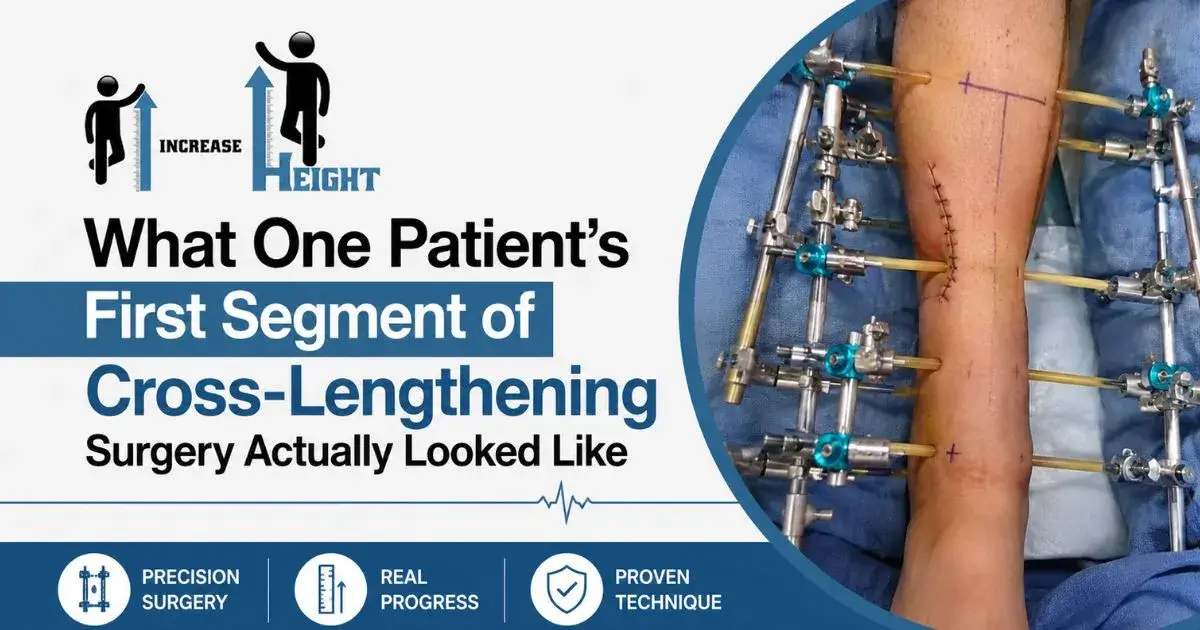
He knew going in that a single segment alone wouldn't satisfy him. He said he wasn't satisfied with where a partial result would leave him and wanted to reach a significantly taller height. So he committed to the full two-segment plan, which meant right femur lengthening of 8 cm and left tibia lengthening of 6.6 cm for the first segment. Combined, the first segment hit approximately 14.5 cm of cross-lengthening.
The second segment, covering the left femur and right tibia, was scheduled within a few days of this interview.
Pain through the Process
He was asked directly about pain levels, and his answer was more nuanced than a simple "it was fine" or "it was awful."
The femur gave him trouble in the beginning. Around one month of pain after surgery, concentrated in the early period. But after that nothing is significant. He said the tibia gave him no real discomfort throughout the entire journey.
One thing worth knowing: the tibia lengthening was pushed slightly past 7 cm at one point, and the team made the decision to reverse it back to around 5 to 6 cm. The reason was proportion. Going too far on the tibia without matching it on the other side risks what's called a ballerina deformity, where the ankle area tightens and the gait shifts in a way that looks and feels wrong. He noticed tightness before the reversal happened. After the correction, the issue resolved.
He also mentioned he didn't lean heavily on daily painkillers, which surprised even the doctor a bit. His view was simple. He knew there'd be pain going in. He'd already made the decision before the surgery date. So he absorbed what came and kept moving.
What the Scars Look Like
A lot of people ask about scars before committing to this surgery. It's a fair concern.
Dr. Hirdesh Kumar walked through each scar point by point during the review. On the tibia side, there's a mark at the nail insertion point, one at the osteotomy site where the bone was surgically broken to begin the lengthening process, a couple of pin scars on each side from the external fixator frame, and small marks from the distal screws that lock the nail in place. There's also a scar from the fibula cut, which is part of the standard tibia lengthening process.
On the femur side, the nail insertion scar sits at the top, the osteotomy scar is nearby, and again there are pin marks and screw-lock points lower on the bone.
All of this was visible and the patient noted this was one month after the fixator frame had been removed. By that point, the scars had already faded noticeably. The pin marks were the most visible, partly because the extended femur lengthening of 8 cm meant the frame was on longer, but even those were softening.
How He Got Mentally Ready
He didn't describe a neat preparation routine. His answer was more honest than that.
He said he was mentally "tortured" by comments about his height for years. Friends, social situations, parties, and events where height really matter’s the most. He couldn't comfortably plant his feet while riding a bike. Small things that add up over time. By the time he came in for a consultation, the decision was already made. He wasn't looking to be talked into it or out of it. He just needed the right information about what the process actually involved.
That's what he said kept him on the channel. Dr. Hirdesh's videos covered both the downsides and the benefits. He felt like the information wasn't being filtered or softened. That mattered to him.
When asked how someone else might prepare mentally, he gave a straightforward answer. You have to be firm inside before you start. The pain and discomfort are real but manageable if your head is in the right place. He also said knowing what to expect the second time made a difference. Now that he knows how the first segment felt, the second doesn't carry that uncertainty.
Living at the Center During Treatment
One of the parts of this surgery people don't always consider is that it requires staying near the treatment center for months. For this patient, that meant being away from his regular environment for four months and counting.
He said the first week was rough. Missing home, friends & the freedom to just go out. That's normal. But he also said it fades. You start fitting into the new environment, building a new rhythm. By the time this interview was filmed, he felt settled. The bigger adjustment was behind him.
He also pointed out that check-ins with the doctor happened regularly throughout. If something came up, he could flag it and get guidance without waiting. That kind of access matters when you're far from home and managing something as physically demanding as this.
Where He Stands Now
He has completed the first segment of what will be a full cross-lengthening surgery. Right femur at 8 cm, left tibia at 6.6 cm, and the frame removed approximately a month before this interview. Activity levels stayed high throughout. Scars are fading. No ongoing pain.
The second segment is coming. He's not nervous. That's the most striking thing about the conversation. Not because it's inspiring in some produced, packaged way. Just because you can hear that he actually means it.
He knows what the frame feels like. He knows how the pain moves. He knows how to talk to the team when something goes wrong. The first segment taught him all of that. Now it's just a matter of finishing what he started.
Checkout More Case Studies: https://www.heightincreaseinfo.com/case-studies.html