
Contents
- The 20-Year Outlook: Does Lengthening Increase the Risk of Early Arthritis
- What the long term data actually shows
- Why the joint carries the extra load
- Femur and tibia don't carry the same risk
- What's still genuinely unclear
- What seems to lower the risk over time
- The honest bottom line
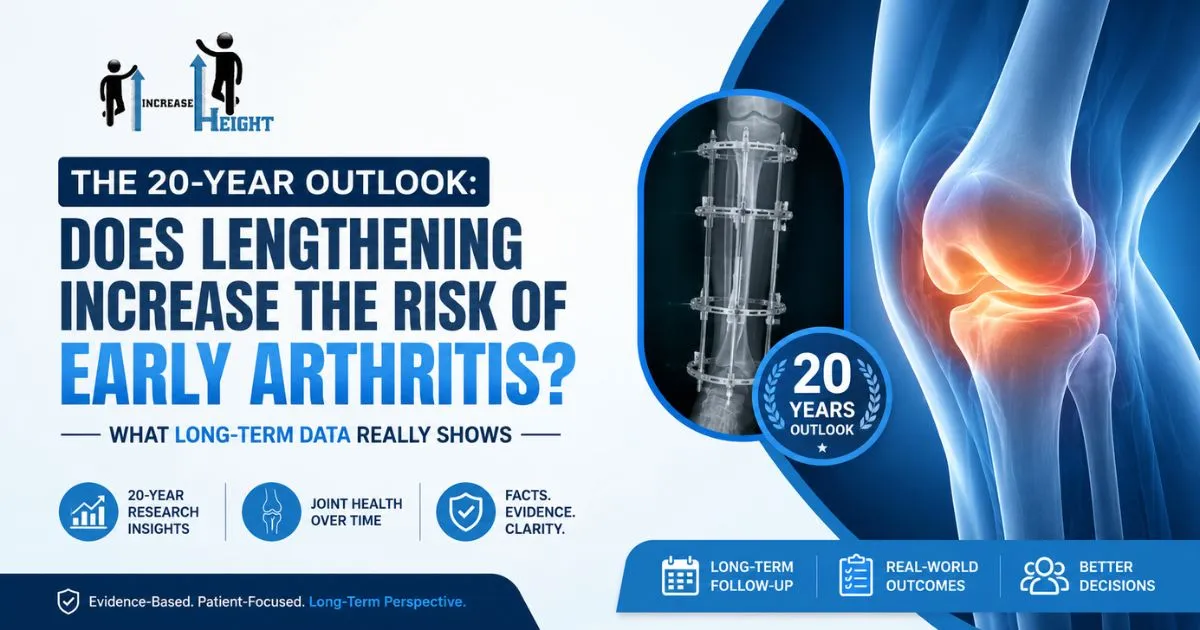
A small study out of Sweden followed ten patients for 27 to 34 years after they had one femur lengthened in childhood. By the time researchers checked back in, three to four of those ten patients showed clear x-ray signs of osteoarthritis in the hip or knee of the lengthened leg. None of their other, un-lengthened legs showed the same wear. It's one of the only pieces of research that actually answers the question patients ask years after surgery: what happens to the joints once the years start piling up. Most people considering the procedure hear plenty about pin sites, regenerate bone, and the months of physiotherapy that follow. Far fewer hear anything concrete about what their hip or knee might look like decades down the line.
What the long term data actually shows
That Swedish study matters because almost nothing else
like it exists. Most research on osteoarthritis after
limb lengthening surgery only tracks patients for two to
seven years, which is barely enough time to watch a bone
heal, let alone watch a joint slowly wear down. A
clinical trial protocol registered a few years ago put
it plainly. There's a real gap in the research.
Arthritis can take a decade or more to show up on an
x-ray after whatever actually set it off. Ask whether
leg lengthening long term effects include arthritis and
the honest answer is messy. Researchers are still
catching up, not because nobody's looking, but because
the disease itself is slow to reveal itself on film.
They know enough to be concerned. They don't know enough
to give a confident percentage.
This isn't just an academic gap either. Arthritis that
shows up at 45 instead of 65 has real consequences. It
can mean earlier joint replacement and physiotherapy
bills that stretch on long after the original surgery is
paid off. A few researchers have pointed out that this
is exactly why the long-term question deserves more
attention than it currently gets, since the cost of
getting it wrong falls on the patient decades after the
surgeon has moved on to other cases.
Why the joint carries the extra load
Lengthening a bone does more than lengthen the skeleton;
it also extends everything around that bone muscles,
tendon, nerves, and blood vessels. Muscles have a limit
to how far they can stretch and still work in the way
they’re designed to. If you push past that limit, the
muscle begins to stiffen, not adapt, and forces change
through the joint above and below it.
A 2026 animal study
on femoral distraction found this directly.
Once the lengthening passed roughly a quarter of the
bone's original length, cartilage in the adjacent knee
started breaking down in a way that moderate lengthening
didn't cause. The mechanism wasn't subtle. The joint was
simply being asked to absorb more force than it was
built for. Soft tissue, unlike bone, doesn't regenerate
to fill a gap. It has to physically stretch, and there's
only so much stretch a muscle fibre can tolerate before
it starts laying down fibrous tissue instead of healthy
contractile fibres. Once that happens, the muscle
behaves less like an elastic shock absorber and more
like a stiff band pulling unevenly on the joint with
every step.
Hip flexion contractures are a known complication in
femoral lengthening, particularly in conditions like
achondroplasia, and they're a good example of how this
plays out in real patients. A tight hip flexor changes
gait. Changed gait changes how weight lands on the hip
and knee with every step, for years. Multiply that by
tens of thousands of steps a year, and the joint ends up
absorbing stress it was never built to handle in that
pattern.
Femur and tibia don't carry the same risk
Not every lengthened segment puts strain on the same joint. Femoral lengthening surgery places the joint closer to the hip and knee, which is why the Swedish follow-up study focused on those two joints. Tibia lengthening shifts the mechanical burden toward the knee and ankle. The amount lengthened matters just as much as which bone gets lengthened. Gain 3 centimetres on a femur and the long-term joint stress looks nothing like what someone gaining 8 centimetres deals with. That's the real issue with treating osteoarthritis after limb lengthening surgery like one single risk number. The bone matters. So does the amount added, and so does how the soft tissue around it held up while it was being stretched. Methods matter too. A lengthening done with an internal nail like PRECICE tends to allow earlier, more consistent weight bearing than an external fixator frame, which may give muscles and joints a steadier loading pattern to adapt to throughout the months of distraction and consolidation. Whether that translates into a measurably lower arthritis rate decade later hasn't been studied directly, but the underlying logic lines up with what the biomechanics research already shows about gradual, well-tolerated loading.
What's still genuinely unclear
The honest gaps matter here too. Ten patients aren’t enough to separate how much of the joint damage came from the lengthening itself versus other factors, like the original condition that made lengthening necessary in the first place, an infection during treatment, or alignment that drifted slightly off course during years of growth. Researchers studying osteoarthritis after limb lengthening surgery have openly said they need follow-up periods stretching past 15 years, sometimes longer, before anyone can put a real number on the risk. Right now, the data points toward an association. It doesn't prove cause in every case, and it definitely doesn't mean every patient who lengthens a limb will end up with arthritis decades later.
What seems to lower the risk over time
A few things keep showing up across the research, even
with the gaps. Catching joint contractures early and
treating them aggressively with physiotherapy seems to
matter more than almost anything else, since gait
compensation is what quietly grinds down a joint over
years, not the lengthening procedure by itself. Staying
within a moderate lengthening percentage rather than
pushing toward the upper limit of what a bone can
tolerate also shows up as protective in the animal data.
Correcting any residual malalignment before it becomes
permanent gives the joint a fair chance at distributing
load the way it's supposed to. Regular imaging in the
years after consolidation, not just during it, also
seems to matter, since small alignment drifts are far
easier to correct early than after a joint has spent a
decade compensating for them.
None of this guarantees anything. But it gives patients
and surgeons something to actually act on, instead of
just worrying about leg lengthening long term effects in
the abstract.
The honest bottom line
Twenty years out, the research on osteoarthritis after limb lengthening surgery still isn't finished, and probably won't be for another decade or so, once the patients being followed right now reach that mark themselves. What exists points to a real but uneven risk: heavier in larger lengthening’s and in cases where contractures went untreated, lighter in smaller, well-managed corrections. Anyone considering the surgery, or already years past it, is better served asking their surgeon about their specific lengthening amount and joint history than searching for a single average that doesn't really exist yet.