
Contents
- The Precursor Era - Limitations of External Fixation
- The First Generation of Internal Lengthening Nails: The Mechanical Approach
- The Revolution: Introducing Remote Control and Magnetic Drive
- Advanced Features and Future Trajectories
- Conclusion
Internal lengthening nails changed orthopedic surgery for the better. In the past, patients with uneven limb lengths or lost bones as a result of injury relied on bulky external devices that caused significant pain and disrupted their daily activities. Today’s modern internal limb lengthening nail allows surgeons to treat these disorders with less pain and more natural healing. Looking back over the history of these instruments, it’s clear that they evolved from bulky mechanical instruments to sophisticated, remotely operated systems. This article examines the technological progression of internal lengthening nails, highlighting the movement from manual, clicking systems to advanced magnetic drives.
The Precursor Era - Limitations of External Fixation
External fixator for leg lengthening: The Initial Solution and Its Challenges
Before internal solutions existed, doctors used external fixation devices to lengthen limbs. The Ilizarov apparatus is the most well-known example of this. It required pins and wires to pass through the skin, muscle, and bone, attaching to a metal frame surrounding the limb. While effective at lengthening bone, the treatment had a high rate of external fixation complications. Patients often dealt with painful pin-site infections, stiffness in nearby joints, and a long, difficult treatment duration. These limb lengthening historical methods placed a heavy burden on patients, who had to adjust the frame manually multiple times a day while coping with the physical presence of the external hardware.
Early Intramedullary Devices: The Mechanical Breakthrough
Orthopedic researchers wanted to move the distraction device inside the bone to eliminate the need for external pins. Early attempts involved simple telescoping nails placed inside the medullary canal. These devices tried to push the two bone segments apart internally. Surgeons hoped this would reduce the risk of infection and improve patient comfort. However, these early versions lacked the necessary internal power to maintain consistent bone distraction, often forcing reliance on secondary manual adjustments or complex external power sources that limited their success.
The Mechanical Clicking Nail: A Stepping Stone
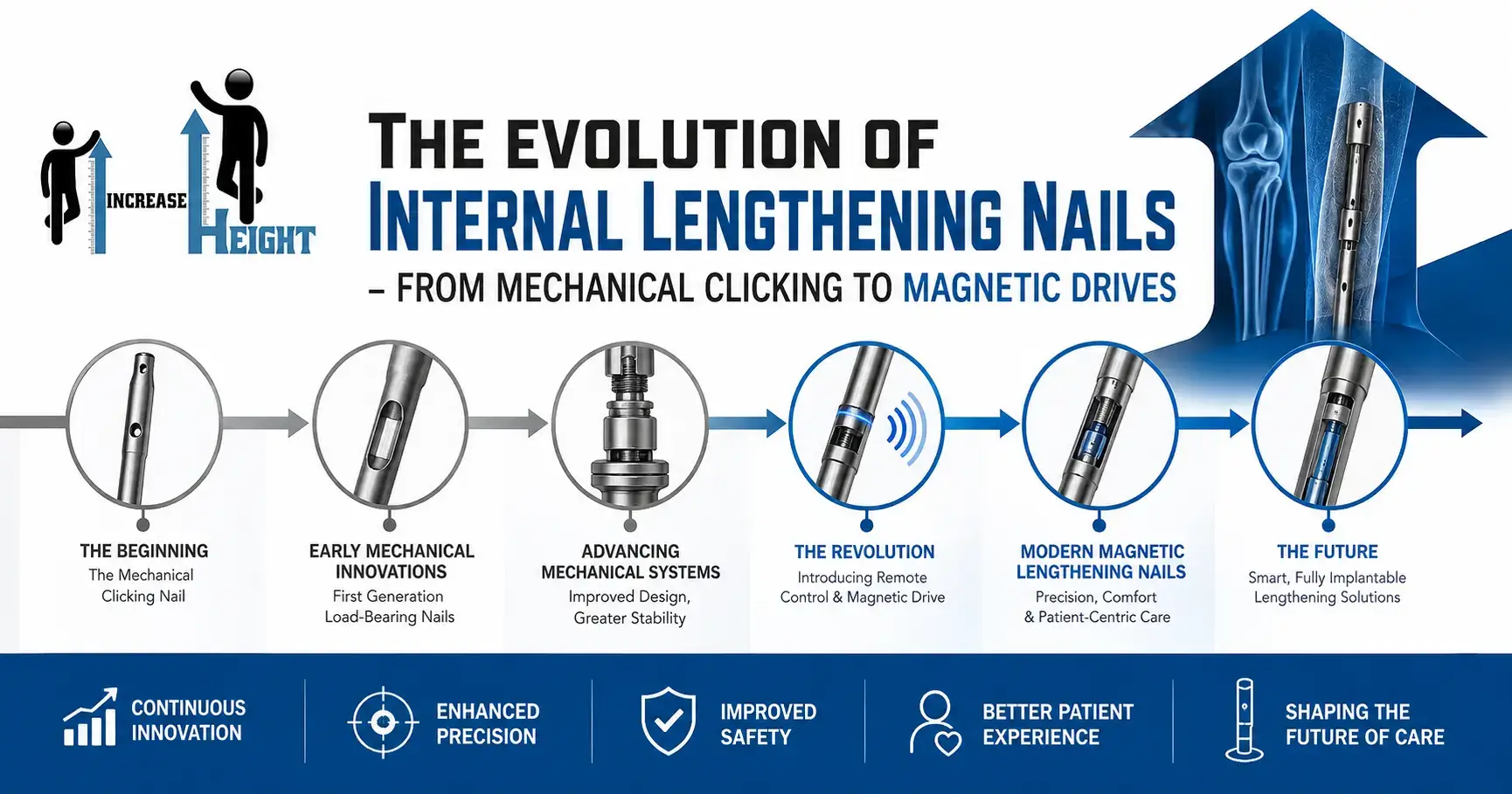
The mechanical internal limb lengthening nail acted as a bridge between bulky external frames and modern technology. These devices used a ratchet mechanism that produced an audible "click" each time the patient or surgeon turned the limb to lengthen it. This provided a way to perform intramedullary osteogenesis distraction without pins protruding from the skin. Despite their apparent ease, these nails did have issues. The parts were easily fatigued, and one could always overtighten the device. Since the nail was rotated in order to extend, it was difficult for patients to precisely time how fast the nail was being distracted, which sometimes resulted in uneven bone growth.
The First Generation of Internal Lengthening Nails: The Mechanical Approach
Design Principles of Early Load-Bearing Lengthening Nails
Early internal nails relied on a simple internal drive system. They often used a screw locking mechanism that converted rotational force into linear expansion. The nail consisted of an inner rod and an outer sleeve that telescoped as the patient rotated their limb. This rotational force pushed the two bone ends apart. The ratcheting system was designed to hold the bone in the new position once the rotation stopped. This design required the nail to withstand high mechanical loads as the bone consolidated, which was a significant engineering challenge for the materials available at the time.
Surgical Protocol and Patient Compliance in Mechanical Systems
The surgical procedure involved inserting the limb lengthening nail into the medullary canal and locking it with screws above and below the distraction site. After surgery, patients had to follow a strict protocol. They were responsible for performing the "clicking" exercises, which involved manual rotation of the limb to activate the internal ratchet. This required frequent clinic visits so the surgeon could track the distraction rate and ensure the device was functioning properly. Compliance was difficult because the physical act of rotating the limb was painful and required a high level of discipline over many weeks.
Complications Associated with Early Internal Mechanisms
Mechanical nails had a high failure rate under high mechanical stress. The internal ratchets could jam, preventing the nail from lengthening further. In other cases, the nail would suffer from structural fatigue, leading to breakage during the bone healing process. Surgeons also found it hard to control the exact rate of distraction. If a patient turned their leg too far or too little, poor bone formation and early bone consolidation could follow. These complications were so common that researchers looked to more reliable, automated ways to cure patients.
The Revolution: Introducing Remote Control and Magnetic Drive
The Paradigm Shift to Non-Invasive Control
The biggest change in this field was the move to remote controlled limb lengthening. Instead of asking the patient to physically rotate their limb or rely on mechanical ratchets, engineers developed systems driven by magnetic fields. This technology allowed the nail to lengthen while the patient remained still. An external remote control, often called a magnetizer, contains strong magnets that spin. When the patient places these spinning magnets against the skin near the nail site, this creates a magnetic field, which turns a gear inside the nail. This eliminates the patient from the tedious task of turning the gears, and provides a controlled distraction.
Anatomy of a Modern Magnetic Lengthening Nail
Modern magnetic intramedullary nail technology is highly advanced. The nail houses a telescoping mechanism powered by an internal motor and gear assembly. This motor responds to the external magnetic field provided by the handheld remote controller. These devices use highly biocompatible materials like titanium alloys, which integrate well with human bone. The entire system is sealed, protecting the motor from the body’s environment, which prevents the mechanical failures seen in earlier designs. The remote controller allows the surgeon to program the exact amount of daily lengthening, ensuring that the bone grows at the optimal rate.
Precision and Patient Experience with Magnetic Systems
Magnetic systems have completely changed the patient experience. The precision of magnetic drive systems allows for distraction down to the millimeter per day. Because the system is entirely internal and automated, the risk of pin-site infection is eliminated. Patients experience significantly less pain during the lengthening phase because the adjustment is smooth and does not require physical manipulation of the bone. Fewer clinic visits are needed because the device can track the amount of lengthening accurately. These magnetic systems are now used in a majority of orthopedic centers, where they are safer and more reliable than previous nail types.
Advanced Features and Future Trajectories
Integrated Monitoring and Feedback Mechanisms
Newer designs also include sensors that provide feedback on the healing of the bone and lengthening as planned. The surgeon can also report on this data to know when the patient is putting too much weight on the leg before the bone is strong enough to support the weight. This provides real-time insight into whether problems have occurred and how treatment can be adjusted prior to any problems occurring. This represents the transition from reactive care to proactive, data-driven management of limb reconstructions.
Addressing the Challenges of Magnetic Devices
Even though magnetic nails have become extremely successful, the road to success has not been without obstacles. One primary issue is the risk of implant malposition, where the surgeon places the limb lengthening nail slightly off-center, making it harder for the external magnet to reach the internal gear. The external remote control devices are also large and require precise placement. A separate disadvantage to this technology is that it can be more expensive than regular mechanical nails. Due to both the cost and the bone anatomy of individual patients, surgeons must be selective about which patients are suitable candidates for this technology.
Emerging Innovations: Fully Implantable Lengthening Solutions
The future of limb lengthening points toward even more advanced technology. Researchers are currently exploring nails that do not require bulky external magnets. Some of these new technology concepts could include an internal battery-powered motor or even a device that draws energy from the body. Other research may use a combination of electronics and imaging to let surgeons see how the new bone growth is growing without constantly taking X-rays. These technological advancements may then lead to more efficient and patient-friendly limb grafts when they are tested in clinical trials.
Conclusion
The evolution of internal lengthening nails has transformed limb reconstruction from a difficult, high-risk process into a reliable, patient-friendly procedure. We have moved from the era of external fixator for leg lengthening and mechanical clicking nails - which were often painful and prone to failure - to the age of sophisticated, remotely controlled magnetic drives. This shift has not only improved the precision of the procedure but has also significantly increased patient safety and quality of life. By removing the need for external pins and manual adjustments, modern magnetic technology has set a new standard of care. As we look toward the future of fully implantable, sensor-integrated solutions, it is clear that internal lengthening technology will continue to be the primary, most effective option for correcting complex limb length differences.