
Contents
- The Bone Has Changed Since the Nail Went In
- Why Intramedullary Nails Are Harder to Pull than to Place
- Screws that Won't Turn
- The Fracture Risk After Removal
- Recovery Looks Different from the First Surgery Too
- What this Means for Patients Planning the Second Surgery
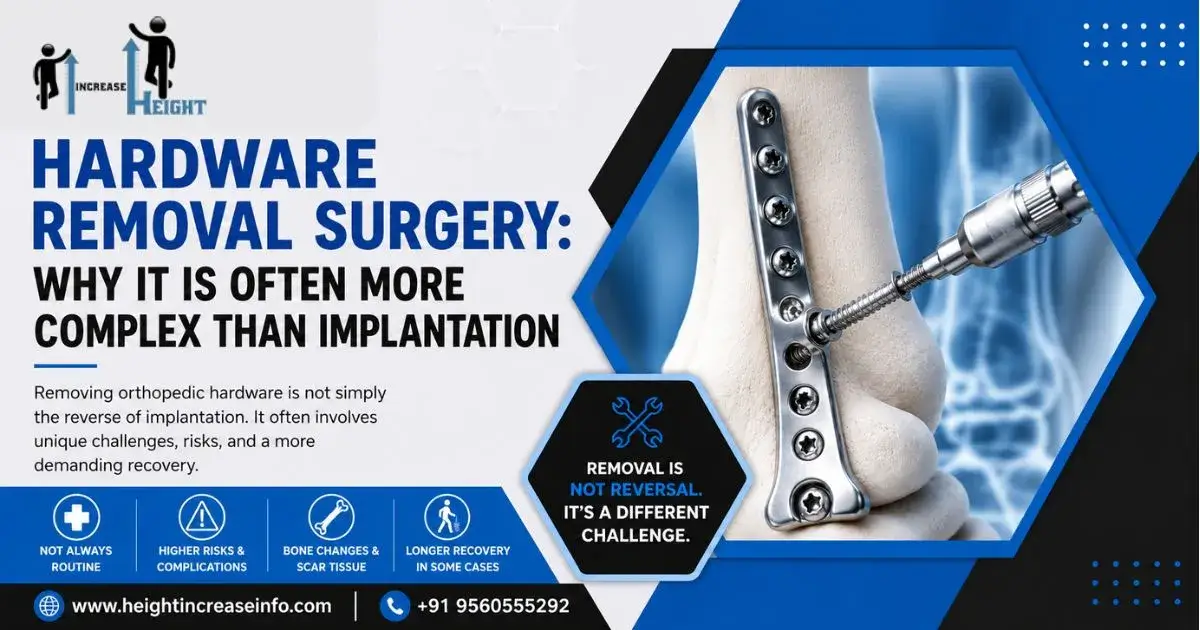
A PRECICE nail takes two to three hours to put in. Taking the same nail out twelve to eighteen months later, after the bone has finished healing around it, can take longer and demand more from the surgical team than the original procedure did.
Patients rarely expect this. Most people walk into limb lengthening surgery focused entirely on the lengthening phase. The removal surgery gets treated as an afterthought, a quick follow up appointment with a scalpel. It isn't.
Surgeons who specialize in implant removal after limb lengthening for height describe the second surgery as its own distinct procedure, with a different risk profile than implantation. The bone is not the same bone it was a year ago. It has grown around the hardware, new cortical layers, and in some cases even partially embedded the metal in its structure. None of that makes removal impossible. It just makes it slower, more technical, and occasionally unpredictable.
The Bone Has Changed Since the Nail Went In
When a nail or plate is inserted into the bone from the prior operation, it is as if nothing had been done. The surgeon has a healthy bone with predictable anatomy. Eighteen months later, after distraction osteogenesis has done its job, the bone around the hardware looks different on X-ray. New bone has filled in around the nail and through the screw holes. In some patients, especially younger ones with strong healing responses, this new bone can partially surround the implant itself.
That sounds like a good problem to have. Strong bone is the goal of the lengthening process. But it also means the surgeon now has to cut through or chip away tissue that didn't exist during the first operation, just to get a clean path to the hardware. This is one reason implant removal after limb lengthening for height takes longer in the operating room than people assume.
Why Intramedullary Nails Are Harder to Pull than to Place
Inserting an intramedullary nail is a matter of reaming a canal and sliding the nail through it, more or less along a straight predictable path. Taking one out is a different story. The nail has to come back out the same way it came in, and the canal around it often has changed in ways that don’t quite match the original shape of the nail.
Intramedullary nail removal complications start here. If the canal has narrowed slightly, or if bone has grown into the locking holes near the ends of the nail, the nail can bind on its way out. Surgeons sometimes need extended extraction sets, slap hammers, or in rare cases have to redrill bone that has grown into the nail's path. A nail that doesn't want to budge raises operative time and, with it, anesthesia time and blood loss.
Screws that Won't Turn
The locking screws holding a nail or plate in place create their own set of problems. Screw heads occasionally strip during removal, particularly if there was any corrosion or micro motion at the screw-bone interface over many months. A stripped screw head turns a five-minute step into a much longer one, sometimes requiring specialized broken screw extraction tools or a small additional incision to access the screw from a different angle.
This is a known and accepted part of intramedullary nail removal complications, and it's one reason experienced surgeons keep backup extraction instruments on hand for every hardware removal case, even routine ones. Nobody plans on a screw breaking. Surgeons plan around the chance that one might.
The Fracture Risk After Removal
Bone is weaker where screw holes used to be for a period of time after hardware comes out. Those holes’ act as small stress points, and the bone needs weeks to months to fully fill them back in with mature tissue. This is part of why surgeons are deliberate about timing implant removal after limb lengthening for height. Removing hardware too early, before the regenerate bone has fully consolidated, raises the odds of a fracture through the old nail or screw tract. Removing it later gives the bone more time to mature, but it also gives the bone more time to grow into and around the hardware, making the extraction itself harder.
The surgery involved is not a checklist item. Rather, surgeons evaluate the appearance of the bones on X-rays, the patient's age, their level of activity, and how the bone has responded during consolidation before scheduling the second surgery.
Recovery Looks Different from the First Surgery Too
Patients who remember waking up from the original nail insertion or fixator application sometimes expect a similar recovery from removal. It's usually shorter, but not always easier in the way people anticipate. Weight bearing restrictions after removal depend heavily on how much bone had to be disturbed to get the hardware out. A nail that slides out cleanly might allow an earlier return to walking unassisted. A nail that needed extra drilling or a wider exposure to free bound screws can mean a longer period of restricted weight bearing, while the surgeon makes sure the bone around those old holes has had a chance to settle.
Pain after removal surgery tends to surprise people too. No new bone is growing or being stretched at this stage, but the dissection of the soft tissue that can reach hardware that has been in place for over a year may leave the patient sorer than they thought after such a minor procedure. Most of that soreness will subside within a few weeks after the bone has set.
What this Means for Patients Planning the Second Surgery
None of this is a reason to avoid hardware removal, and complications are far from universal. Most removal surgeries go smoothly and patients recover quickly. But anyone considering implant removal after limb lengthening for height should understand that this isn't a simple reversal of the first procedure. It's a separate operation with its own planning, its own instrumentation needs, and its own recovery timeline.
Patients should ask their surgeon if consolidation has taken time, what image show around the hardware, and will the surgeon just remove it easily or will it take a bit longer. Any surgeon who has performed dozens of these procedures will know which cases fall into which category before picking up an instrument.
Wondering whether hardware removal is the right next step for you? Contact our specialists today to discuss your case, understand your options, and receive personalized guidance for a safe recovery.