Contents
- The Knee Joint Itself Isn't Being Reshaped
- Proportion Plays a Bigger Role than People Expect
- Muscle Changes around the Joint are Real, though usually temporary
- Scarring near the Joint is worth Discussing Directly
- Swelling during Treatment isn’t the Same as a Permanent Change
- Patellar Tracking Deserves Attention in Certain Cases
- How the Whole Leg's Silhouette Shifts Together
- What's Temporary versus What Sticks Around
- Questions worth Asking Before Surgery
- The Bigger Picture
Most people start with height when they first look into this. Centimeters, timelines, & how tall they'll end up. What rarely comes up early on is what happens to the parts of the leg that aren't directly involved in the lengthening, the knee especially. It's a reasonable thing to wonder about, and it comes up a lot once patients move past the abstract numbers and start picturing what their actual leg will look like. Knee appearance after limb lengthening surgery deserves a real answer before surgery, not a surprise discovered three months into recovery. Search for this topic online and you'll find almost nothing useful, which is exactly the gap this is meant to fill.
The Knee Joint Itself Isn't Being Reshaped
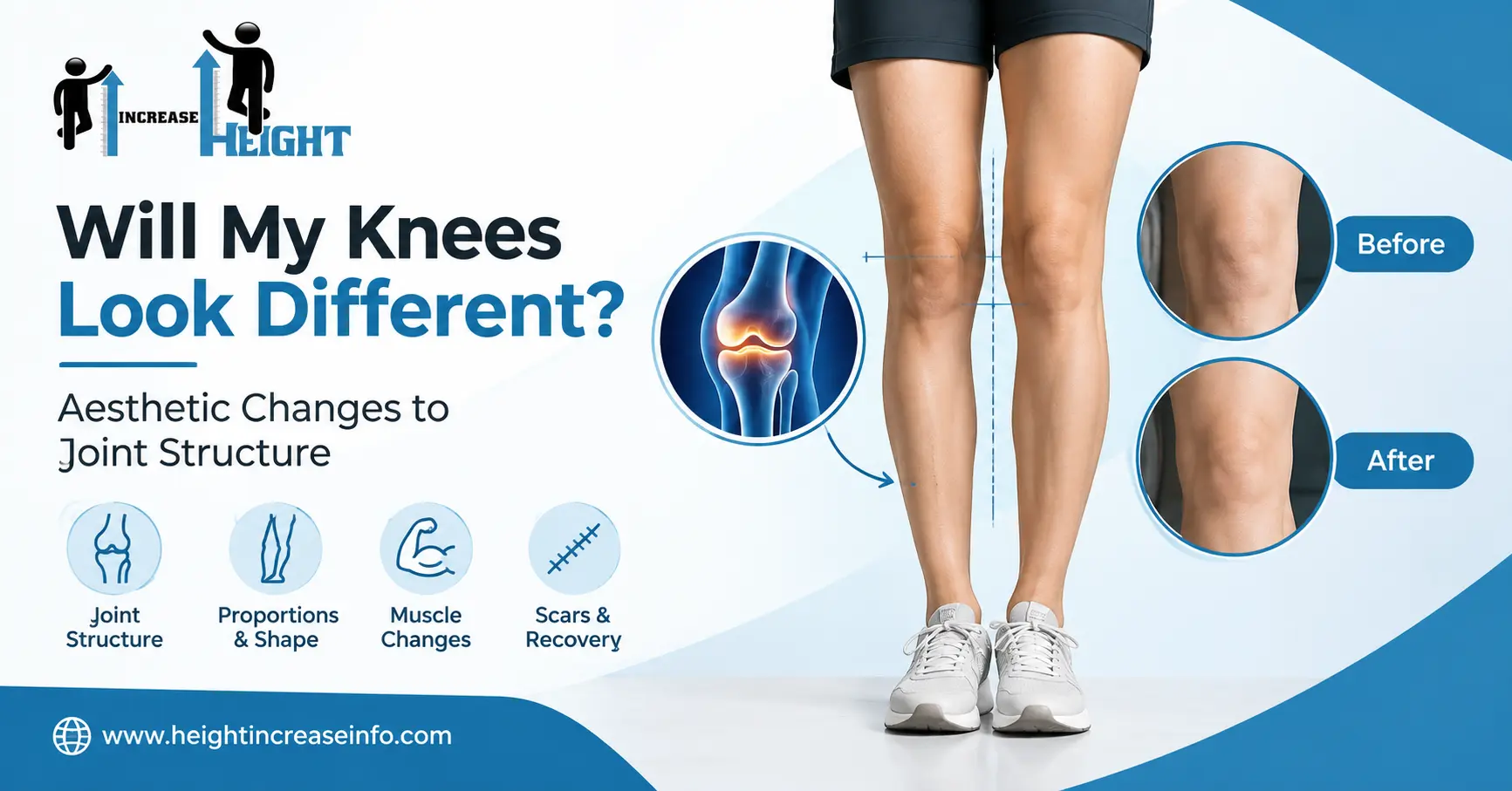
Here's the reassuring part, once it's actually explained. Standard tibial or femoral lengthening happens well away from the joint surface itself. Cartilage, ligaments, the joint capsule, none of it gets touched directly. What changes instead is everything surrounding the joint. Soft tissue shifts. Muscle bulk shifts. Skin adjusts. And the visual proportion between the knee and the rest of the leg moves too. That combination, more than anything structural, is usually what people are actually noticing when they say their knee looks different.
Proportion Plays a Bigger Role than People Expect
These proportional changes are particularly relevant for people considering cosmetic limb lengthening surgery, where the final appearance of the legs is an important part of treatment planning. Stretch a femur or tibia and the ratio of knee and leg changes as well. What once looked perfectly proportionate on a shorter leg suddenly looks smaller and delicate. Nothing physically shrank. The geometry around it just changed, and the eye needs time to recalibrate to that.
Muscle Changes around the Joint are Real, though usually temporary
Muscles around the knee go through real changes during distraction and consolidation. Less weight bearing early on, less activity overall and some visible atrophy in the thigh tends to follow. That thinner muscle can make the knee look more prominent for a while, simply because there's less bulk softening its outline. The upside here is real though. This part reverses more easily than almost anything else in the process. This is one of the reason rehabilitation after limb lengthening is an important part of the recovery process. Strength comes back, and so does that proportionate look for most people. Out of everything that shapes knee appearance after limb lengthening surgery, muscle bulk is the one variable actually within a patient's own hands.
Scarring near the Joint is worth Discussing Directly
Some techniques place incisions or hardware close to the knee. Certain femoral nailing approaches do this. So do some external fixation setups that cross near the joint line. These scars fade a lot, usually over twelve to eighteen months, going from raised and pink to flat and pale. They don't vanish completely though. If visible scarring near the knee is a real concern, ask before surgery, not after. Pin exactly where incisions will go. Every surgeon has their own approach here, so there's no single standard answer to fall back on.
Swelling during Treatment isn’t the Same as a Permanent Change
Puffiness around the knee during active lengthening is common, and understandably alarming if someone assumes that's the final look. Rarely, if ever. A puffiness such as that is normally inflammatory, the result of active distraction and the body going into overdrive to heal, and usually goes away once consolidation is over and normal activities resume. Keep the mid treatment picture and the fully healed picture separate in your head. They rarely look the same.
Patellar Tracking Deserves Attention in Certain Cases
Some cases involve real angular correction alongside the lengthening. A congenital limb defect that already affects joint alignment adds another layer here too. Either way, patellar tracking can shift a bit as the overall mechanics of the limb change. Function matters more than looks in this particular case, but the two aren't entirely separate either, since how the kneecap sits and tracks ends up shaping how the knee looks while moving. Surgeons keep a close eye on this in complex cases, mainly because letting misalignment slide can cause trouble both functionally and visually down the road. Anyone with prior joint issues should bring this up directly in consultation. Knee appearance after limb lengthening surgery in these more complicated cases depends heavily on how carefully that alignment gets managed throughout.
How the Whole Leg's Silhouette Shifts Together
This one surprises people the most. Limb proportions after lengthening surgery shift together as a whole, never in isolated chunks. They shift as one connected picture. Thighs read differently against calves. The knee reads differently against both. Even feet, which stay the exact same physical size, can look smaller next to a longer leg purely because of visual proportion. None of it signals a problem. Stretch one dimension of a familiar shape and the eye simply takes a moment to catch up, that's all this is. People get used to it quicker than they expect, especially once muscle definition comes back and swelling settles. Photos taken at steady intervals through recovery tend to help here too, showing lower limb appearance after limb lengthening surgery as the slow, natural shift it actually is rather than something abrupt.
What's Temporary versus What Sticks Around
Most of managing expectations here comes down to sorting temporary from permanent. Muscle atrophy fades. Swelling fades. That first jolt of seeing proportions shift fades too, given enough time and consistent physiotherapy. Scars land somewhere in the middle, fading a great deal but never fully disappearing. Joint structure holds steady unless angular correction was specifically written into the surgical plan from day one. Early lower limb appearance after limb lengthening surgery and the final settled version can honestly look like two completely different legs. For an honest read on lower limb appearance after limb lengthening surgery, the one year mark is the number that counts, not month three. Month three tells you almost nothing useful.
Questions worth Asking Before Surgery
A few pointed questions go a long way for anyone worried specifically about how their knee or leg will end up looking. Ask where incisions or pin sites will actually land in relation to the knee. Ask about a realistic scar fading timeline, not a hopeful one. Ask how this specific technique tends to affect muscle bulk around the joint during recovery. Ask for real pictures before and after surgery for limb lengthening. Ask for pictures of the same patient, who had a similar anatomy. These kinds of questions call for answers, not vague comfort. Your expert surgeon shouldn’t hesitate to give them.
The Bigger Picture
Concern over knee appearance after limb lengthening surgery is almost always strongest right at the start, during planning and the opening weeks of recovery, and then it quietly fades long before treatment wraps up. The same goes for lower limb appearance after limb lengthening surgery as a whole, it settles as muscle returns, swelling disappears, and proportions that once looked strange simply become the new normal. Nobody's knee joint was ever being rebuilt in a standard case. What patients do notice is often temporary and fixable, and nowhere near permanent. Take that knowledge with you to surgery, and it’s no longer a string of unexpected surprises.