
Contents
- What Actually Happens Inside the Nerve
- Why Monitoring Matters More Than People Expect
- Adjusting the Plan When Nerves Push Back >
A nerve doesn't behave like a rubber band. Push it too fast, and it reacts almost right away. Tingling. Numbness. Sometimes just dull ache patients can't quite name yet. Slow the pace down, though, and that same nerve can add a surprising amount of length without any lasting harm. That gap between "too fast" and "slow enough" is where nerve adaptation during distraction osteogenesis stages actually plays out, and it's a far more delicate process than most people expect going into limb lengthening surgery.
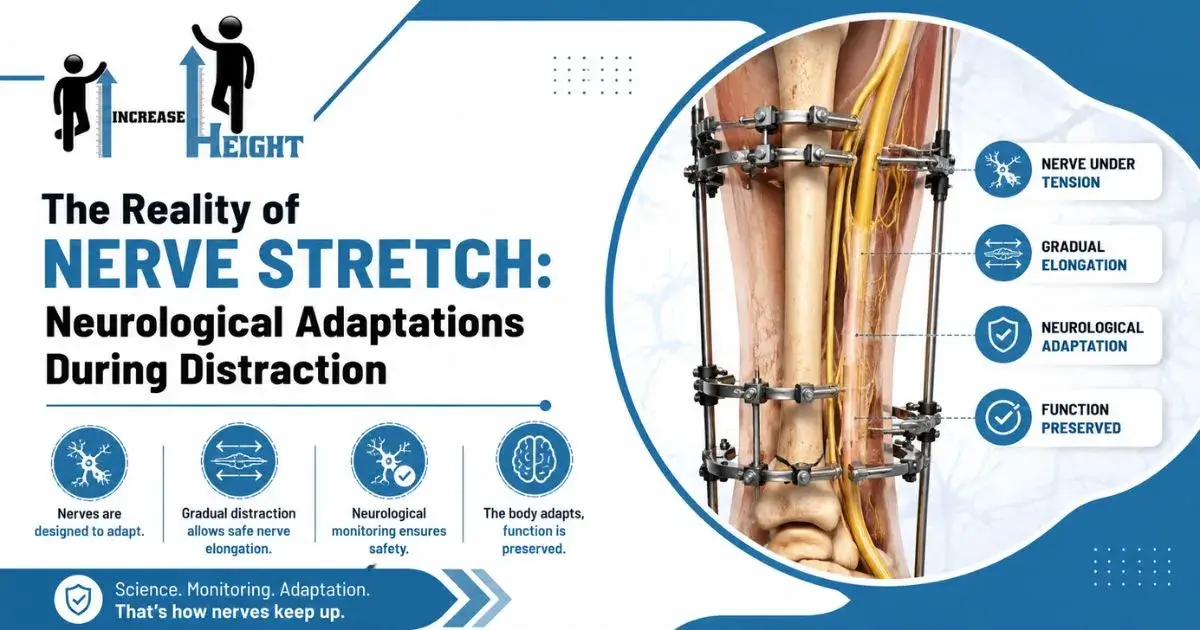
Peripheral nerves have some built-in slack that people don't always realize. The fascicles inside sit coiled and slightly wavy rather than running perfectly straight. So when a bone lengthens, the nerve around it gets pulled taut first, burning through that slack before any real stretching even starts. This is one reason the standard distraction rate of about one millimeter per day, split into smaller increments, was settled on rather than something faster. Go beyond what the nerve tissue can tolerate and blood flow within the nerve drops, which is usually the real driver behind pain or numbness, not the stretching itself.
What Actually Happens Inside the Nerve
During the early days of lengthening, microscopic changes begin within the axons and the connective tissue that wraps them. The nerve fibers elongate, and so do the blood vessels that feed them, though not always at the same rate. If the vascular supply falls behind the physical stretch, the nerve starts running on borrowed time. Studies on distraction have generally pointed to somewhere around eight percent elongation as a rough ceiling before ischemic stress becomes likely, though this varies between individuals and even between different nerves in the same leg.
The peroneal nerve gets mentioned constantly in tibial lengthening discussions, and for good reason. It sits close to the fibular head with very little cushioning, and it's more prone to compression than nerves buried deeper in muscle. For example, a dropped foot or a changing sensation at the top of the foot is usually seen first by a surgeon. Waiting until an X-ray confirms the problem isn’t advisable.
Nerve adaptation during distraction osteogenesis stages isn't a single event either. Latency, active distraction, and consolidation each put different demands on the nerve. During latency, the callus hasn't formed yet, so there's little tension on surrounding soft tissue. Once active lengthening starts, that tension builds daily and this is where most neurological symptoms tend to appear. By consolidation, the nerve has usually settled into its new length, assuming the earlier phases went reasonably well.
Why Monitoring Matters More Than People Expect
Patients are often told to report tingling right away, and this instruction sounds almost too simple given how serious nerve injury can be. But early reporting really is the line between a small rate tweak and a permanent problem. Say a patient mentions numbness in the foot around day twelve of active distraction. A clinician who slows things down, or just holds the rate steady for a bit, can often give the nerve enough time to catch up before anything lasting happens.
Neurological complications of limb lengthening surgery aren't some rare footnote tucked into a consent form nobody reads. They show up often enough in published case series that most limb lengthening centers build in scheduled nerve checks rather than waiting for patients to bring up symptoms unprompted. A simple pinprick test, a check of dorsiflexion strength, or just asking a patient to describe any new sensations can catch a problem while it's still reversible.
Here's the tricky part. Not every tingle means nerve damage. Sometimes it's just the muscle or fascia stretching, and it has nothing to do with the nerve underneath. It takes a lot of clinical judgment to know which symptoms are associated with which tissue, which is why checking in during the distraction phase is important, either in person or over video. A nerve that's actually under strain usually gives you something sharper and more specific. It tends to follow the nerve's own path rather than spreading out as a dull ache across the whole limb.
Patients downplay symptoms sometimes, most likely because they don’t want to slow themselves down. A missed centimeter feels like a setback in the moment, even a small one. But mentioning a strange sensation on day nine isn't failing at anything. That's the whole point of close monitoring during lengthening. Surgeons would honestly rather field ten false alarms than miss the single report that actually mattered.
Adjusting the Plan When Nerves Push Back
Two patients can lengthen the same bone by the same amount and end up with completely different nerve responses. Age matters. So does any prior nerve injury, diabetes, even how flexible someone's soft tissue was to begin with? All of it factors into how well nerve adaptation during distraction osteogenesis stages actually unfolds for that particular person. None of this is something a protocol alone can predict with certainty, which is why ongoing clinical observation stays central to safe lengthening rather than something that gets automated away.
You don't need a background in neurophysiology to understand nerve adaptation during distraction osteogenesis stages. Mostly it comes down to patience, talking honestly with the surgical team, and flagging small changes before they turn into bigger ones. In the overwhelming majority of cases, neurological complications of limb lengthening surgery stay manageable. And the nerve's own ability to adjust gradually is really what makes this whole process work in the first place.
So if you're getting ready for limb lengthening, ask your surgical team directly. How often do they check sensation and strength during active distraction? That answer tells you a lot about what monitoring will actually look like for you.