
Contents
- What early bridging callus formation actually looks like
- Why premature bone healing during limb lengthening surgery happens
- How this usually gets caught
- When early intervention isn't enough
- What this means for anyone going through it
Day 22 of the distraction phase. That's the day a patient's X-ray stopped the surgical team cold. Right where the gap between the two bone ends was supposed to stay open, with new tissue slowly filling it in, things had already started closing up. Dense, mineralized bridging had shown up weeks earlier than anyone expected. Doctors have a name for this premature consolidation. It's also one of the trickier problems a lengthening procedure can run into.
Most people picture limb lengthening as simple. Stretch the bone. Let new bone grow into the space done. Except timing matters as much as the stretching does. Consolidate too early, and the entire plan can unravel. Sometimes literally.
What Early Bridging Callus Formation Actually Looks Like
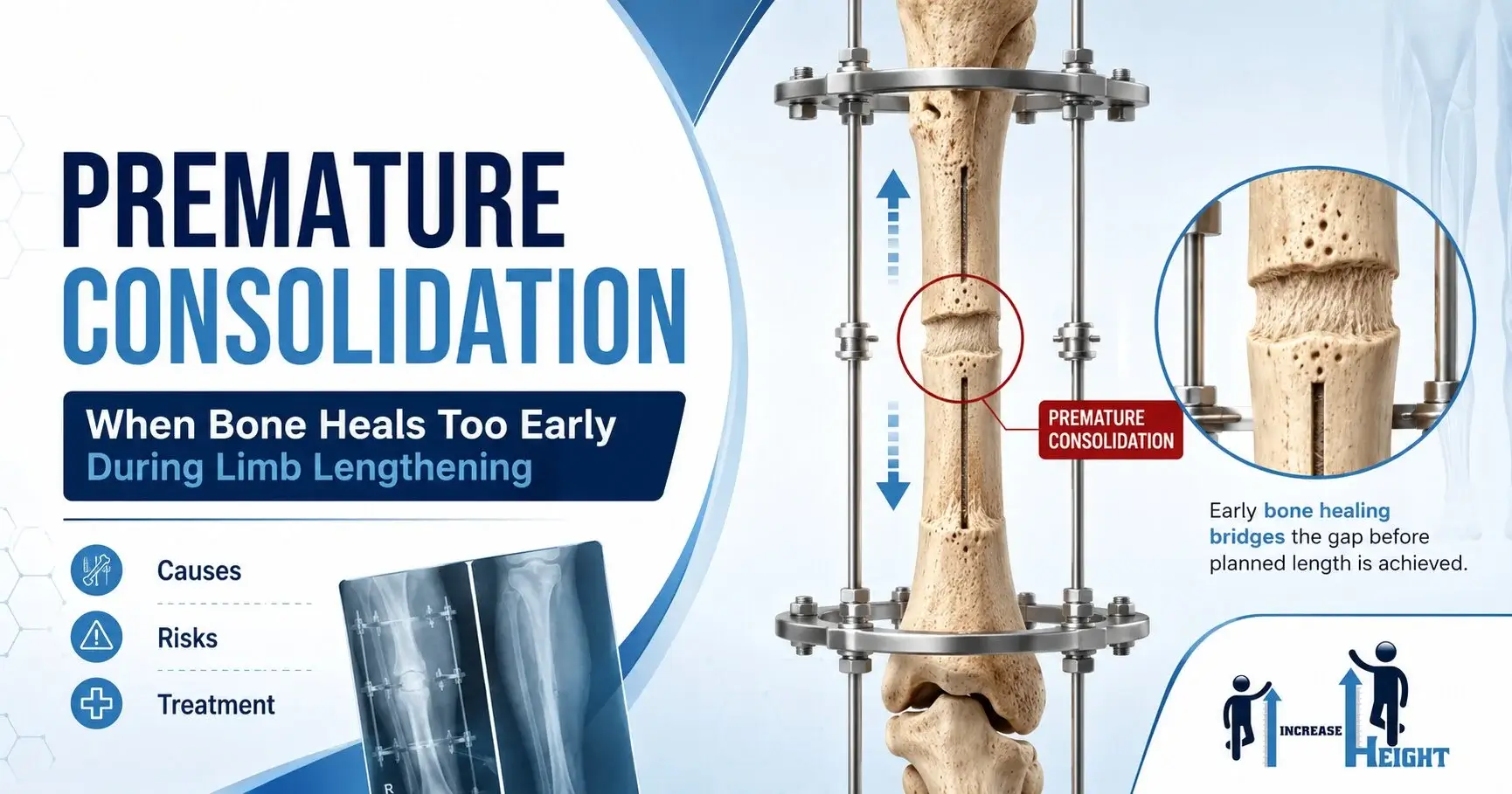
Early bridging callus formation is what happens when the regenerated bone, that soft immature tissue sitting in the distraction gap, hardens and bridges across before lengthening has actually finished. Normally, that gap stays soft and stretchable for months, only calcifying once the target length is reached. Not here. When it shows up too soon, the strut or nail runs straight into resistance. Turning the mechanism gets harder. Sometimes it stops moving altogether.
Routine X-rays are usually how surgeons catch this, which is exactly why the imaging schedule isn't something patients get to skip. Patients notice it too sometimes. The turning wheel feels stiffer, or suddenly painful in a way it wasn't the week before. A few mention a dull ache settling into the shin or thigh out of nowhere. None of that confirms anything on its own, though. Only the X-ray does.
Why Premature Bone Healing During Limb Lengthening Surgery Happens
No single cause explains this. Kids simply form bone faster than adults, and more aggressively too, so pediatric cases start with a higher baseline risk. Bone type matters too. The tibia often behaves differently than the femur, and some patients simply have a biology that leans toward fast healing regardless of the bone involved.
Rate and rhythm play a role as well. If the distraction rate is set too slow, or if the latency period before lengthening begins runs too long, the body gets a head start on healing before it's supposed to. A gap that isn't being pulled apart fast enough will do what bone naturally wants to do. Close.
General health and nutrition play into it too, just less predictably. Good bone density and solid calcium metabolism can push healing faster than expected. That sounds great until it starts working against the distraction schedule instead of helping it. Smoking habits, certain medications, even how consistently someone follows their own turning routine- any of these can tilt the timeline one direction or the other.
How This Usually Gets Caught
Monitoring isn't exciting work, but it's exactly why this gets caught in time. The surgical team watches the regenerate zone on weekly or biweekly X-rays, looking specifically for early bridging callus formation before it turns into something harder to manage. Waiting for symptoms alone isn't reliable, because by the time a patient notices real resistance, the bridging may already be substantial.
When early bridging callus formation is caught early, the fix is often straightforward. Surgeons can bump up the distraction rate temporarily, forcing more mechanical stress through the gap to break up the immature bridge and keep it soft. Physical therapy and weight bearing adjustments sometimes get added into the mix too, since mechanical loading itself influences how bone remodels. Some teams will also recheck the mechanical setup itself, since a misaligned frame or nail can quietly slow distraction without anyone noticing right away.
When Early Intervention Isn't Enough
Not every case responds to a rate change. When premature bone healing during limb lengthening surgery has gone on long enough, the bridge can turn solid enough to physically block any further lengthening. Push past that point, and you risk bending the hardware, fracturing the regenerate the wrong way, or causing real pain without gaining another millimeter of length.
In these situations, a second procedure may be necessary. Surgeons sometimes have to go back in and manually break up the consolidated bone, essentially repeating part of the original osteotomy, so distraction can continue. It doesn't happen often. But when it does, it's a big part of why patients hear early on that this whole process rarely moves in a perfectly straight line from surgery to target length.
Revision surgery obviously adds time, recovery, and stress that nobody wants mid-treatment. But surgeons generally consider it far better than pushing forward through a solid bridge and risking a fracture at the wrong location, or damage to the hardware itself. Most patients who go through a revision still reach their target length in the end. It just takes a detour nobody planned for going in.
What This Means for Anyone Going Through It
None of this is meant to scare anyone off distraction osteogenesis. Premature consolidation is a known risk, and a manageable one. Nothing catastrophic is happening. Routine imaging picks up most cases well before they ever become a real obstacle. Still, patients need to take the monitoring schedule seriously. Show up for every scheduled X-ray. Say something the moment turning the device feels different than it did last week.
Knowing why the schedule exists helps too. Every appointment, every X-ray, every small tweak to the turning rate exists because of this exact risk. It gets repetitive when everything's fine, sure. That repetition is the point though. It's exactly what keeps a small problem from turning into a much bigger one.
Healing faster than expected sounds like good news on the surface. In the context of limb lengthening, it usually isn't. The entire process depends on keeping that gap open just long enough, and a body that heals too efficiently can end up working against the plan rather than with it. Understanding that upfront makes the monitoring feel less like a formality and more like the reason the whole approach works. A fast-healing body isn't a flaw to fix. It's just one more variable the surgical team is already watching for, right alongside everything else.