
Contents
- Understanding the Core Concepts of Limb Lengthening Surgery
- Engineering Design and Biomechanics of Weight-Bearing Implants
- Engineering and Design of Non-Weight Bearing Implants
- The Surgical and Rehabilitation Divide
- Case Studies and Real-World Applications
- The Future of Limb Lengthening Implants
- Conclusion
This has been the case for many years. In the past, people walked with bulky frames strapped to the outside of their legs for months. The frames were uncomfortable and could easily get infected. Today, most surgeons use internal nails made of metal inserted within your bone. When deciding between weight-bearing versus non-weight bearing limb lengthening implants, this is a crucial decision. It’s the metal in your leg that determines how you walk, heal, and recover. Understanding the technology in your leg will help you understand what to expect during your healing process.
Understanding the Core Concepts of Limb Lengthening Surgery
The procedure starts with a controlled fracture. An implant then pulls the two bone ends apart very slowly, usually about one millimeter per day. As the gap opens, the body fills it with new bone tissue. That process is called distraction osteogenesis.
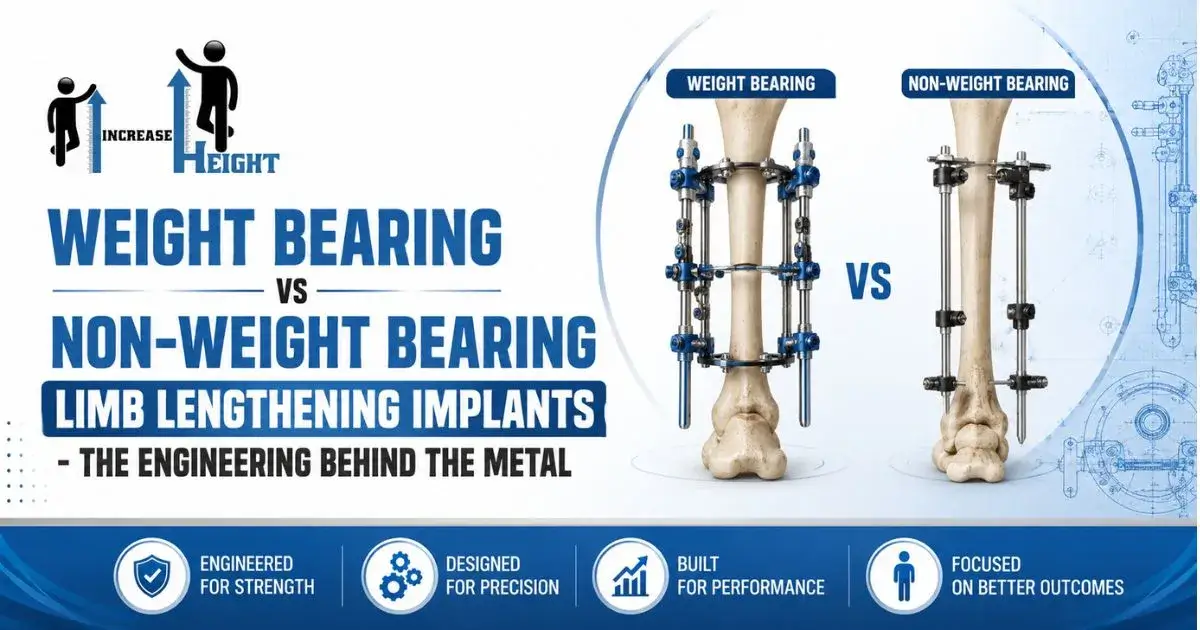
Internal lengthening devices, or intramedullary nails, have become the standard for this work. These devices sit inside the canal of your bone, holding it steady while it grows. The choice between a weight bearing and a non-weight bearing implant changes your life for those few months. Weight bearing implants allow you to walk on the leg while it lengthens. Opting for a weight bearing nail limb lengthening procedure gives you the ability to maintain mobility, whereas non-weight bearing implants mean crutches or a wheelchair for the duration. The leg carries no load at all. This distinction matters because it dictates your daily freedom and the specific engineering required to keep the device from breaking.
Engineering Design and Biomechanics of Weight-Bearing Implants
Weight-bearing implants take the full force of your body with every step. That load goes through the bone and the nail simultaneously. If the metal can't hold up to that, the whole system breaks down.
Material Strength and Geometry
These implants usually use titanium alloys. Titanium is strong, light, and safe for the body to touch for long periods. The engineering team focuses on the cross-sectional geometry of the nail. A thicker nail wall is more rigid. Engineers also create specific locking mechanisms at the top and bottom of the nail. These locking screws attach the nail to the bone, ensuring that the force travels through the metal and the bone rather than just the soft tissues.
Mechanisms of Controlled Lengthening
The device must lengthen while supporting your weight. Most of these nails use a magnetic motor or a ratcheting gear system inside. You place a remote control device over your leg to signal the nail to grow. Because you are walking on it, the internal mechanism must be protected. The gears are encased in a sealed unit. This prevents fluids from entering the motor. If the motor fails, the entire lengthening process stops. Therefore, the seal is a critical piece of the engineering puzzle.
Clinical Use
Surgeons choose these implants for patients who need significant height or leg lengthening. If you want to remain active, a weight bearing nail limb lengthening approach provides the best option. However, your bone quality must be excellent. If your bones are weak, even the strongest metal might fail.
Engineering and Design of Non-Weight Bearing Implants
Non-weight bearing implants serve a different purpose. They are often designed for patients who cannot put pressure on the limb. This might include children, patients with bone conditions, or cases where the bone is too fragile to handle stress.
Design for Controlled Stress
Because the patient will not walk on the limb, the engineering focus shifts. These implants do not need to withstand high axial loads from body weight. Engineers can sometimes use thinner profiles. This allows the nail to fit into smaller bones, such as those found in pediatric patients. The design aims for stability above all else. Since the patient is not walking, the risk of the nail bending from external pressure is low.
Fixation and Stability
Fixation strategies focus on holding the bone ends in the correct position. The locking screws might be thinner or placed differently than in weight-bearing nails. The goal is to prevent rotation and shifting of the bone. Without the downward force of walking, the nail's only real job is alignment. The bone ends stay in position, and new growth follows a straight path.
Clinical Scenarios
Doctors recommend these implants when early mobility is dangerous. If a child walks on a nail that wasn't built for it, the bone can heal crooked. Or the nail fails. Neither outcome is acceptable when the goal is correcting a discrepancy. So the child stays off the leg entirely.
The Surgical and Rehabilitation Divide
The choice of implant changes your surgery and your life for several months. These differences go beyond the metal itself.
Surgical Approaches
Placing a weight-bearing nail requires very precise positioning. The surgical process for a weight bearing nail limb lengthening requires the bone canal to be wide enough for the thicker nail, and the locking screws have to be seated correctly. They must also place the locking screws carefully. Non-weight bearing implants might allow for slightly different surgical paths. Because the nails are often thinner, they may fit into smaller bone canals with less drilling.
Weight-Bearing Protocols
Your timeline for walking is strictly tied to the device type. With a weight-bearing nail, you might start putting some weight on the leg within days. You will start with a walker or crutches and move to full weight quickly. With a non-weight bearing nail, you must stay off the leg entirely until the bone has solidified. This can take months.
Rehabilitation Strategies
Physiotherapy looks very different for these two paths:
- Weight-bearing patients: You focus on strengthening muscles and getting back to a normal gait. Balance training is a major part of the work. You want your muscles to adapt to the new, longer limb immediately.
- Non-weight bearing patients: Work on keeping the joints from stiffening up. You can't load the leg, so walking isn't an option for building strength. You use machines or manual therapy to move the joints and keeps blood flowing.
Complications also differ. Push too hard on a weight-bearing implant and the metal can fatigue over time. Stay too still on a non-weight bearing protocol and the joints lock up while the muscles waste away.
Case Studies and Real-World Applications
Example 1: Adult Stature Increase
Consider an adult patient seeking to increase height. The surgeon chooses a heavy-duty option, executing a weight bearing nail limb lengthening protocol using an internal nail. The patient undergoes surgery and begins physical therapy immediately. By month three, the patient is back to walking, working, and living a mostly normal life. The engineering of the nail allowed the bone to support the patient's full weight during the process.
Example 2: Pediatric Leg Length Correction
A child has a leg length difference from a previous injury. The surgeon uses a smaller, non-weight bearing implant. The child uses a wheelchair and crutches throughout. The implant holds the bone steady so it grows straight. Keeping the joints mobile is a priority during this period. When consolidation is done, the nail comes out and the child gets back to normal activity.
The Future of Limb Lengthening Implants
Advanced Materials
Engineers are looking at new alloys that are even stronger and lighter than titanium. Some are testing coatings that help bone grow faster or prevent infection. A faster healing time means less time with the nail inside the leg.
Smart Implants
The next big step is the "smart" nail. These devices will contain sensors that send data to your surgeon’s office. Load data, gap measurements, and consolidation status could reach the surgical team continuously. Weekly X-rays become less necessary. The recovery plan shifts in response to what's actually happening inside the bone.
Better Patient Fits
Before any surgery happens, a digital model of the patient's leg can be built and tested. Surgeons try different implant configurations virtually to see which one handles the mechanics best for that specific anatomy. It takes some of the guesswork out of planning.
Conclusion
A weight bearing implant vs. a non-weight bearing implant has many differences and can alter the form, design, and procedure as well as your recovery. Weight bearing implants allow you to be free and get back to your daily activities sooner if your bones can support the weight. The non-weight bearing implant is an effective way to correct misalignments in fragile or small bones where direct pressure can be dangerous. Before choosing a weight bearing or non-weight bearing implant for you, it is important to discuss your goals, the health of your bones, and your daily life goals with your surgeon. Understanding the engineering behind the metal will help you feel confidently approach your surgery.