
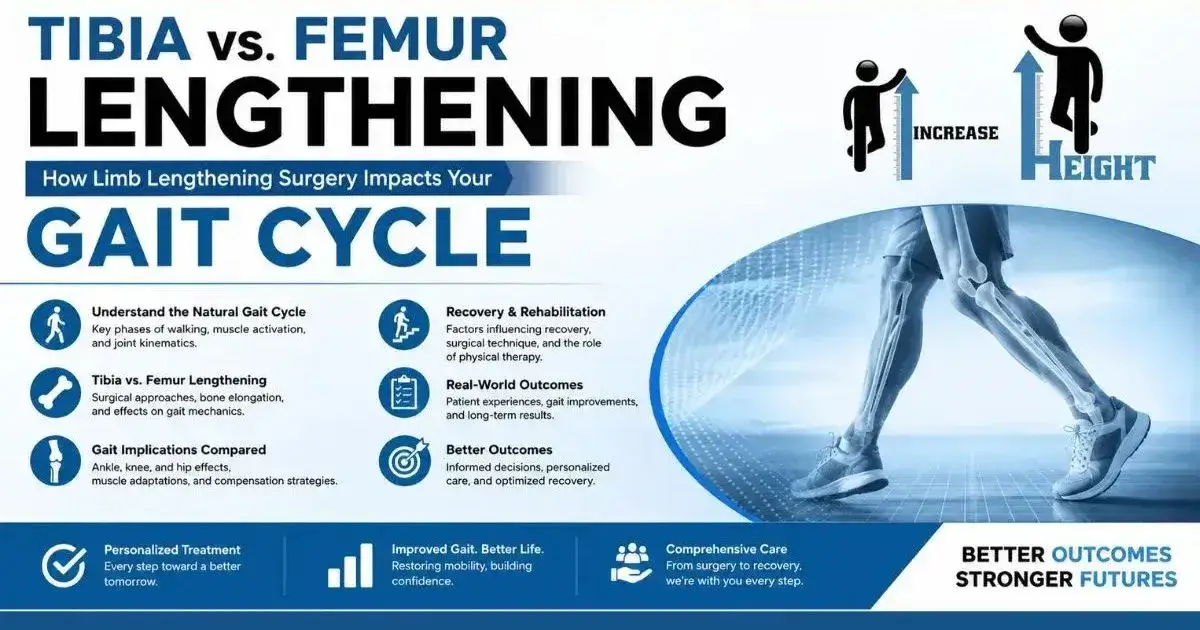
Contents
- The Biomechanics of the Natural Gait Cycle
- Tibia Lengthening Surgery and Its Effects on Gait
- Femur Lengthening Surgery and Its Impact on Gait
- Comparing Tibia vs. Femur Lengthening: Distinct Gait Implications
- Factors Influencing Gait Recovery Post-Lengthening
Walking is usually automatic. You do not sit around thinking about your feet hitting the pavement until something goes wrong. Limb lengthening surgery changes how all of that works by making your bones longer. Some people need it because one leg is shorter than the other. Others just want to be taller. When the bone gets longer, the muscles and the nerves have to stretch out too, which puts a ton of stress on your joints. You also have to learn how lengthening the tibia or the femur affects your gait cycle. That is just the word for how you walk. When the bones change, your walk has to change too. It takes work.
People undergo these surgeries for many reasons. Some have congenital conditions, others deal with the results of trauma, and some seek it for cosmetic height increases. The surgery changes your leg’s physical structure. The bone gets longer and so does the soft tissues around it. This can change how you walk. Choosing the right lengthening process for your tibia or shin bone in comparison to lengthening the femur in your thighs can assist you in your recovery.
The Biomechanics of the Natural Gait Cycle
Key Phases of Walking
Walking is a rhythm that happens without much thought. First, your heel hits the floor. Then the whole foot goes flat. You lean forward as your weight moves toward your toes until the heel lifts up. Then you push off. This part where your foot stays on the ground is the stance phase. Once you are in the air, you are in the swing phase. Your hip, knee, and ankle joints have to bend just right so you do not trip. It takes many parts working together to keep you moving.
Muscle Activation and Joint Kinematics
Muscles move your body. Every time you take a step, your quads and calves need to kick in right at the right moment. Your glutes and hip muscles must work hard to keep you steady so you don’t swing or trip. Your joints need to move the right way for this to happen. If one bone is longer than it should be, your muscles are forced to do a lot more work. They have to pull from different spots and stretch in ways they are not used to just to keep your walk looking normal. It really starts to wear them down. You will feel that extra effort in your legs.
Tibia Lengthening Surgery and Its Effects on Gait
Surgical Approach and Bone Elongation
Surgeons use different tools to lengthen the tibia. Common methods include internal nails that sit inside the bone or external fixators that hold the leg from the outside. These tools use distraction osteogenesis. This process slowly pulls the cut ends of the bone apart. As they separate, your body builds new bone in the gap. This growth is slow and requires constant monitoring.
Impact on Stance Phase Mechanics
Lengthening the tibia places unique stress on your lower leg. Most common problems involve your ankle and foot. During heel strike, you might have trouble getting your heel on the ground because of tightness in your Achilles tendon. Once you reach the foot flat phase, your pressure distribution changes. Your body must find a new way to balance your weight. By the time you reach toe off, your calf muscles might feel weak or tight. This can make the push-off phase feel stiff or shortened.
Influence on Swing Phase Dynamics
The swing phase relies on your knee flexing to clear the ground. A longer tibia can change the lever arm of your lower leg. If your muscles cannot adapt quickly after your tibia lengthening surgery, you might struggle to bend your knee enough. This can lead to compensatory movements. You might notice yourself vaulting, which means rising onto the toes of your other foot to clear the long leg. You might also see circumduction, where you swing your leg out to the side to avoid dragging your toe.
Femur Lengthening Surgery and Its Impact on Gait
Surgical Methods for Femur Elongation
Doctors put metal rods inside your leg or use frames on the outside to make your thigh bone longer. It works a lot like the way they fix shins. Your femur is the biggest bone you have. Since it is buried in thick muscles, stretching it creates a ton of tight pressure. The surgery involves slowly separating your bone over many weeks so that you can grow new bone in the hole while your body heals. This is done very carefully to make sure your muscles and skin are healthy. It takes time.
Alterations in Hip and Knee Mechanics
An increased length of your femur affects your hip and knee joints. Your hip flexors and extensors cross the femur, as well as your quadriceps and hamstrings. This tightening increases your hip range of motion during your swing and makes it difficult to fully straighten or bend your knee. A long lever, your femur will be more powerful when you lengthen it.
Compensation Strategies and Gait Patterns
You are smart and will find a way to walk despite the new tension in your body. Some people develop an increased pelvic tilt or lean in their trunk to move the leg forward. You may also notice a shorter stride length or broader base of support to stay stable. If walking is painful, you may have antalgic gait (a limp).
Comparing Tibia vs. Femur Lengthening: Distinct Gait Implications
Differential Effects on Ankle, Knee, and Hip
Comparing Tibia vs. femur lengthening surgery shows clear differences in how the body reacts. Tibia lengthening surgery focuses its impact on the ankle and foot. Your calf muscles and the way your foot hits the ground are the primary areas of concern. The slenderisation of the femur puts more load on the hip and knee, as the muscles controlling the thighs are larger and more likely to become tight, affecting the mechanics of the upper leg joints.
Muscle Adaptations and Rehabilitation Challenges
Each surgery requires its own special focus in rehabilitation. After tibial lengthening, you’ll be working on your calf and tibialis anterior. Keep the ankle flexible. If your femur is being lengthened, you’ll be working on your hip flexors and the heavy muscles of the thigh. The more you work on your hip and knee, the more range of motion you’ll have. Your gait will be stiff or altered without that flexibility.
Real-World Gait Outcomes and Patient Experiences
People say their walk feels weird for a few months. You might have to really think about where you put your feet. It stops being something you just do without thinking. If you stay on top of the moves your trainer gives you, you will find your old pace much faster. The work helps your brain and your muscles learn how to act as a team again now that your bones are a new length. It is the main thing that gets you back to a normal stride.
Factors Influencing Gait Recovery Post-Lengthening
Amount of Lengthening and Surgical Technique
The amount of length added to your bone changes the difficulty of your recovery. A smaller increase often means a shorter time to regain a normal gait. A larger increase requires more time for the muscles to stretch and adapt. The surgical technique also plays a part. Internal methods might allow for different movement patterns compared to external fixators, which can be bulky and heavy.
Pre-existing Conditions and Patient Compliance
Your baseline fitness matters. If you had issues with your hip or ankle before tibia lengthening surgery, those problems might become more obvious after lengthening. Patient compliance is perhaps the most important factor. Doing your physical therapy exercises as prescribed changes your outcome. If you skip sessions or exercises, the muscles tighten, and your gait deviations can become permanent habits.
Importance of Comprehensive Physical Therapy
Physical therapy is the foundation of a successful recovery. You need a program that focuses on strength, flexibility, balance, and proprioception. Proprioception is your body’s ability to sense its position in space, which is often disrupted by changing the bone length.
- Start gentle stretches early to keep tissues supple.
- Use light resistance training to rebuild muscle tone.
- Focus on gait training to practice a normal heel-to-toe pattern.
- Work on balance exercises to keep your core strong. These steps help you regain a smooth, natural gait as your body adjusts to its new structure.
Moving after leg lengthening surgery is a slow process. Your body has to learn how to handle the new height and it feels weird for a while. If you had the tibia done, your ankle and lower leg will feel a big change in how they hit the ground. Femur surgery is different. It messes with the way your hips and knees work together when you step. You have to stay on top of your physical therapy every day to get your old walk back. It takes real work. How you walk in the future depends on how much you do in the gym now. Give your muscles time to stretch out. Eventually, you will move just fine.
Also Read: