
Contents
- The First Month is about Survival - Not Progress
- Months Two and Three bring the Active Distraction Phase
- Consolidation Takes Over in Months Four and Five
- Months Six and Seven bring a Return to Normal Life
- Why the Timeline Varies So Much between Patients
- What a Leg Lengthening Journey Actually Demands from Patients
- What Life after Limb Lengthening Surgery Actually Looks Like
- Bringing it All Together
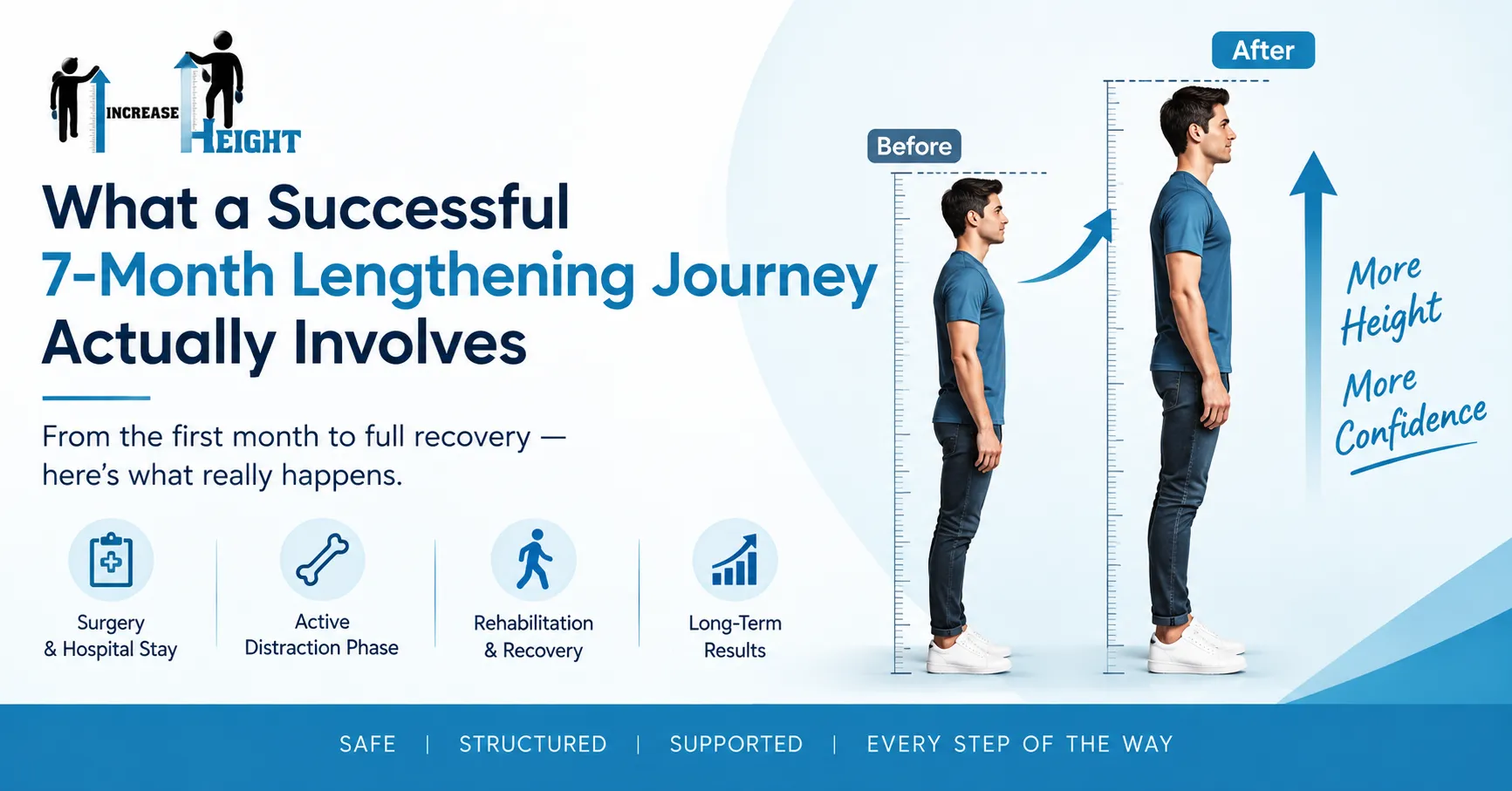
Someone who's never been through it might picture a leg-lengthening journey as two events. Surgery happens, then some fuzzy waiting period, then it's over. That's not how it works. A genuinely successful seven-month stretch is made of several distinct chapters, each one demanding something different from the patient. Knowing what actually happens month by month turns the whole thing from a vague, scary unknown into something you can actually plan your life around.
The First Month is about Survival - Not Progress
Right after surgery, the goal isn't lengthening yet. It's getting through the initial trauma of the operation itself. Swelling and pain that need managing around the clock. Learning to move on crutches or with a walker without falling over. Most surgeons hold off starting the actual distraction for about a week to ten days, letting the bone get its footing first. People often expect to feel functional sooner than they do, and the amount of rest the body demands here catches almost everyone off guard. Rush this stage, and you tend to pay for it later.
Months Two and Three bring the Active Distraction Phase
This is the part most people associate with a leg lengthening journey, the daily or near-daily adjustments that gradually separate the bone segments and create new space for bone to fill in. Roughly a millimeter a day, broken into tiny increments throughout each day. Nothing dramatic-looking, but the muscles, tendons, and nerves stretching to keep pace with the bone feel every bit of it. Physiotherapy stops being optional around here. Skip stretching sessions and stiffness moves in fast. Somewhere in here, how long does limb lengthening take stops being a theoretical question and turns into something you think about daily, mostly because the constant measuring and adjusting won't let the timeline fade into the background.
Consolidation Takes Over in Months Four and Five
Once the target length is hit, the hardware stays put while the newly formed bone quietly hardens underneath it, a stage called consolidation. Day-to-day life gets easier here since the constant adjustments stop. Don't mistake that for coasting, though. The limb-lengthening recovery period during consolidation still means regular physiotherapy, careful and gradual weight bearing, and follow-up scans confirming the bone is filling in the way it should. A lot of patients say this stretch is harder mentally than the distraction phase was, precisely because visible progress slows to a crawl even while the actual healing keeps grinding forward underneath the surface.
Months Six and Seven bring a Return to Normal Life
By now, plenty of patients are walking with a lot less support, some without any assistive device at all, depending on how consolidation has gone. Strength work ramps up. Range of motion keeps opening back up. What once felt completely out of reach starts folding itself back into ordinary daily life. Reach 7 months after limb lengthening surgery with the bone healing well and mobility coming back, and that's a real win, one that looks a little different for everyone since it hinges on the amount of length gained, the specific bone involved, and how that individual body chose to heal.
Why the Timeline Varies So Much between Patients
There's no single clean answer here, because too many variables pull in different directions. More length gained means more time needed for consolidation, plain and simple. Age matters. Bone density matters. Nutrition matters. So does how consistently someone actually shows up for physiotherapy instead of skipping sessions when they're tired. A seven-month timeline represents a reasonably efficient, well-managed case rather than a guaranteed outcome for everyone. Some patients need longer, particularly with larger lengthening goals or slower individual healing, and that's not a sign anything went wrong.
What a Leg Lengthening Journey Actually Demands from Patients
The physical healing is only part of it. A lot of what determines success is just showing up, over and over, even on days motivation is nowhere to be found. Following weight-bearing limits even when they feel unnecessarily cautious. Telling the surgical team the truth about pain or stiffness instead of hoping it fixes itself quietly. The limb lengthening recovery period has very little patience for shortcuts or bursts of intensity. It rewards boring consistency instead. Patients who treat this like a long, steady project tend to come out the other side in much better shape than those chasing speed.
What Life after Limb Lengthening Surgery Actually Looks Like
By the seven-month mark, most people have mostly stopped thinking about their legs every waking hour, and that quiet fact is itself a real marker of progress. Clothes sit differently. There's a shift in confidence too, one that's easier to spot in someone than to put into words. And that ever-present background awareness of the hardware, the one that used to sit at the front of your mind, keeps fading a bit further back with each passing week. Walking stops requiring conscious thought. Old hobbies come back into rotation. Life just starts feeling normal again instead of feeling like an ongoing medical project. No number on a chart captures that shift as well as the quiet return to normal does. Family tends to notice this before the patient does. They'll mention it before the patient ever would, something about seeming lighter, easier to be around, more like themselves again.
Bringing it All Together
A genuinely successful leg lengthening journey was never about one dramatic turning point. It's built from a stack of smaller phases, each one handled with reasonable patience along the way. Surgery early recovery - Active distraction, Consolidation, and then finally the slow climb back toward full function. Add it all up and what you're left with is a seven-month result that actually holds together, not something patched over and hoping to survive. Seeing the process as a set of manageable stages, instead of one long undefined blur, changes the entire experience for the better. That reframe alone carries more weight than most of the advice people get going in. Nobody should treat seven months as gospel, but as a benchmark to aim for; it holds up, and reaching it in decent shape deserves to be treated as the real win it is.
Schedule a consultation with our team to discuss your limb lengthening journey and recovery options.